Tuesday, May 28, 2013

Join Us at the Hero Round Table!

This November, I have the pleasure of running a breakout session at the first ever Hero Round Table, a conference on heroism, which will be in central Michigan on November 9 & 10, 2013. It will feature some huge names in the field of psychology, anti-bullying, education, and others that spend their time.

The breakout session I've proposed is on "Starting a Hero Fund," where I take many of the ideas I've developed as part of my 40 Days of Giving project and will give tips and ideas on how to incorporate philanthropic giving into one's life on a regular basis ... and, to my surprise, I even made it into the promo video!

If you have a desire to learn more about heroism and to be involved in the discussions about how we can work on being heroic individuals in our daily lives, I urge you to attend the conference.

Of course, if you can't, then there are still ways you can working on your heroism:


Tuesday, May 07, 2013

The Heterosexist Agenda

Source: Flickr (Creative Commons)
I have really grown to hate the term "homophobe," because it just really doesn't seem particularly descriptive of many people it's applied to. For one thing, just because a person opposes gay marriage doesn't necessarily mean that they're afraid of gay people. When you apply that term to someone, you can't actually know whether or not it's true.

Whether it's true or not, it's very easy to deflect, with the classic response, "Hey, I don't fear people, so I can't be a homophobe." While this seems like a highly suspect claim from someone claiming that a homosexual lifestyle is an abomination that will send them to hell, since we don't know whether or not they're experiencing fear, we can never really know if the homophobe label is or is not accurate in that particular case.

For that reason, I've begun to find the term "heterosexist" a lot more appropriate. 
A heterosexist is someone who believes that heterosexual/opposite-sex relationships are inherently superior and/or more deserving of legal recognition/protection than homosexual/same-sex relationships.
Heterosexism is a clearer description of the ideology that these people hold (whether or not they are actually homophobic on top of this). And, if this label is applied to someone, they really can't deny it ... unless, of course, they aren't heterosexist. Denying one's heterosexism requires saying, "No, I don't believe that heterosexual relationships are superior to homosexual ones" ... at which point, the heterosexist argument falls apart.

So I suggest that people begin using the term heterosexist instead of homophobe. If the debate over whether a "civil union" is equivalent to a "marriage" has taught us anything, it's that words have a very real meaning, and calling something by its true name is a worthy endeavor.

Related Article:

Wednesday, April 03, 2013

The Philosophical Christian: Understanding Easter as Survival of Love

Buddy Christ icon from Kevin Smith's film Dogma
Despite having been raised Christian and celebrating Easter throughout my youth, I'll confess that this holiday never made any sense whatsoever to me. Christmas makes sense. You don't have to believe in the Virgin Birth as a literal event to understand the wonder inherent in the story of the nativity for those who believe it.

My Easter Confusion

Easter is an entirely different animal. Sure, the Resurrection is clearly a miraculous thing worthy of celebration ... but just two days before that is Good Friday, which celebrates the Crucifixion, and you really can't decouple the two. In the traditional Christian view of these events, it's actually the Crucifixion - the blood sacrifice of the son of God - which is the big deal, with the Resurrection being "merely" the event that happens to highlight how important the Crucifixion was.

The result is an Easter weekend (and a religious view) that has always vexed me. See, I don't personally hold with human sacrifice (or animal sacrifice, for that matter). It just seems to me a very poor way for a benevolent deity to structure the universe. "In order to appease me, you've got to kill" is not exactly a starting point that resonates with me. I've never understood how anyone would be comfortable with the central role of this brutal murder in a spirituality of salvation.

This view only makes sense to me in one of two cases:

  1. God was powerless to forgive sins without a blood sacrifice of his son.
  2. God could have forgiven sin without the blood sacrifice, but demanded it anyway.

Neither of these creates a view of God that I find particularly appealing (although I much prefer 1 to 2), and certainly neither meshes well with the traditional Christian view of God.

A Revised Metaphysics of Easter

But this Easter, I instead heard a new interpretation which actually resonated with me. Attending my Christian Church, which emphasizes a "metaphysical" reading of the Bible over a literal one, the Crucifixion is viewed instead as a the attempt to kill Christ, who represents a perfectly loving being. Christ's Resurrection, therefore, is the bold declaration that, despite all appearances, love cannot die.

This, to me, has profound implications. This creates a view of the Easter weekend events which allow for me to look at them as something other than an indictment of God as a malevolent force. Instead of the Crucifixion being a blood sacrifice demanded as atonement for sin (the traditional Christian view), the Crucifixion can be interpreted as an event that Jesus chose to do to get the attention of those around him, to shake them out of their pre-conceived notions about what was important.

Nor, for that matter, is my minister the only guy teaching this view of Easter. Over on Patheos, there's a post discussing the Easter season (who knew it was a whole season? 50 days of Easter?), and the words he use are in line with the metaphysical interpretation that I heard on Sunday:
Easter invites us to imagine a world without fear. It invites us to imagine what our world would look like if violence and retribution were indeed signs of weakness rather than strength and might makes right. It invites us to imagine that violence and death and the Powers that Be do not have the last word. It invites us to imagine the transformative, mountain-moving power of nonviolence and grace, of faith, hope and love. 
In fact, Easter proclaims that this is true. Easter proclaims this is the reality of the world God has created, and that this had indeed always been the reality in which we live. God has always been calling to us, through prophets and sages of the past, to live as if love, not hate and violence, were the forces that matter most in the world. Easter isn’t true because Jesus was resurrected. Easter is true because it has always been true that God loves us, because it has always been true that God hasn’t been interested in controlling the world with war, violence and oppression like the Powers that Be, but in transforming it with love and the giving away of power. 
... 
Easter invites us to start living, and living fully, and living fully for others rather than living for ourselves, for security, for our small portion of domination of others in the midst of our own oppression. 
Easter is costly.
Easter asks us not to perform penance, but to practice hope. 
This is a view of the Easter events that I can respect. The focus on the literal historical nature of the Crucifixion and Resurrection creates all sorts of metaphysical, logical, and moral problems for me, but ignoring the literal events and focusing exclusively on the message of hope, that works for me.

Friday, February 15, 2013

What does the internet think ... and does it matter?

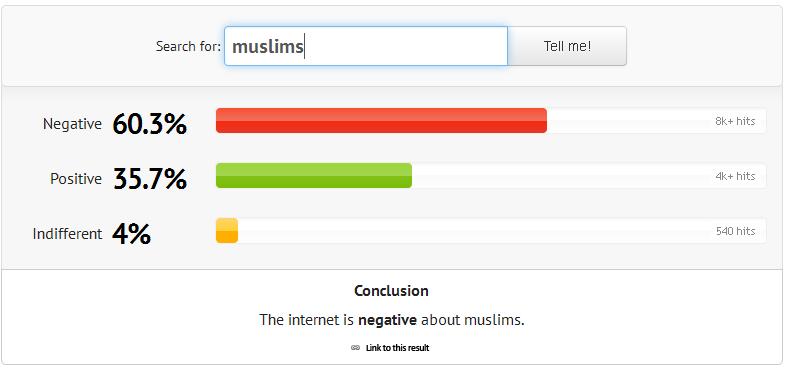
Thanks to the science fiction author John Scalzi, I stumbled upon an intriguing website called "What Does the Internet Think?" The site uses some methodology (who knows what) it comes up with a rating of the percentage of positive and negative postings on a topic across the internet. I couldn't pass up the chance to see what sort of fun data I could get out of this. For now, I'll post the information with very little commentary, but may follow up in the future.

Let's start by considering some broad subjects:

Where does the internet find truth and meaning?


It's probably not at all surprising that the internet skews toward the science-loving end of the spectrum, at least at the broadest level. I'm kind of surprised at the level of negativity about religion, to be honest. 

I would like to be heartened by the overflow of positive regard for skepticism, but it occurs to me that whatever methodology they're using probably cannot sort out the context of positive or negative statements ... so if a post is saying that it supports science, but then puts forward a concept like intelligent design as being scientific, it would likely count as a pro-science posting, even though it's really contradicting and undermining scientific inquiry and findings. Similarly, someone who supports being skeptical of evolution or skeptical of global warming would probably count toward being positive toward skepticism, even if their approach to the facts is fundamentally dogmatic, authoritarian, and revisionary instead of supporting principles of skeptical inquiry.

Which leads us to the next question ...

Does the internet prefer evolution or creationism?

The thing I find most interesting about this is that while there's a lot of indifference about creationism, there's virtually no indifference about evolution. This runs counter to my own experience. I know several people who are religious but are fairly indifferent about whether or not evolution is the physical mechanism of creation. In other words, they're religious but believe that God started evolution. But I know very few people on either side of the debate that are indifferent about creationism. 

However, given the extremely low hits on which "Creationism" is based, probably not much should be made of comparing these graphs. The "evolution" graph itself is, I think, telling enough on its own.

To put some of these values in context, though, we should look at a few baseline moral concepts, to see how they rate on the internet:

What does the internet think about morality?


I will let the above conclusion speak for itself ... for now. It's worthy of another post at another time.

On a morality-related note, though ...


What does the internet think of religion?


Christianity, Judaism, and Islam all rank positively ... but check out atheism & Buddhism! Amazingly polarized results on these religious viewpoints. Again, I'll let the results speak for themselves, although I'm sure I'll come back to this in another post sometime.

For comparison, though:


So atheists are viewed basically as negatively as their doctrine ... but both Christians and Muslims are (fairly or unfairly) viewed negatively by the internet, despite the fact that their religions themselves are viewed positively.

And, finally, a grain of salt:


Thursday, February 07, 2013

Open Letter to the Boy Scouts of America

Photo from Instructables
I sent the following e-mail to the Boy Scouts of America last week, when they announced that they were reconsidering the ban on homosexuals in the organization. They have since delayed the decision until their National Annual Meeting in May. I don't expect this message to change anyone's view on the issue, of course, but it is the view of someone who profoundly respects the Boy Scouts of America and their values, and so I hope is a viewpoint that is taken into consideration during the deliberations:

Subject: Eagle Scout & father supporting inclusive scouting

Dear Boy Scouts of America,

I am writing to you today to offer my thoughts on your upcoming Feb. 6 vote regarding lifting the national ban on homosexuals serving in Scouts. As an Eagle Scout and a father, the current discriminatory practices of the Boy Scouts of America - specifically the bans on homosexuals and atheists - has been deeply troubling to me. This stance has always affected me strongly, because my father is a homosexual. My parents divorced when I was young and my father lived in a nearby town, so for much of my formative years the primary male influences in my life were the Scouting leadership. My father, a teacher with a distinguished career of educating and mentoring young people, was not allowed to take part in this extremely influential part of my life. I couldn't even invite him to come on the occasional trip.

I fully support the BSA's efforts to protect youth in their care from harm, but open homosexuals are not threats in this area. Molesters and predators are not open about their sexual preferences, they use secrecy as a means of preying on victims. An open homosexual who is leading a Scout troop would have an even stronger vested interest in making sure that nothing happens to any of the youths under his charge. And the idea that lesbian mothers are *any* threat to male youths is absolutely ludicrous on every level.

As someone with family members and close friends who are homosexuals, I have wrestled with the decision of how to proceed in relation to Scouting now that I am a father. My wife and I have discussed it frequently. Our son is in Cub Scouts, which was a very difficult choice for us. I have seriously considered returning my Eagle Scout badge in protest. We both, however, strongly believe in the core values that Scouting represents. We believe that the organization is an absolute benefit to youth.

We also feel, however, that one of the values which Scouting needs to embrace more fully is inclusiveness, which I feel is implicit in virtues of Helpfulness, Friendliness, Courteousness, Kindness, and Bravery (and, for many religions at least, Reverence). We want to be involved in leadership roles within the Scouting organization, but cannot in good conscience do this if we would be forced to enforce exclusionary policies to which we object.

The values that are offered by Scouting are critically important to the youth of our nation. Children of gay and lesbian couples, as well as gay youth themselves, deserve equal access to this organization. There may be difficulties and challenges in handling the logistics of such an inclusion in a way that is equitable to everyone, but if Scouting is to continue to thrive and to maintain its position as an organization that represents American values, it must change this policy. Otherwise, it will wither away as an archaic reflection of antiquated prejudices ... and rightly so.

I urge you to make the right decision for the future of the Boy Scouts of America ... and if you do, know that my family and I will be proud to be associated with this organization. 

Monday, December 31, 2012

Books Read in 2012

Here are the books I read in 2012. Even when you take into account that many of these were slim Kindle Singles, given how busy I've been over the last year, I'm impressed by the numbers...

The Books
  1. Read This Before Our Next Meeting by Al Pittampalli
  2. A Feast of Crows by George R. R. Martin
  3. Dreadnought by Cherie Priest
  4. The Quantum Universe (Or Why Anything That Can Happen, Does) by Brian Cox & Jeff Forshaw
  5. Lying by Sam Harris
  6. Thinking, Fast and Slow by Daniel Kahneman
  7. A Dance with Dragons by George R. R. Martin
  8. A Universe From Nothing: Why There Is Something Rather Than Nothing by Lawrence Krauss
  9. Triggers by Robert J. Sawyer
  10. The Flinch by Julien Smith
  11. Beyond the Hole in the Wall: Discover the Power of Self-Organized Learning by Sugata Mitra
  12. One Way Forward: The Outsider's Guide to Fixing the Republic by Lawrence Lessig
  13. Living Architecture: How Synthetic Biology Can Remake Our Cities and Reshape Our Lives by Rachel Armstrong
  14. Homo Evolutis: Please Meet the Next Human Species by Juan Enriquez and Steve Gullans
  15. Free Will by Sam Harris
  16. Thor Meets Captain America by David Brin
  17. What the Plus?: Google+ For the Rest of Us by Guy Kawasaki
  18. What's Killing Us: A Practical Guide to Understanding Our Biggest Global Health Problems by Alanna Shaikh
  19. Shadows in Flight by Orson Scott Card
  20. The Alchemist by Paolo Bacigalupi
  21. The Executioness by Tobias S. Buckell
  22. Even Mystics Have Bills to Pay: Balancing a Spiritual Life and Earthly Living by Jim Rosemergy
  23. Back to Work: Why We Need Smart Government for a Strong Economy by Bill Clinton
  24. The Ultimate Harry Potter and Philosophy: Hogwarts for Muggles edited by Gregory Bassham
  25. Ender's Game by Orson Scott Card
  26. The Evolution of Faith by Philip Gulley
  27. Laches by Plato
  28. Hybrid Reality: Thriving in the Emerging Human-Technology Civilization by Parag Khanna and Ayesha Khanna
  29. The Geeks Shall Inherit the Earth: Popularity, Quirk Theory, and Why Outsiders Thrive After High School by Alexandra Robbins
  30. The Demise of Guys: Why Boys Are Struggling and What We Can Do About It by Philip G. Zimbardo and Nikita Duncan
  31. Believe in America: Mitt Romney's Plan for Jobs and Economic Growth by Romney for America
  32. Beyond the Wall: Exploring George R. R. Martin's A Song of Ice and Fire, From A Game of Thrones to A Dance With Dragons edited by James Lowder
  33. It's Dangerous to Be Right When the Government is Wrong: The Case for Personal Freedom by Judge Andrew Napolitano
  34. The Void by Frank Close
  35. Harry Potter and the Sorcerer's Stone by J.K. Rowling
  36. The Death and Life of the Great American School System: How Testing and Choice Are Undermining Education by Diane Ravitch
  37. Higgs Discovery: The Power of Empty Space by Lisa Randall
  38. Ruling Your World: Ancient Strategies for Modern Life by Sakyong Mipham
  39. Humanism as the Next Step by Lloyd & Mary Morain
  40. Why School?: How Education Must Change When Learning and Education Are Everywhere by Will Richardson 
  41. Quiet: The Power of Introverts in a World That Can't Stop Talking by Susan Cain 
  42. We Are All Weird by Seth Godin
  43. Mind Amplifier: Can Our Digital Tools Make Us Smarter? by Howard Rheingold
  44. Gratitude: Reflections on What We Owe to Our Country by William F. Buckley, Jr.
  45. If Grace Is True: Why God Will Save Every Person by Philip Gulley & James Mulholland
  46. The Happiness Hypothesis: Finding Modern Truth in Ancient Wisdom by Jonathan Haidt 
  47. If God Is Love: Rediscovering Grace in an Ungracious World by Philip Gulley & James Mulholland
  48. Paradox: The Nine Greatest Enigmas in Physics by Jim Al-Khalili 
  49. The Particle at the End of the Universe: How the Hunt for the Higgs Boson Leads Us to the Edge of a New World by Sean Carroll
  50. The Many Lives of Lilith Lane by E.V. Anderson
  51. Smile by Ron Gutman
  52. When I'm 164 by David Ewing Duncan
  53. The Happiness Manifesto by Nic Marks
  54. Beware Dangerism! by Gever Tulley
  55. Harry Potter and the Chamber of Secrets by J.K. Rowling
  56. Stormdancer by Jay Kristoff 
  57. A Haystack Full of Needles: Cutting Through the Clutter of the Online World to Find a Place, Partner, or President by Jim Hornthal
  58. The Falling Machine (Society of Steam Book One) by Andrew P. Mayer
  59. Hearts of Smoke and Steam (Society of Steam Book Two) by Andrew P. Mayer
  60. Knocking on Heaven's Door: How Physics and Scientific Thinking Illuminate the Universe and the Modern World by Lisa Randall
  61. The Portable Atheist: Essential Readings for the Nonbeliever edited by Christopher Hitchens
  62. Space Chronicles: Facing the Ultimate Frontier by Neil deGrasse Tyson
  63. Tell Them I Built This: Transforming Schools, Communities, and Lives with Design-Based Education by Emily Pilloton
  64. The Constant Art of Being a Writer: The Life, Art, and Business of Fiction by N.M. Kelby
  65. Energy For Future Presidents by Richard A. Muller
  66. Citizen Advocate: How to Get Government to Move Mountains and Change the World by Omar Ahmad
  67. Hacker Mom by Austen Rachlis
  68. Power Under Pressure (Society of Steam Book Three) by Andrew P. Mayer
Analysis

Format:
  • Audiobooks: 8
  • Kindle: 42
    • Kindle Singles (mini-books/solo essays): 27
    • Kindle Serials: 2
    • Kindle Lending Library: 3
  • Google eBooks: 1
  • Dead tree books: 17
My number of audiobooks has dropped dramatically for two reasons: I no longer commute and I now listen to several podcasts, in place of my audiobook time. For those audiobooks I do listen to, I've begun using Audible.com a lot, and some books that I've really enjoyed (mostly non-fiction), I've bought the book in both Audible and Kindle formats, so that I can synchronize between them using Amazon's Whispersynch for Voice, switching between listening and reading as time permits. (This also allows me to conveniently highlight passages even if I only have time to listen to the book on audiobook.)
Subjects:
  • Total Fiction: 18
    • Science Fiction: 9
    • Fantasy: 11
      • Epic Fantasy: 4
      • Young Adult: 2
      • Steampunk: 5
  • Non-Fiction: 51
    • Science: 26
      • Physics: 9
      • Psychology: 9
      • Biology: 4
      • Technology: 5
    • Religion: 8
    • History: 3
    • Politics: 7
    • Education: 6
    • Business: 6
    • Philosophy: 12
These numbers don't quite match up, because some books cover multiple areas. For example, I determined that Sam Harris' Free Will fell under both the Psychology and Philosophy headings and, frankly, I could have justified also counting it as a Religion book, while a book about Buddhism is classified as both Religion and Philosophy ... and could probably also be classified as Psychology!

The History

And for anyone who is interested in looking into the past to see some of my previous book lists...
Prior to 2008, I didn't keep a precise record, so they aren't listed anywhere.

Monday, December 17, 2012

The Philosophical Christian: 5 Reasons Not to "Fear God"

Today I finally got back on Facebook for the first time since the shooting at Sandy Hook Elementary School. I've been intentionally avoiding it. It's made my wife cry multiple times already and, since we don't have television, I was able to have a nice weekend without being confronted with the tragedy continuously.

When I finally did log on to Facebook, I was prepared for the assorted pro- and con-gun control/Second Amendment posts ... but I was not prepared for the bizarre religious trend to many posts. I was not prepared for the proclamation, from seemingly sane friends of mine, that this sort of thing happens because God is absent from schools.

And perhaps most bizarrely, I was not expecting the post which said the problem is that children are not taught to "Fear God." (The above picture isn't the one from Facebook, but you get the idea.)

The entire notion of "God-fearing" has never resonated with me, but to invoke it in the wake of this tragedy is absolutely perplexing to me on a number of levels. Specifically, I can think of 5 huge problems with it:

1. You Can't Love What You Fear - You cannot have a healthy, loving relationship with an entity that you fear. You can certainly have strong emotions, but if you love someone and fear them, then your relationship is dysfunctional. Most people who believe in God have a dysfunctional relationship with the notion of God because they hate and fear it at the same time. Unless you drop the notion of God entirely, the best approach I've seen is to let go of the fear part.

2. The Best Christians Don't Fear God - If you look at the Christians who are worthy of the name - including the big J.C. himself - you'll find very little "fearing" in relation to God going on. They exalt God, because they believe in a God who's worth exalting.

3. It's Blasphemy - The phrasing "Fear God" should be absolutely offensive to any God that's worth worshiping, and equally offensive to his followers. If you're going to use "fear" and "God" together, it should be as a negation, such as "Because I believe in God, I fear no evil" or something like that. If you believe in a God who relishes that those who believe in him fear him, I humbly submit that you worship a psychopathic bully.

4. God Didn't Do This - Specifically in the wake of these shootings, this comment to fear God is especially bizarre, because the implication is therefore that God was somehow behind the shootings. Or, at the very least, he removed his hand of protection from innocent children because of offenses committed by others. Most Christians would, I believe, find this highly offensive as well.

5. In conclusion, children (and the rest of us) certainly have enough to fear in this world. There's no need to add God to the list.


Tuesday, November 06, 2012

Election Day 2012 - Final Thoughts

Today is the final day in an election cycle that has gone on far too long. I began following things back in fall of 2011, when I was curious what the various Republican primary candidates had to say for themselves. I offered an open mind that perhaps they could sway me to vote for them. Now that we're on election day - and I genuinely have no idea who is going to win, with close polls on pretty much all sources - it seems like a good idea to collect my general thoughts on this election.

Here's the thing. I am a fan of Barack Obama's. I've read both of his books and voted for him in 2008. I genuinely like the guy. By and large, I agree with the policies that he's tried to implement, though I continue to be a little concerned about his expanded use of drones and assassinations, but no more concerned than I was about the previous administration's willingness to send troops into harm's way. There's no good way to conduct violent action against the nation's enemies.

The Republican Primaries

Still, just because I like Barack Obama, however, doesn't mean that I necessarily think he's done a bang-up job. He's certainly not the failure that the Republicans have painted him to be, but neither is he a particularly adept leader. He wasted his first two years trying to generate a consensus with Republicans, when it should have been extremely clear that they'd have none of it. There's nothing in his background which shows that he's got any particular skills at financial matters or general organization, and there are ample aspects of the way the government's run over the last four years that can legitimately be called into question.

So I began watching the Republican primary and it quickly became clear that only a couple of those lunatics had any chance of winning against Obama: either Mitt Romney or John Huntsman. Everyone else was just too extreme and would have no real chance of convincing moderates like me to vote for them. In fact, the extremism being displayed even prompted me to start the Vast Middle-Wing Conspiracy page on Facebook.

Romney himself recognized this, in the famous "47%" video that surfaced a while back and which I've discussed previously. In that video, he went on to talk about independents, in a way that demonstrated much more awareness of the realities of the electorate than the 47% part of the talk did:
Those people I told you—the 5 to 6 or 7 percent that we have to bring onto our side—they all voted for Barack Obama four years ago. So, and by the way, when you say to them, "Do you think Barack Obama is a failure?" they overwhelmingly say no. They like him. But when you say, "Are you disappointed that his policies haven't worked?" they say yes. And because they voted for him, they don't want to be told that they were wrong, that he's a bad guy, that he did bad things, that he's corrupt. Those people that we have to get, they want to believe they did the right thing, but he just wasn't up to the task. They love the phrase that he's "over his head." But if we're—but we, but you see, you and I, we spend our day with Republicans. We spend our days with people who agree with us. And these people are people who voted for him and don't agree with us. And so the things that animate us are not the things that animate them. And the best success I have at speaking with those people is saying, you know, the president has been a disappointment. 
So, basically, this tactic worked very early on with me. I conceded that Barack Obama was a bit of a disappointment and allowed the possibility of supporting a different candidate. And, thankfully, the Republicans offered up one of the two sane options from their primary. So now it became a case of asking whether Mitt was a better choice than Obama.

The Case for Either

First, let me get this prediction out of the way: Regardless of who is elected, I believe that the economy will do better in 2013 than it did in 2012. We are on an upswing. If Obama is re-elected, then he'll claim that his policies caused it. If Romney is elected, he'll claim that Obama's policies were a failure and it's his policies that caused the recovery.

In my view, the economy was so bad that it's bound to begin improving. The big question is not who will cause it to improve, but rather which policies are best to be in place when it does improve. Do you want a regulation-free, very corporation-friendly set of Republican policies in place or greater access to healthcare? A somewhat lukewarm relationship with Israel or a U.S. that seems willing to goad Israel into military conflict with Iran, somehow in the interests of "peace?"

On the single most important issue for me - American education policy - Republicans and Democrats are pretty much in lockstep these days, with a heavy emphasis on school choice in both camps.

The Case for Mr. Romney

Though I voted for Obama, I don't agree with many of his supporters that Romney is a rampaging conservative monstrosity that will destroy our country. As Newt Gingrich said during the Republican primaries, Romney is a "Massachusetts moderate" and that's his saving grace. Honestly, Romney is something of a geek. A money geek. A policy geek.

He himself seems to resent, on at least some level, the fact that he hasn't been able to focus on his intellectual policy arguments. In the leaked video from last spring, he said:
Well, I wrote a book that lays out my view for what has to happen in the country, and people who are fascinated by policy will read the book. We have a website that lays out white papers on a whole series of issues that I care about. I have to tell you, I don't think this will have a significant impact on my electability. I wish it did. I think our ads will have a much bigger impact. I think the debates will have a big impact…My dad used to say, "Being right early is not good in politics." And in a setting like this, a highly intellectual subject—discussion on a whole series of important topics typically doesn't win elections.
I didn't actually read Romney's book, but I did read his jobs plan. Though it over-simplifies things and places blame for dwindling jobs squarely on Obama's shoulders without providing the larger context of where the economy was at when Obama stepped in, the plan itself isn't half bad. Nor, frankly, is it that aggressively conservative. Despite the deeply anti-government rhetoric of the Republican primary and subsequent campaign, the jobs plan itself includes such near-socialist gems as:
Government has a role to play in innovation in the energy industry. History shows that the United States has moved forward in astonishing ways thanks to national investment in basic research and advanced technology.

There is a place for government investment when time horizons are too long, risks too high, and rewards too uncertain to attract private capital.
The above quotes make it clear that, at least in this policy statement, Romney understands the critical role government must play in scientific research. The emphasis of his plan is on "long-term" economic recovery, so if this understanding is genuine then we can expect a Romney administration to recognize these funding needs and to back them up with money.

Also, Romney implemented the Massachusetts healthcare plan. When repealing Obamacare, he can't just leave people without a replacement, so he's going to have to move forward on some sort of policies that will help insure people with pre-existing conditions are eligible at somewhat affordable rates. When he outlines the list of points that need to be included in his healthcare plan, it actually sounds remarkably like Obamacare.

In some ways, a moderate Romney has a lot of potential advantages. The Republicans would presumably cooperate with him more than they have with Obama, which means that Congress could return to actually doing something. Democrats don't quite have the backbone to completely hamstring a president for 4 years solid, to throw the entire country under the bus for political advantage, so they'll grouse a bit but will finally cooperate with a Romney administration as well. Honestly, just having a Congress that's able to do anything will be such a change that it might improve the morale of the country..

Of course, this argument is all founded on the idea that Romney is able to govern as a "Massachusetts moderate" ... but that's certainly not how he's campaigned. And that, ultimately, is why I voted against him.

The Case Against Mitt

Since I like Obama, Romney really had to make a pretty strong case to get me to switch support to him. I was still giving him the benefit of the doubt into the debates, although I was not impressed with much of what I'd seen.

For the last four years, I've watched the Republicans steamroll over the President of the United States. The President's biggest leadership failure has been his inability to win over any significant Republican cooperation on any issue. So the big question for me was whether Romney would be able to stand up to his own party.

Unfortunately, absolutely nothing during Romney's campaign showed me that this would happen. He chose Tea Party favorite Paul Ryan as his running mate. Better than Michelle Bachmann, to be sure, but still far too ideologically conservative for my tastes. When Rush Limbaugh called a college girl a "slut," Romney didn't condemn it, he just said he wouldn't have used those words. (Of course not, he's a Mormon!)

Time and time again, Romney has refused to stand up confidently against the extreme elements of his party. I have seen no evidence that a Romney administration would fight for anything that I value in the face of his party's interests.

There may well be a Mitt Romney somewhere in there who will be a great president, one that I will admire. So far, I haven't really seen it. If elected, though, I do hope he shows up to lead the nation.

If Romney is elected, I hope he does such a fine job that in 2016 there is no question about who I'm going to support.

And if Obama is re-elected ... then I really hope the 2016 primary season is a lot shorter than this one was, because I don't think I can deal with this level of crazy from both parties.

Wednesday, September 19, 2012

I Am the 47%

I haven't been on Facebook yet today, but I can only imagine that the subject line of this blog post has become cliched even moments after I thought of it. Alas, there's nothing new under the sun.

And that includes Mitt Romney sticking his foot in it, which seems to be a pretty regular event. The latest kerfuffle is over his comments back at a spring fundraiser with wealthy donors, where he was caught on hidden camera saying:
There are 47 percent of the people who will vote for the president no matter what. All right, there are 47 percent who are with him, who are dependent upon government, who believe that they are victims, who believe the government has a responsibility to care for them, who believe that they are entitled to health care, to food, to housing, to you-name-it. That that's an entitlement. And the government should give it to them. And they will vote for this president no matter what…These are people who pay no income tax. 
[M]y job is is not to worry about those people. I'll never convince them they should take personal responsibility and care for their lives.
So let's do a little personal case study of someone who falls in this 47%, voted for Obama and, according to Romney, cannot be convinced to "take personal responsibility."

My 47% Street Cred

To be honest, it would be more appropriate to say "I was the 47%" because in 2011 I actually did pay 1.12% in federal income taxes, on top of the state income taxes (4.37%) and federal payroll taxes. However, for several years before that, I was not paying income taxes:
  • 2010: 0.00%
  • 2009: -0.85%
  • 2008: (can't find, but it was 0% or very near 0%)
  • 2007: 10.37%
So, what happened in 2008 that caused my taxes to drop so much? My income from my day job has increased every year. Well, there were actually several different factors that figured into the low tax rate, all of which can be traced back to 2008:
  • I got married.
  • I became a stepfather.
  • I began donating 10% of my income to charity and local churches (and itemizing deductions accordingly).
  • I became a landlord. (My wife's previous home became a rental property.)
  • I learned about the pro-business tax code and began intensely keeping records and making use of deductions to legitimately reduce my taxable business income from freelance writing.
  • My wife returned to college.
Oh, yes, a couple of other things happened in 2008 that should have raised my total income tax:
  • I started writing String Theory For Dummies, which resulted in a net income increase, so actually raised my gross business income for 2008 and 2009 both.
  • I received an greater-than-10% raise, due to restructuring at work and them realizing that they were seriously underpaying me.
Ah, yes, and I finished my Master's Degree, paid for by reimbursement from my company (so I couldn't deduct any significant amount of it). No real bearing on my tax situation ... although it might have some bearing on that whole "personal responsibility" line.

Who Made Me Dependent Upon the State?

So the driving forces behind my sudden drop in income tax liability were primarily the following (in no particular order, since I don't feel like looking through old tax forms to figure which benefited me most):
  • Small business tax deductions and credits
  • Married filing jointly status
  • Kid-related deductions and credits
  • Rental property depreciation deduction
  • Itemized deductions: Charitable (and church) donation and mortgage
  • Education deductions for my wife
A quick look at this list really makes one wonder which of these deductions Mitt Romney is planning to revoke or reduce in order to wean me off of my "entitlement" mentality.

In fact, aren't these precisely the sorts of things that Republicans typically argue should reduce your tax liability even more? Isn't it really the Republicans who have decreased taxability so severely that it took me 3 years of raises and working on my writing career to work my way up to 1% income tax? Does anyone else recall Mitt Romney re-affirming his right to reduce his tax liability to the legal limits, when it was released that he way paying 15% in taxes?

Note to the IRS:
I said "legal limits."
I am very careful with my deductions and record-keeping.
If a deduction is questionable, I don't take it.
So, really, it would be a waste of time to audit me.
A waste of my time and yours.
Keep up the good work, guys!

According to Mitt Romney, this places me in a very unenviable position. I am now counted among those "who are dependent upon government, who believe that they are victims, who believe the government has a responsibility to care for them, who believe that they are entitled to health care, to food, to housing, to you-name-it."

I will concede that I am probably at the top of the 47% of which Mitt Romney speaks. While he doesn't care about most of them, he maybe cares a little bit about what I think. See, I'm one of these moderates who voted for Obama in 2008 and wishes his policies had done better. And I am giving Mitt Romney the chance to convince me that his policies will do better, so that I can vote for him today.

However, we've seen the results of his policies. His policies removed my tax liability. His policies have, apparently, turned me into a entitlement-seeking person, unable to take care of my own life, let alone the lives of the two children tragically entrusted to my care by the vagaries of fortune and chance! Those poor children! How will they suffer, to be raised by a father with so little self worth?

I dare ask, is there any solution?

Yes, I believe there is ...

I Need to Be Taxed More ... and So Do the 53% Above Me

It's totally absurd, with the amount of income I bring in, that I am paying only 1% income tax. I'm not wealthy, by any stretch of the imagination. (Well, unless you compare me to the 95% or so of the world that makes less income than I do ... in which case I'm doing alright.) I have to crimp and save just like anyone else, and there's never quite enough to do everything I want.

However, I also have two kids. I'm a member of a community and a nation. And we're overspending. To fix that, we need to do what any businessman in that room with Mitt Romney would do if faced with a tough personal or corporate budget. They would figure out how to:
  • Increase revenue
  • Cut expenses
We've let taxes drop too low and they need to go up a bit on the middle class. Not a lot, but at least a bit. Cap some deductions, such as the charitable deduction. Either an absolute cap or as a percentage of income. There are a lot of options here.

But to set the country on a course to fix the deficit, taxes have got to go up. Mitt Romney has made a pledge not to raise taxes. I'm hoping that he's a good enough businessman to know that he was lying when he made that pledge, because there's no way he can be serious about the deficit while clinging to it.

Of course, there is a third option that the businessmen in that room may be familiar with, especially if Trump was there. It's an option I unfortunately had to exercise in 2006. It's one that isn't fun and, as a patriotic American, it's one I hope we can avoid:

Bankruptcy.

Update:
Sept. 26: I found out about the blog We Are the 47%, which shares open letters (ostensibly to Romney) about individual experiences within the 47%. Here's an overview of some of the people who have stepped forward through that website:
We have letters from a Pulitzer Prize-winner in fiction and a Pulitzer Prize-winning columnist, as well as an 82nd Airborne paratrooper, a recipient of a Purple Heart, the wife of a med student, a special education teacher, a union carpenter... We have letters from those who share Mitt Romney's faith, but disagree with his disregard for the 47 percent; and we have a letter from someone who, like Romney, graduated from Harvard Law School, but, unlike Romney, made the financial sacrifice to work as a public defender ...

Saturday, July 14, 2012

Corporations: People, Entities, or a Hybrid of Both?

Many liberals have made a lot out of the Citizens United decision by the Supreme Court, which they describe as saying "corporations are people." However, the Supreme Court ruling doesn't actually use this terminology, even if the spirit of the ruling does imply that .

Still, one of the major elements of the campaign is the degree to which corporations deserve special considerations and what types of considerations those are. While both political sides of the debate tackle this argument with a lot of preconceptions, I think it's possible to really look at the facts behind how corporations are formed to understand the degree to which a corporation, in general, can be viewed as equivalent to an individual.

Mitt Romney's Evolving View of Corporate Personhood

Mitt Romney did use these words on the campaign trail during the Republican primary, when he replied to a critic at an event, "Corporations are people, my friend." He has been very vocal about his strong beliefs regarding the importance of corporate rights. I'm in the process of reading Romney's jobs plan, Believe in America: Mitt Romney's Plan for Jobs and Economic Growth (available on the Kindle). In it, he (or his team, at least) says the following:
The truth is, as Mitt Romney likes to say, "corporations are people." They represent human beings acting cooperatively to be economically productive.
In the e-book, Scott McNealy, the founder and former CEO of Sun Microsystems, writes a piece about tax policy that delves even more deeply into the "corporations are people" narrative.
To the vast majority of Americans who have held real jobs in the real economy, often in corporations, the point made perfect sense. Indeed, it seemed a statement of the obvious. A corporation, after all, is nothing more than people who have joined together to work cooperatively. The word "corporation" itself means "body of people." And in fact, corporations consist of two groups of "people": employees and shareholders. The former work hard to make a profit and earn their salaries and benefits. The latter, now widely dispersed across the economy by means of mutual funds and retirement-plan investment portfolios, provide the capital and can reap the financial benefits while also assuming the financial risk.
However, today I was listening to the radio and heard an intriguing segment about the latest campaign kerfluffle. I've been busy with work (at a corporation) and haven't kept up with the news, so didn't know much about the outsourcing that Obama has been accusing Romney of. Apparently, Bain Capital is accused of outsourcing some jobs, and this seems to be during a nebulous time between 1999 (when Romney stepped aside at Bain to run the Salt Lake City Olympics) and 2002, when he was still listed as CEO, President, and sole owner of Bain Capital, but wasn't actively involved in the day-to-day operations. Apparently, in response, Romney said:
"Well, I was the owner of an entity that is filing that information, but I had no role whatsoever in the management of Bain Capital after February of 1999," he told CNN. "Not that that would have been a problem to have said that I was with the firm beyond that, but I simply wasn't."
Since I had just been reading the jobs plan, the use of the word "entity" struck me as odd. So which is it? Is a corporation a person or some other type of entity?

The Benefits of Incorporating

To really understand this question, we have to consider the reasons why people incorporate their businesses. For example, in addition to my day job, I am self-employed as a freelance writer. I am not incorporated, however, and file taxes on my business as a sole proprietor of a business, The Philosopher's Stone.

As a  sole proprietor, my business is treated as an extension of me as a person. Though I have an Employer Identification Number (EIN) to file payroll taxes (my wife is my salaried employee), I have not been able to us this EIN to gain business credit cards or financing. When I set up my business checking account, I tried to use my EIN and was told that since I wasn't incorporated, I needed to set it up with my Social Security Number. When I fill out W-9 forms, the documentation says that the IRS prefers sole proprietorships to use my Social Security Number instead of my EIN. Since I am not incorporated, the credit cards I use for business expenses are in my own name, not in the name of my business.

When you begin to investigate home-business tax savings, you do find that there are a number of reasons to incorporate.
  1. Credit Benefits:The first reason to incorporate, as hinted at above, is that you can now begin establishing lines of credit and bank accounts using your business' EIN instead of your personal Social Security Number. If your personal credit is poor - perhaps due to a failed business or personal bankruptcy in the past - this can be a crucial benefit to gain the necessary financing for your business venture.

  2. Liability Protection:Related to the access to credit, corporations also create a level of liability protection. If a sole proprietorship goes under, all of the debt is in your name, so your creditors are able to come after your individual assets. You could lose not only your business, but also your house, your savings, garnishments against future wages, and so on. When you incorporate, a very powerful legal wall is built between these two entities. This is how people like Donald Trump can have multiple major corporate bankruptcies while maintaining their personal wealth. Even if the corporation is sued for some sort of illegal business activity and loses, the fact that it's a corporation can sometimes still protect the individual from having their personal assets garnished ... or vice versa.

  3. Tax Benefits: And, of course, there are tax benefits to being a corporation. Even as a sole proprietorship, I'm in the advantageous situation where my business income is taxed after expenses, in contrast to my personal income, which is taxed before expenses. Corporations have all sorts of tax loopholes created (we hope) with the genuine desire to enhance the ability of these corporations to grow their business and become economically prosperous, thus generating overall more wealth (and, ultimately, tax revenue).
The exact nature and degree of the benefits change depending upon the type of incorporation, of course, and I'm sure that there are many other benefits beyond these. Still, one glance at these reasons makes it clear that the point of incorporating is to separate the business activity from the individual.

Are Corporations People?

Taking all of this into consideration really calls into question the "corporations are people" narrative, which Romney has chosen to officially embrace on the campaign trail and in his jobs plan. While it is certainly true to say that a corporation involves "human beings acting cooperatively to be economically productive," this description by itself isn't particularly helpful. For example, the mob, street gangs, and a team of bank robbers are all attempting to "act cooperatively to be economically productive" as well! Certainly corporations are something different.

No, saying that a corporation is " nothing more than people who have joined together to work cooperatively" (as Scott McNealy does) is a gross over-simplification. I think of it more like this:
A corporation is a group of people who have jointed together to work cooperatively for economic advantage and have then asked the government for special dispensation to treat their group activity as distinctly (and legally) different from their personal activity.
The whole point of incorporation is that it provides a powerful division between the business and the personal activities. Saying that "corporations are people" requires completely ignoring the legal meaning of a corporation ... and negating the validity of the legal protections that corporation-hood confers.

This is why as soon as Romney was called into question on the activity of his corporation, he fell back on the true definition of a corporation. A corporation was no longer a noble reflection of the people united for economic productivity, but instead just an "entity" that files paperwork. His name happened to be on the line that said he was CEO, but that doesn't mean anything at all.

Wednesday, July 04, 2012

The Mutual Pledge of the Declaration of Independence

The most often-quoted part of the Declaration of Independence is, of course, the introductory part, up until the famous lines:
We hold these truths to be self-evident, that all men are created equal, that they are endowed by their Creator with certain unalienable Rights, that among these are Life, Liberty and the pursuit of Happiness.
Many people rightly recognize this as a declaration of individual freedom. Since it was written, it was viewed in this light.

However, it is not true that the Declaration of Independence is just a statement of individual liberty. It is  also a statement of unity, a call to action of a diverse group of nation-states acting together. Nowhere is this better represented than in the closing line of the Declaration itself:
And for the support of this Declaration, with a firm reliance on the protection of divine Providence, we mutually pledge to each other our Lives, our Fortunes and our sacred Honor.
Those who emphasize only the individual liberty aspect of the Declaration miss the point of it and of the entire American Revolution. If each individual founding father, or each individual colony, had clung fast to only its own interests, its own economic drivers, there could never have been the sort of unity needed for independence.

How many people today, on either the political left or the political right, are truly willing to pledge their "Lives, Fortunes, and sacred Honor" to protect the unalienable Rights of "Life, Liberty, and the pursuit of Happiness."

I see a lot Americans with great fortunes who don't seem to give a care about the lives and happiness of others.

Many Americans are not willing to accept a slight inconvenience to their sense of entitlement, suffer even a slight disturbance in their happiness, in order to defend the rights of another.

On this Independence Day, I will be teaching my son that individual liberty is tied together with our responsibility to help others, especially those who are less fortunate than us.

As Benjamin Franklin said at the signing of the Declaration of Independence:
We must all hang together, or assuredly we shall all hang separately.
Sources and Related Information:

5 Patriotic Videos for Independence Day

For the past several years, my Fourth of July tradition has been to watch the 1972 musical 1776 (Amazon, BN), which recounts the events surrounding the writing and passage of the Declaration of Independence. This isn't the only film appropriate for this day, of course - GeekDad has a nice list (linked below). In that vein, I consider a handful of other films and videos that I've begun working into my Independence Day traditions.

1776 (AmazonBN)

This is a film adaptation of a stage musical which, were it not about America's independence, probably would not have gotten any traction beyond its initial limited release. As a musical it contains a few decent songs, but the real enjoyment comes from the vivid and charming portrayal of the founding fathers (particularly Howard Da Silva's Benjamin Franklin) and the trials they faced in uniting together to stand against the British. There are a number of historical inaccuracies, but the overall mood portrayed is spot on and helps to illustrate conflicts which are still taking place in American politics over two centuries later ... and over quarter century after 1776 was produced!

Liberty Kids (Amazon, BN)

This 2002 animated series outlines the events from the Boston Tea Party through to the writing of the Constitution, as seen from the point of view of a handful of teenagers in the service of Benjamin Franklin. What's nice about the show is that it focuses on a very diverse perspective of the revolution, rather than just presenting the straight historical account that most of us grew up with. Here are the main characters of the series:
  • James - An orphan who works as a reporter for Franklin's newspaper, the Pennsylvania Gazette.
  • Moses - A free black man who is Franklin's apprentice at the print shop and newspaper.
  • Sarah - A British citizen who is living in the colonies and becomes a journalist out of a desire to see that the British viewpoint is represented to the colonists.
  • Henri - A French boy who was transported to the colonies as an indentured servant.
  • Benjamin Franklin - Voiced by veteran newsman Walter Cronkite, Franklin is the perfect founding father to be at the center of a series which includes such a broad perspective on the revolutionary activities.
While being firmly rooted in the patriotic ideals that founded the nation, it doesn't gloss over the failings of those same colonists to recognize liberty for everyone, nor does it shy away from the reality that the British troops could at times be heroic and noble, even while being on the wrong side of the conflict.

The 6-disc series contains 40 episodes, plus a host of extra features that are great for teaching your kids history, including:
  • A full-sized poster of the main characters with a map of the colonies and major events on the back
  • A booklet containing descriptions of all episodes, plus a timeline of revolutionary events running from the Boston Massacre (1770) through to Washington assuming the Presidency (1789)
  • Benjamin Franklin's Newsbytes
  • Continental Cartoons
  • Now and Then feature
  • Mystery Guest Game
  • A Look Back at Liberty's Kids with the Creators

The Patriot (Amazon, BN)

Once upon a time, Mel Gibson was a good actor. The Patriot represents a period that was probably the apex of his career, before he became known as a man who goes off on drunken rants about the Jews (but does, afterward, give decent apologies).

This is one of the most ambitious feature films to depict the American revolution and certainly received the broadest popular reception. Gibson plays a military veteran of the French and Indian Wars (called "the wilderness campaigns" in the film) who is initially hesitant to take up arms against the British, though he himself does agree with the cause of liberty.

It also features a great performance by Heath Ledger as Gibson's son, a young idealist who enthusiastically joins the cause of liberty, not understanding why his father resists. The film vividly depicts the battles, making it clear that the American Revolution was not won through a sanitized process of debates (though the first two shows on this list make it clear that even the debate process wasn't particularly sanitized).

My Fellow Americans (Amazon, BN)

The only film on this list that isn't directly related to the founding fathers and their activities, this James Garner and Jack Lemmon comedy film nonetheless represents one of the most fun patriotic films out there. Two ex-presidents and intense political rivals discover a conspiracy that goes to the very highest levels of government. After escaping assassination, they travel America on the run in attempt to get proof and uncover the truth. In the process, they discover - in between sniping at each other - that their political differences are a lot less important than the things that unite them as Americans.

National Treasure (Amazon, BN)

Finally comes the most fantastic of the explorations of America's history, in which Nicolas Cage goes on a quest to discover a mysterious lost treasure of the ancients that the founding fathers hid, leaving clues throughout documents and locations that were central to the founding of America, including the very Constitution of the United States. With much more emphasis on action and adventure than historical accuracy, it's still a fun movie to watch that can help give some historical facts along the way.

Related Links:

Tuesday, June 26, 2012

15 Religion Quotes from George R. R. Martin's Song of Ice and Fire

Today is the launch date of Smart Pop BooksBeyond the Wall (Amazon, BN), a collection of essays  from a diverse set of authors and fans about George R. R. Martin's modern classic, the Song of Ice and Fire series ... known to most people from the HBO series Game of Thrones (Amazon, BN).

Authors from the anthology have joined together to create a sort of "Extras" sampling on their various blogs to help promote the book launch. In this "An Event of Ice and Fire." Smart Pop Books is doing their part by making available the wonderful introduction by editor James Lowder:


This blog post will get updated later in the day to include links to some of the other Event of Ice and Fire links, once they get posted. For now, on to my extra offering...

Martin's Religiosity

My contribution to the volume is the essay "Of Direwolves and Gods," in which I make the argument that the gods of Westeros are not the ones we usually expect in a fantasy series, but ... well, perhaps this quote from the essay best sums up the thesis:
"In fact, the religions portrayed in A Song of Ice and Fire are reflections of the religions in our own world. They require a leap of faith, because the effects of belief are so intangible. The religions of Westeros claim to dictate absolute, perfect truths through imprecise, flawed institutions and beings--just like the religions we encounter every day."
During the research for the essay, I was very pleased to stumble upon this great Entertainment Weekly interview with George R. R. Martin where he discussed his own religious views, or lack thereof. He identifies himself as a lapsed Catholic, an atheist or agnostic. Still, he says "I find religion and spirituality fascinating," and that fascination has surely manifested at the rich religious diversity that shows up in his series ... as well as the diversity of religious viewpoints that are presented.

Martin's Religion Quotes

In addition to the interview, I also read all 5 volumes of the series, specifically with an eye toward highlighting any reference to religion. As such, I feel fairly well qualified to present an authoritative list of the best religion quotes from the series. Perhaps ironically, most of them are made by Lannisters. Many of these quotes, with some swaps of nouns and titles, could well apply in our own world.

Here they are, in sequential order of how they appear in the series (so you can stop if you want to avoid spoilers from later books):
  1. Catelyn had more faith in a maester’s learning than a septon’s prayers. - A Game of Thrones

  2. "The Seven have never answered my prayers. Perhaps the old gods will." - Samwell Tarlys, A Game of Thrones

  3. “If I could pray with my cock, I’d be much more religious.” - Tyrion Lannister, A Game of Thrones

  4. Almost a prayer . . . but was it the god he was invoking, the Father Above whose towering gilded likeness glimmered in the candlelight across the sept? Or was he praying to the corpse that lay before him? Does it matter? They never listened, either one. - Jaime Lannister, A Feast for Crows

  5. "The septons sing of sweet surcease, of laying down our burdens and voyaging to a far sweet land where we may laugh and love and feast until the end of days . . . but what if there is no land of light and honey, only cold and dark and pain beyond the wall called death?" - Maester Aemon, A Feast for Crows

  6. Lancel Lannister: "Will you pray with me, Jaime?"
    Jaime Lannister: "If I pray nicely, will the Father give me a new hand?"
    Lancel: "No. But the Warrior will give you courage, the Smith will lend you strength, and the Crone will give you wisdom."
    Jaime: "It's a hand I need." - A Feast for Crows

  7. Lancel Lannister: “My faith is all the nourishment I need.”
    Jaime Lannister: “Faith is like porridge. Better with milk and honey.” - A Feast for Crows

  8. “Death should hold no fear for a man as old as me, but it does. Isn’t that silly? It is always dark where I am, so why should I fear the darkness? Yet I cannot help but wonder what will follow, when the last warmth leaves my body. Will I feast forever in the Father’s golden hall as the septons say? Will I talk with Egg again, find Dareon whole and happy, hear my sisters singing to their children? What if the horselords have the truth of it? Will I ride through the night sky forever on a stallion made of flame? Or must I return again to this vale of sorrow? Who can say, truly? Who has been beyond the wall of death to see? Only the wights, and we know what they are like. We know.” - Maester Aemon, A Feast for Crows

  9. "Gorghan of Old Ghis once wrote that a prophecy is like a treacherous woman. She takes your member in her mouth, and you moan with the pleasure of it and think, how sweet, how fine, how good this is . . . and then her teeth snap shut and your moans turn to screams. That is the nature of prophecy, said Gorghan. Prophecy will bite your prick off every time." - Marwyn, A Feast for Crows

  10. "My own gods are the old gods, the gods of the North, but you can keep the red god, or the Seven, or any other god who hears your prayers. It’s spears we need. Bows. Eyes along the Wall." - Jon Snow, A Dance with Dragons

  11. "Give me priests who are fat and corrupt and cynical., ... the sort who like to sit on soft satin cushions, nibble sweetmeats, and diddle little boys. It’s the ones who believe in gods who make the trouble." - Tyrion Lannister, A Dance with Dragons

  12. The gods are mad. - A Dance with Dragons

  13. "The gods are blind. And men see only what they wish." - Tyrion Lannister, A Dance with Dragons

  14. "Prophecy is like a half-trained mule.... It looks as though it might be useful, but the moment you trust in it, it kicks you in the head." - Tyrion Lannister, A Dance with Dragons

  15. The Drowned God did not answer. He seldom did. That was the trouble with gods. - A Dance with Dragons