Showing posts with label Barack Obama. Show all posts

Tuesday, November 06, 2012

Election Day 2012 - Final Thoughts

Today is the final day in an election cycle that has gone on far too long. I began following things back in fall of 2011, when I was curious what the various Republican primary candidates had to say for themselves. I offered an open mind that perhaps they could sway me to vote for them. Now that we're on election day - and I genuinely have no idea who is going to win, with close polls on pretty much all sources - it seems like a good idea to collect my general thoughts on this election.

Here's the thing. I am a fan of Barack Obama's. I've read both of his books and voted for him in 2008. I genuinely like the guy. By and large, I agree with the policies that he's tried to implement, though I continue to be a little concerned about his expanded use of drones and assassinations, but no more concerned than I was about the previous administration's willingness to send troops into harm's way. There's no good way to conduct violent action against the nation's enemies.

The Republican Primaries

Still, just because I like Barack Obama, however, doesn't mean that I necessarily think he's done a bang-up job. He's certainly not the failure that the Republicans have painted him to be, but neither is he a particularly adept leader. He wasted his first two years trying to generate a consensus with Republicans, when it should have been extremely clear that they'd have none of it. There's nothing in his background which shows that he's got any particular skills at financial matters or general organization, and there are ample aspects of the way the government's run over the last four years that can legitimately be called into question.

So I began watching the Republican primary and it quickly became clear that only a couple of those lunatics had any chance of winning against Obama: either Mitt Romney or John Huntsman. Everyone else was just too extreme and would have no real chance of convincing moderates like me to vote for them. In fact, the extremism being displayed even prompted me to start the Vast Middle-Wing Conspiracy page on Facebook.

Romney himself recognized this, in the famous "47%" video that surfaced a while back and which I've discussed previously. In that video, he went on to talk about independents, in a way that demonstrated much more awareness of the realities of the electorate than the 47% part of the talk did:
Those people I told you—the 5 to 6 or 7 percent that we have to bring onto our side—they all voted for Barack Obama four years ago. So, and by the way, when you say to them, "Do you think Barack Obama is a failure?" they overwhelmingly say no. They like him. But when you say, "Are you disappointed that his policies haven't worked?" they say yes. And because they voted for him, they don't want to be told that they were wrong, that he's a bad guy, that he did bad things, that he's corrupt. Those people that we have to get, they want to believe they did the right thing, but he just wasn't up to the task. They love the phrase that he's "over his head." But if we're—but we, but you see, you and I, we spend our day with Republicans. We spend our days with people who agree with us. And these people are people who voted for him and don't agree with us. And so the things that animate us are not the things that animate them. And the best success I have at speaking with those people is saying, you know, the president has been a disappointment. 
So, basically, this tactic worked very early on with me. I conceded that Barack Obama was a bit of a disappointment and allowed the possibility of supporting a different candidate. And, thankfully, the Republicans offered up one of the two sane options from their primary. So now it became a case of asking whether Mitt was a better choice than Obama.

The Case for Either

First, let me get this prediction out of the way: Regardless of who is elected, I believe that the economy will do better in 2013 than it did in 2012. We are on an upswing. If Obama is re-elected, then he'll claim that his policies caused it. If Romney is elected, he'll claim that Obama's policies were a failure and it's his policies that caused the recovery.

In my view, the economy was so bad that it's bound to begin improving. The big question is not who will cause it to improve, but rather which policies are best to be in place when it does improve. Do you want a regulation-free, very corporation-friendly set of Republican policies in place or greater access to healthcare? A somewhat lukewarm relationship with Israel or a U.S. that seems willing to goad Israel into military conflict with Iran, somehow in the interests of "peace?"

On the single most important issue for me - American education policy - Republicans and Democrats are pretty much in lockstep these days, with a heavy emphasis on school choice in both camps.

The Case for Mr. Romney

Though I voted for Obama, I don't agree with many of his supporters that Romney is a rampaging conservative monstrosity that will destroy our country. As Newt Gingrich said during the Republican primaries, Romney is a "Massachusetts moderate" and that's his saving grace. Honestly, Romney is something of a geek. A money geek. A policy geek.

He himself seems to resent, on at least some level, the fact that he hasn't been able to focus on his intellectual policy arguments. In the leaked video from last spring, he said:
Well, I wrote a book that lays out my view for what has to happen in the country, and people who are fascinated by policy will read the book. We have a website that lays out white papers on a whole series of issues that I care about. I have to tell you, I don't think this will have a significant impact on my electability. I wish it did. I think our ads will have a much bigger impact. I think the debates will have a big impact…My dad used to say, "Being right early is not good in politics." And in a setting like this, a highly intellectual subject—discussion on a whole series of important topics typically doesn't win elections.
I didn't actually read Romney's book, but I did read his jobs plan. Though it over-simplifies things and places blame for dwindling jobs squarely on Obama's shoulders without providing the larger context of where the economy was at when Obama stepped in, the plan itself isn't half bad. Nor, frankly, is it that aggressively conservative. Despite the deeply anti-government rhetoric of the Republican primary and subsequent campaign, the jobs plan itself includes such near-socialist gems as:
Government has a role to play in innovation in the energy industry. History shows that the United States has moved forward in astonishing ways thanks to national investment in basic research and advanced technology.

There is a place for government investment when time horizons are too long, risks too high, and rewards too uncertain to attract private capital.
The above quotes make it clear that, at least in this policy statement, Romney understands the critical role government must play in scientific research. The emphasis of his plan is on "long-term" economic recovery, so if this understanding is genuine then we can expect a Romney administration to recognize these funding needs and to back them up with money.

Also, Romney implemented the Massachusetts healthcare plan. When repealing Obamacare, he can't just leave people without a replacement, so he's going to have to move forward on some sort of policies that will help insure people with pre-existing conditions are eligible at somewhat affordable rates. When he outlines the list of points that need to be included in his healthcare plan, it actually sounds remarkably like Obamacare.

In some ways, a moderate Romney has a lot of potential advantages. The Republicans would presumably cooperate with him more than they have with Obama, which means that Congress could return to actually doing something. Democrats don't quite have the backbone to completely hamstring a president for 4 years solid, to throw the entire country under the bus for political advantage, so they'll grouse a bit but will finally cooperate with a Romney administration as well. Honestly, just having a Congress that's able to do anything will be such a change that it might improve the morale of the country..

Of course, this argument is all founded on the idea that Romney is able to govern as a "Massachusetts moderate" ... but that's certainly not how he's campaigned. And that, ultimately, is why I voted against him.

The Case Against Mitt

Since I like Obama, Romney really had to make a pretty strong case to get me to switch support to him. I was still giving him the benefit of the doubt into the debates, although I was not impressed with much of what I'd seen.

For the last four years, I've watched the Republicans steamroll over the President of the United States. The President's biggest leadership failure has been his inability to win over any significant Republican cooperation on any issue. So the big question for me was whether Romney would be able to stand up to his own party.

Unfortunately, absolutely nothing during Romney's campaign showed me that this would happen. He chose Tea Party favorite Paul Ryan as his running mate. Better than Michelle Bachmann, to be sure, but still far too ideologically conservative for my tastes. When Rush Limbaugh called a college girl a "slut," Romney didn't condemn it, he just said he wouldn't have used those words. (Of course not, he's a Mormon!)

Time and time again, Romney has refused to stand up confidently against the extreme elements of his party. I have seen no evidence that a Romney administration would fight for anything that I value in the face of his party's interests.

There may well be a Mitt Romney somewhere in there who will be a great president, one that I will admire. So far, I haven't really seen it. If elected, though, I do hope he shows up to lead the nation.

If Romney is elected, I hope he does such a fine job that in 2016 there is no question about who I'm going to support.

And if Obama is re-elected ... then I really hope the 2016 primary season is a lot shorter than this one was, because I don't think I can deal with this level of crazy from both parties.

Wednesday, September 19, 2012

I Am the 47%

I haven't been on Facebook yet today, but I can only imagine that the subject line of this blog post has become cliched even moments after I thought of it. Alas, there's nothing new under the sun.

And that includes Mitt Romney sticking his foot in it, which seems to be a pretty regular event. The latest kerfuffle is over his comments back at a spring fundraiser with wealthy donors, where he was caught on hidden camera saying:
There are 47 percent of the people who will vote for the president no matter what. All right, there are 47 percent who are with him, who are dependent upon government, who believe that they are victims, who believe the government has a responsibility to care for them, who believe that they are entitled to health care, to food, to housing, to you-name-it. That that's an entitlement. And the government should give it to them. And they will vote for this president no matter what…These are people who pay no income tax. 
[M]y job is is not to worry about those people. I'll never convince them they should take personal responsibility and care for their lives.
So let's do a little personal case study of someone who falls in this 47%, voted for Obama and, according to Romney, cannot be convinced to "take personal responsibility."

My 47% Street Cred

To be honest, it would be more appropriate to say "I was the 47%" because in 2011 I actually did pay 1.12% in federal income taxes, on top of the state income taxes (4.37%) and federal payroll taxes. However, for several years before that, I was not paying income taxes:
  • 2010: 0.00%
  • 2009: -0.85%
  • 2008: (can't find, but it was 0% or very near 0%)
  • 2007: 10.37%
So, what happened in 2008 that caused my taxes to drop so much? My income from my day job has increased every year. Well, there were actually several different factors that figured into the low tax rate, all of which can be traced back to 2008:
  • I got married.
  • I became a stepfather.
  • I began donating 10% of my income to charity and local churches (and itemizing deductions accordingly).
  • I became a landlord. (My wife's previous home became a rental property.)
  • I learned about the pro-business tax code and began intensely keeping records and making use of deductions to legitimately reduce my taxable business income from freelance writing.
  • My wife returned to college.
Oh, yes, a couple of other things happened in 2008 that should have raised my total income tax:
  • I started writing String Theory For Dummies, which resulted in a net income increase, so actually raised my gross business income for 2008 and 2009 both.
  • I received an greater-than-10% raise, due to restructuring at work and them realizing that they were seriously underpaying me.
Ah, yes, and I finished my Master's Degree, paid for by reimbursement from my company (so I couldn't deduct any significant amount of it). No real bearing on my tax situation ... although it might have some bearing on that whole "personal responsibility" line.

Who Made Me Dependent Upon the State?

So the driving forces behind my sudden drop in income tax liability were primarily the following (in no particular order, since I don't feel like looking through old tax forms to figure which benefited me most):
  • Small business tax deductions and credits
  • Married filing jointly status
  • Kid-related deductions and credits
  • Rental property depreciation deduction
  • Itemized deductions: Charitable (and church) donation and mortgage
  • Education deductions for my wife
A quick look at this list really makes one wonder which of these deductions Mitt Romney is planning to revoke or reduce in order to wean me off of my "entitlement" mentality.

In fact, aren't these precisely the sorts of things that Republicans typically argue should reduce your tax liability even more? Isn't it really the Republicans who have decreased taxability so severely that it took me 3 years of raises and working on my writing career to work my way up to 1% income tax? Does anyone else recall Mitt Romney re-affirming his right to reduce his tax liability to the legal limits, when it was released that he way paying 15% in taxes?

Note to the IRS:
I said "legal limits."
I am very careful with my deductions and record-keeping.
If a deduction is questionable, I don't take it.
So, really, it would be a waste of time to audit me.
A waste of my time and yours.
Keep up the good work, guys!

According to Mitt Romney, this places me in a very unenviable position. I am now counted among those "who are dependent upon government, who believe that they are victims, who believe the government has a responsibility to care for them, who believe that they are entitled to health care, to food, to housing, to you-name-it."

I will concede that I am probably at the top of the 47% of which Mitt Romney speaks. While he doesn't care about most of them, he maybe cares a little bit about what I think. See, I'm one of these moderates who voted for Obama in 2008 and wishes his policies had done better. And I am giving Mitt Romney the chance to convince me that his policies will do better, so that I can vote for him today.

However, we've seen the results of his policies. His policies removed my tax liability. His policies have, apparently, turned me into a entitlement-seeking person, unable to take care of my own life, let alone the lives of the two children tragically entrusted to my care by the vagaries of fortune and chance! Those poor children! How will they suffer, to be raised by a father with so little self worth?

I dare ask, is there any solution?

Yes, I believe there is ...

I Need to Be Taxed More ... and So Do the 53% Above Me

It's totally absurd, with the amount of income I bring in, that I am paying only 1% income tax. I'm not wealthy, by any stretch of the imagination. (Well, unless you compare me to the 95% or so of the world that makes less income than I do ... in which case I'm doing alright.) I have to crimp and save just like anyone else, and there's never quite enough to do everything I want.

However, I also have two kids. I'm a member of a community and a nation. And we're overspending. To fix that, we need to do what any businessman in that room with Mitt Romney would do if faced with a tough personal or corporate budget. They would figure out how to:
  • Increase revenue
  • Cut expenses
We've let taxes drop too low and they need to go up a bit on the middle class. Not a lot, but at least a bit. Cap some deductions, such as the charitable deduction. Either an absolute cap or as a percentage of income. There are a lot of options here.

But to set the country on a course to fix the deficit, taxes have got to go up. Mitt Romney has made a pledge not to raise taxes. I'm hoping that he's a good enough businessman to know that he was lying when he made that pledge, because there's no way he can be serious about the deficit while clinging to it.

Of course, there is a third option that the businessmen in that room may be familiar with, especially if Trump was there. It's an option I unfortunately had to exercise in 2006. It's one that isn't fun and, as a patriotic American, it's one I hope we can avoid:

Bankruptcy.

Update:
Sept. 26: I found out about the blog We Are the 47%, which shares open letters (ostensibly to Romney) about individual experiences within the 47%. Here's an overview of some of the people who have stepped forward through that website:
We have letters from a Pulitzer Prize-winner in fiction and a Pulitzer Prize-winning columnist, as well as an 82nd Airborne paratrooper, a recipient of a Purple Heart, the wife of a med student, a special education teacher, a union carpenter... We have letters from those who share Mitt Romney's faith, but disagree with his disregard for the 47 percent; and we have a letter from someone who, like Romney, graduated from Harvard Law School, but, unlike Romney, made the financial sacrifice to work as a public defender ...

Saturday, July 14, 2012

Corporations: People, Entities, or a Hybrid of Both?

Many liberals have made a lot out of the Citizens United decision by the Supreme Court, which they describe as saying "corporations are people." However, the Supreme Court ruling doesn't actually use this terminology, even if the spirit of the ruling does imply that .

Still, one of the major elements of the campaign is the degree to which corporations deserve special considerations and what types of considerations those are. While both political sides of the debate tackle this argument with a lot of preconceptions, I think it's possible to really look at the facts behind how corporations are formed to understand the degree to which a corporation, in general, can be viewed as equivalent to an individual.

Mitt Romney's Evolving View of Corporate Personhood

Mitt Romney did use these words on the campaign trail during the Republican primary, when he replied to a critic at an event, "Corporations are people, my friend." He has been very vocal about his strong beliefs regarding the importance of corporate rights. I'm in the process of reading Romney's jobs plan, Believe in America: Mitt Romney's Plan for Jobs and Economic Growth (available on the Kindle). In it, he (or his team, at least) says the following:
The truth is, as Mitt Romney likes to say, "corporations are people." They represent human beings acting cooperatively to be economically productive.
In the e-book, Scott McNealy, the founder and former CEO of Sun Microsystems, writes a piece about tax policy that delves even more deeply into the "corporations are people" narrative.
To the vast majority of Americans who have held real jobs in the real economy, often in corporations, the point made perfect sense. Indeed, it seemed a statement of the obvious. A corporation, after all, is nothing more than people who have joined together to work cooperatively. The word "corporation" itself means "body of people." And in fact, corporations consist of two groups of "people": employees and shareholders. The former work hard to make a profit and earn their salaries and benefits. The latter, now widely dispersed across the economy by means of mutual funds and retirement-plan investment portfolios, provide the capital and can reap the financial benefits while also assuming the financial risk.
However, today I was listening to the radio and heard an intriguing segment about the latest campaign kerfluffle. I've been busy with work (at a corporation) and haven't kept up with the news, so didn't know much about the outsourcing that Obama has been accusing Romney of. Apparently, Bain Capital is accused of outsourcing some jobs, and this seems to be during a nebulous time between 1999 (when Romney stepped aside at Bain to run the Salt Lake City Olympics) and 2002, when he was still listed as CEO, President, and sole owner of Bain Capital, but wasn't actively involved in the day-to-day operations. Apparently, in response, Romney said:
"Well, I was the owner of an entity that is filing that information, but I had no role whatsoever in the management of Bain Capital after February of 1999," he told CNN. "Not that that would have been a problem to have said that I was with the firm beyond that, but I simply wasn't."
Since I had just been reading the jobs plan, the use of the word "entity" struck me as odd. So which is it? Is a corporation a person or some other type of entity?

The Benefits of Incorporating

To really understand this question, we have to consider the reasons why people incorporate their businesses. For example, in addition to my day job, I am self-employed as a freelance writer. I am not incorporated, however, and file taxes on my business as a sole proprietor of a business, The Philosopher's Stone.

As a  sole proprietor, my business is treated as an extension of me as a person. Though I have an Employer Identification Number (EIN) to file payroll taxes (my wife is my salaried employee), I have not been able to us this EIN to gain business credit cards or financing. When I set up my business checking account, I tried to use my EIN and was told that since I wasn't incorporated, I needed to set it up with my Social Security Number. When I fill out W-9 forms, the documentation says that the IRS prefers sole proprietorships to use my Social Security Number instead of my EIN. Since I am not incorporated, the credit cards I use for business expenses are in my own name, not in the name of my business.

When you begin to investigate home-business tax savings, you do find that there are a number of reasons to incorporate.
  1. Credit Benefits:The first reason to incorporate, as hinted at above, is that you can now begin establishing lines of credit and bank accounts using your business' EIN instead of your personal Social Security Number. If your personal credit is poor - perhaps due to a failed business or personal bankruptcy in the past - this can be a crucial benefit to gain the necessary financing for your business venture.

  2. Liability Protection:Related to the access to credit, corporations also create a level of liability protection. If a sole proprietorship goes under, all of the debt is in your name, so your creditors are able to come after your individual assets. You could lose not only your business, but also your house, your savings, garnishments against future wages, and so on. When you incorporate, a very powerful legal wall is built between these two entities. This is how people like Donald Trump can have multiple major corporate bankruptcies while maintaining their personal wealth. Even if the corporation is sued for some sort of illegal business activity and loses, the fact that it's a corporation can sometimes still protect the individual from having their personal assets garnished ... or vice versa.

  3. Tax Benefits: And, of course, there are tax benefits to being a corporation. Even as a sole proprietorship, I'm in the advantageous situation where my business income is taxed after expenses, in contrast to my personal income, which is taxed before expenses. Corporations have all sorts of tax loopholes created (we hope) with the genuine desire to enhance the ability of these corporations to grow their business and become economically prosperous, thus generating overall more wealth (and, ultimately, tax revenue).
The exact nature and degree of the benefits change depending upon the type of incorporation, of course, and I'm sure that there are many other benefits beyond these. Still, one glance at these reasons makes it clear that the point of incorporating is to separate the business activity from the individual.

Are Corporations People?

Taking all of this into consideration really calls into question the "corporations are people" narrative, which Romney has chosen to officially embrace on the campaign trail and in his jobs plan. While it is certainly true to say that a corporation involves "human beings acting cooperatively to be economically productive," this description by itself isn't particularly helpful. For example, the mob, street gangs, and a team of bank robbers are all attempting to "act cooperatively to be economically productive" as well! Certainly corporations are something different.

No, saying that a corporation is " nothing more than people who have joined together to work cooperatively" (as Scott McNealy does) is a gross over-simplification. I think of it more like this:
A corporation is a group of people who have jointed together to work cooperatively for economic advantage and have then asked the government for special dispensation to treat their group activity as distinctly (and legally) different from their personal activity.
The whole point of incorporation is that it provides a powerful division between the business and the personal activities. Saying that "corporations are people" requires completely ignoring the legal meaning of a corporation ... and negating the validity of the legal protections that corporation-hood confers.

This is why as soon as Romney was called into question on the activity of his corporation, he fell back on the true definition of a corporation. A corporation was no longer a noble reflection of the people united for economic productivity, but instead just an "entity" that files paperwork. His name happened to be on the line that said he was CEO, but that doesn't mean anything at all.

Monday, February 20, 2012

It Is About Contraception (and Healthcare)

In a recent post over at The Freeman, there's an eloquent argument that the recent healthcare debate is not about contraception. The article is even entitled "It's Not about Contraception." The argument, as the author frames it, is about "freedom versus compulsion." (I mentioned this in my post on this subject yesterday, though linked to a copy of the article at Reason.)

However, there's a major sense in which this is entirely about contraception ... a sense which is inherent in both The Freeman post and in the Catholic Church's stance on this issue.

You see, the author discusses a claim (from a Catholic) that there were "legitimate liberty interests on both sides of this debate." His argument is that the only claim with any legitimacy is the religious liberty claim. The claim that women have the right to contraception is, in his argument, fundamentally invalid.

But that's precisely the point that's in question. If contraception access (for free) is a fundamental right, then there are conflicting liberty interests.

Religious Liberty Limitations

As far as I know, no one is actually questioning whether religion has a fundamental liberty interest. No one is saying that religious liberty shouldn't be protected from intrusion by the government. The only question is whether the claim to contraceptive rights is valid.

However, we all recognize limitations on where religious liberty extends. There are fundamentalist Muslims who believe it's a moral right to pour battery acid on children who disobey their moral code. Virtually no one  in America--not even the most ardent religious libertarian--would really argue that they should be allowed to do this. In fact, the government has a legitimate liberty interest to move in and intercede in these situations. Any law that prohibits battery acid assault restricts our hypothetical fundamentalist Muslim's "free exercise" of their religion.

So we all recognize that the government does have a right to intervene in ways that violate the letter of the First Amendment. The current issue is a debate where, from the President's perspective, he's trying to balance the two liberty interests (broad access to health care and religious rights of conscience).

The Freeman article makes a compelling case that these two claims are not equivalent, saying that health care is not a fundamental right. However, there is an organization which would disagree with that ... the Catholic Church.

Health Care as a Right

As if the situation weren't muddled enough already, there's the fact that, on the whole, the Catholic Church has been a major supporter of the Obamacare legislation from the beginning, according to not only George Will and Rick Santorum, but also stemming from their very own statement on the issue which begins:

Catholic teaching insists that health care is a basic right flowing from the sanctity of human life and dignity of the human person.

The Catholic statement goes on to protest wording in the legislation that may support abortions.

Still, the core is this: Catholic teachings indicate that "health care is a basic right." So health care would be a competing liberty interest, based specifically upon Catholic teachings.

Of course, Catholic teachings don't concede that birth control is a legitimate component of health care ... but it also doesn't agree with the greater thesis of The Freeman article (or the conservative attack on Obamacare) that mandating health care access is fundamentally a violation of individual liberty. In other words, they agree with the basic principle of Obamacare, but disagree with the specifics of the implementation.

So the first step in the debate is whether or not the health care legislation (and contraceptive access specifically) is constitutionally valid. That's a question for the Supreme Court ... and it is heading there shortly.

This specific religious liberty conflict is just one component of the greater debate over the role of the federal government in providing health care. The ultimate question is not about religious liberty, but about whether or not the government can mandate health care guidelines and force any institution to pay for them.

Once that is decided, then (if Obamacare is upheld) the question gets into a more detailed one of just and constitutional implementation ... and whether these competing liberty claims have equal standing.

Saturday, February 18, 2012

Ham Sandwiches for Jews and Religious Liberty

Unless you've lived under a rock the last couple of weeks, you've heard about President Obama's latest maneuver in his "War on Religion." In case you missed it, here are the particulars:
Obamacare includes a mandate that all employers provide health insurance. Part of this is a provision that the health insurance provide free access to contraception. Certain religious organizations, most notably the Catholic Church, objected to this. Churches that morally object to contraception were given a specific exemption, but organizations related to those organizations - hospitals, schools, and other institutions - were not included in this exemption. Many within these religions, on both the right and left, thought this violated their religious rights of conscience, because they were now forced to provide to their employees the means of acquiring free birth control.
In response, Obama announced that they would revise the rule. Religious-affiliated institutions would have to supply healthcare, but they would be offered special plans which do not explicitly include contraceptive coverage. Instead, the insurance company would independently approach the employees, offering them free coverage, with none of the cost passed on to the religious institution. The religious are rightly skeptical of this solution, because the fact is that the cost for this will ultimately be passed on to someone, and very likely it'll be in the premiums paid by the religious-affiliated institution (if not spread out over all premiums). Still, some are appeased by this decision and some are not. 
The libertarian magazine Reason contains a very well-reasoned argument (appropriately enough, given the magazine's name) that contraception is not a fundamental right, but I don't for the moment want to get into debating Obamacare ... I want to discuss what I'm beginning to see as a fundamentally flawed interpretation of religious freedom. It was inherent in my earlier discussion of a recent Supreme Court case that left ministers unprotected from job discrimination and I see it now front and center in this new argument.

The problem is that we're fundamentally misplacing where religious freedom is supposed to reside: with the individual or with the institution.

The Jewish Ham Sandwich

First, a thought experiment:

The Jewish and Muslim religions oppose the eating of pork on religious grounds. It is taught in these religions that they have received a divine command from the Lord God to avoid eating this unclean animal.

Now, let us assume that a law passed which set the price of ham sandwiches for everyone. It got through the process and was passed. If you live in America, you can buy a ham sandwich for $1.00, let's say. Americans as a whole subsidize these discounted sandwiches with their tax dollars. (The usefulness of such a law is, for the moment, beside the point. Apparently the pork lobby went whole hog on this one, if you'll excuse the pun.)

Jewish institutions (as well as Muslim ones) complain about this, because their religion doesn't permit the consumption of ham sandwiches. They do not want their employees to be able to get cheap ham sandwiches, so there is a special exemption. People who work for Jewish institutions - even secular employees who are not themselves Jewish - must pay the full price for ham sandwiches.

What is the consequence of this? The consequence is simply this:
Employees of Jewish institutions who choose to eat a ham sandwich have to pay more than anyone else.
The Contraceptive Ham Sandwich

No, it's not a new special at Subway.

There are certainly differences between the ham sandwich situation and the contraceptive one - most notably that there is a mandate for the Catholic institutions to pay for healthcare while there's no similar imperative on my hypothetical Jewish organization (since religions and religious-affiliated institutions are, typically, tax exempt). But the end result of both of these is the same:
These religious institutions want to create a situation where if an individual (secular) employee chooses to act in a way that is contrary to their religious doctrine, it will be more financially costly for them to do so.
In other words, those who argue for this broader exemption are implying something significant:
The rights of the religious institution to enforce their religious doctrine on employees takes precedence over the rights of the religious individual (religious or not) to choose how to live their life.
This, to me, seems like the specific oppression of religious individuals, not their liberation.

Frankly, my employer - even if it's a religious employer - does not have the right to decide for me which legal rights apply to me. (They really don't even get to decide which moral rights apply to me. If I'm a Catholic and I disagree with their mandate and want to have birth control, I am perfectly free to do so, and it's none of the Catholic Church's business unless I choose to make it their business and tell them.)

This would be like the Christian Scientists (who do not believe in medical treatment) being able to exempt themselves from paying into Medicare, thus denying all of their employees the rights to a health insurance safety net! The employer just doesn't get to make that choice.

The goal of the Obamacare legislation is purportedly to place all healthcare rights in the hands of the individual, making it so that they can make the best choices for them and have healthcare that will make those choices more accessible. You cannot invoke rules which remove that access from certain people based upon the religious institution that they work for!

The Religious Charade

It's of course perfectly legitimate to think that Obamacare is bad law. The Reason article I cited earlier, for example, is really making this argument. The flaw in the article, and in this entire line of attack, is that it's not about religion, it's about contraception and healthcare. The conservatives who are attacking it over and over as a "War on Religion" are just grabbing any opportunity to attack legislation they don't like.

They might be right to oppose the legislation, but they aren't right to manipulate religious sentiment to do it.

I genuinely think that President Obama gave very little thought to religious institutions when he crafted the law. I think he felt that contraception was an important public health issue and invoked that rule, without any consideration that it would offend certain religions. And then, when those religions were offended, he made a reasonable stab at amending the legislation to address their concerns. And when they continued to complain, he once again amended it.

If that's a "War on Religion," it's the wussiest war I've ever heard of.

Follow-Up Notes

Since posting this, I've found the following two interesting online posts which have a direct bearing on the themes based in my post. I guess great minds think alike:

Wednesday, April 28, 2010

My Delusion of Grandeur - 4 Degrees from Ultimate Power!

So today an odd thought struck me ... which is, of course, not particularly unusual, but this one was odder than most. If I needed, for some reason, to get in touch with the President of the United States ... would I have any potential means to do so? (Aside from, of course, the WhiteHouse.gov contact page.) It just so turns out that I do!

Now, for my purposes, it has to be a path to the President in which each and every person actually knows who the other person is. My father, for example, is active in local and state Democratic politics and has met both of the Clintons, and may even have met Obama himself ... but if he tried to get in touch with any of them, I'm fairly certain that none of them would remember him. So each leg has to be a two-way street, not just fawning over a famous person who has no idea who you are.

It took only a few minutes of thought before I realized that I do have such a path. In fact, not only do I have the path, but I can document it photographically ... which I will now do.

First, a 2001 picture of me with science fiction author Robert J. Sawyer, when we met at Eeriecon III. (I interviewed Robert J. Sawyer, in fact.) In 2005, I took part in the week-long "Writing with Style" workshop at the Banff Centre for the Arts, taught by RJS, and I have been acknowledged in his Hugo-winning novel Hominids and in Rollback. He was the first person to review String Theory for Dummies on Amazon.com. So, he knows who I am, and therefore qualifies under my terms as a legitimate leg of this odd thought experiment. If I needed to get in touch with the President, Sawyer would take my call ... even if he refused to pass me further up the chain (which is, let's face it, probably the smart course of action on his part).
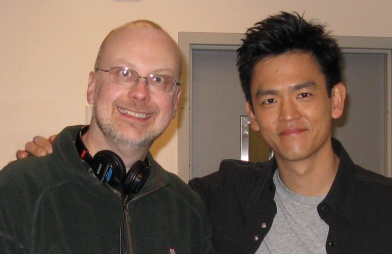
Next comes an August 2009 picture featuring a much-leaner Robert J. Sawyer alongside John Cho, one of the stars of the ABC television series FlashForward (loosely based upon the RJS novel of the same name). Based upon the exchange detailed on Rob's blog, it appears that John would probably remember Rob ... although it might be as the person who obliquely implied that he's a closet homosexual, so who knows if he'd be inclined to pass any message along. Still, it fits my criteria as a potential route to contact the President (although at this point, some of you dear readers may be confused as to how).
Also, Rob appeared in the pilot episode of FlashForward, in which Cho was a main character, which means that from this point forward we can proceed loosely under the rules of the "6 Degrees of Separation of Kevin Bacon" ... I'll just need to bring my camcorder next time I meet up with Rob at a convention! (Cho & Sawyer were not in a scene together, however, which means that my more strict rules for "6 Degrees of Separation," which necessitates that characters not just be in the same television show or film, but also be in the same scene, cannot be applied.)

John Cho is known for things other than FlashForward, of course. He first came to prominence as the guy who, in the original American Pie film, defined the term "MILF" for an unfamiliar public. (Kids, if you don't know already, ask your mom. Please videotape her reaction for me.) His most popular role, though, is as Harold Lee in the buddy-stoner films Harold & Kumar Go to White Castle and Harold & Kumar Escape from Guantanamo Bay, alongside the Indian actor Kal Penn. (The image below is from the Guantanamo Bay installment of the saga.)
Kal Penn followed up Harold & Kumar by taking on the role of Lawrence Kutner on Fox's medical drama series House, M.D. ... which he left in early 2009 to join the staff of the Obama White House as associate director of the White House Office of Public Engagement, as an Indian-American community liason. Here is a picture of him with Barack Obama. (I assume that video of the two of them together at some sort of rally or press release exists, but I haven't been able to find it.)
Unfortunately, as I researched this blog post (yes, I actually research this stuff), I found out that just earlier this month Kal Penn announced that he's leaving his post at the White House to return to Hollywood, apparently for a Christmas-themed Harold & Kumar movie. (Another five after that and they'll surpass the Hope/Crosby "Road to" movies as the classic buddy/adventure/romance/comedy/satirical movies.)

April 2010 has been a particularly interesting month for Penn, since he's also been mugged at gunpoint.

Despite Penn's pending return to Hollywood, given the amount of campaigning he did for the President, Obama is certain to know who he is, so he fits my criteria.

Therefore, the path is: Me -- Robert J. Sawyer -- John Cho -- Kal Penn -- Barack Obama. 

4 degrees of separation! I officially rock!

What's really disturbing is that I'm even slightly more excited that this same chain gets me to Joss Whedon (creator of Buffy the Vampire Slayer, Angel, Firefly/Serenity, and Dollhouse) in just as many steps: 

Me -- Robert J. Sawyer -- John Cho -- Neil Patrick Harris (also in both Harold & Kumar films) -- Joss Whedon (Dr. Horrible's Sing Along Blog)

Ah, the (impotent) power that I now (think I) wield!