Showing posts with label atheism. Show all posts

Thursday, September 11, 2014

Religion, ISIS, Atheist Hypocrisy, Confirmation Bias, and Tribalism

"Symbols of Religions".
Licensed under Creative Commons
Attribution-Share Alike 3.0 via Wikimedia Commons
Several recent atheist commentators have rightly condemned ISIS, citing it as an example of religion gone horribly wrong. But then they go further, using the example of ISIS to condemn religion as a whole. Is this a valid move? If not, then why not? And what clues, if any, does the activity of ISIS give us about religion as a whole?


Atheists Condemning Religion via ISIS

The theologian Randal Rauser has one of a handful of Christian blogs that I find quite fascinating and worth following, if only irregularly. I haven't been following it long and though he seems to focus a bit more attention on apologetic-style arguments than I tend to appreciate, he does so in a clever and fair manner, with pleas for nuance that are often missing from most others of that ilk.

Rauser recently posted a brief article called "If we all reasoned like the atheist ideologue" which made an excellent point, but I think did so in an incredibly unilluminating way. In it, Rauser attacks the notion that ISIS's mere existence is an example of problems caused by religion:
In the last few weeks the internet has seen a flurry of armchair analysis by atheistic ideologues offering their ruminations on ISIS. Desperately short in their understanding of the geopolitical, social, cultural and historical factors at play in the Middle East, they sashay into the hornet’s nest and opine that the problem is “religion”.
Rauser doesn't link directly to any such commentary, but here's one that I saw on Lawrence Krauss' Facebook feed that I think fits the bill.
"ISIS is a barbaric reminder: no such thing as a religion of peace, certainly not in Islam today nor Judaism and Christianity throughout history." (link)
Now, I am a fan of Lawrence Krauss - in both the Facebook and more general sense. I've read (and reviewed) his books for years. I interviewed Lawrence Krauss last spring, at a showing of his film The Unbelievers, and got my first edition of The Physics of Star Trek autographed. But, as Krauss himself often points out, there are no authorities in science, only experts ... and as such I am not in any sense obligated to agree with everything he says.

So I absolutely disagree with Krauss's point that there is "no such thing as a religion of peace." First of all, it's not true as a stand-alone statement, because many examples of peaceful religions can be found (and warlike non-religious teachings).

But even in the context of ISIS - a group of people that clearly hold to a barbaric, non-peaceful religious viewpoint - the line between evidence and conclusion is tenuous here. The barbarity of ISIS is so extreme that it actually serves to highlight how benign most Islamic interpretations are. Pointing at a clearly-aberrant example as if it were normative is not something you can do!

It is this second issue that Rauser focuses on (again, in general ... he doesn't specifically cite the Krauss comment):
What if we all adopted this degree of inane, ideologically driven analysis? What would the world look like?
For starters, if a woman cut you off in traffic, you wouldn’t blame her. Instead, you would conclude that women shouldn’t drive cars, period.
And if your neighbor’s boy damaged your flower garden while attempting to earn a skateboarding badge for Boy Scouts, you’d conclude that youth organizations should be abolished.
And if your son twisted his ankle doing track and field, you’d cast a pall on all youth sporting events.
And if you had a bad dinner at the local Chinese restaurant, you’d eschew all Chinese (or better yet, all “ethnic”) food.
This is the degree of absurdity we are dealing with when folks with little-to-no understanding of ISIS and the complex geopolitical, social, cultural and historical factors at play in Syria and Iraq offer their absurdly crass analysis that the problem is intimately related to “religion”.
I have two main points about Rauser's attack.

  1. His examples are incorrect.
  2. He doesn't explain the actual problem (which is far worse, I think, than mere crassness).

The examples all show a case where a single piece of evidence leads to an extreme general conclusion. This is known as the hasty generalization fallacy, and Rauser is right that it would be a real problem ... if that were the actual fallacy being committed in these cases.

But it's not. How do we know? Because Rauser has himself identified these people as "atheist ideologues," which suggests that these are established people who have already concluded that atheism is the proper way of viewing the world and religion is problematic. They may have committed the hasty generalization fallacy at some point in the past, but having read several books by these people, it's clear that it's not nearly as hasty as Rauser's examples suggest. They didn't look at one piece of evidence against religion and arrive at a generalization that religion was a problem. Rauser just wrote a 15-part review of a biography of a man who abandoned religion for atheism, so he presumably knows there's more than one piece of evidence at work here, which means this is easily classified as a straw man fallacy.

But there is a serious problem here, although it's not actually a logical fallacy per se, so much as a methodological fallacy. It is, in my opinion, one of the worst cognitive errors that we have to deal with in our search for a better understanding of the world: Confirmation Bias.


Confirmation Bias and Religion

Confirmation bias is the tendency to give more weight or significance to results or evidence that confirm an already-established opinion than we do to evidence that contradicts that opinion.

In this case, the error that the atheists are making in pointing to ISIS is that they are being very selective in the evidence they look at. Again, go back to the Krauss quote. He points to ISIS as a barbaric reminder that there is no religion of piece, but in doing so clearly ignores the many pieces of evidence that suggest religions are peaceful. You don't even have to leave Islam to find far more peaceful Muslims - and Muslims who say that their peaceful acts are motivated by their religious faith - than Muslims who are driven by hate toward violence.

And, as a scientist, Krauss certainly knows about confirmation bias. One of the major goals of the scientific enterprise is to minimize it. And he pretty much mocked poor confirmation bias on the religious side, quite deftly, here.

This is the real irony of Rauser's attack, for me, because confirmation bias is for me the largest problem with religion.
My issue with religion is not a fundamental rejection of mystical or supernatural influences, but rather that religion adopts a methodology in which confirmation bias is not only allowed, but encouraged.
My strongest evidence for this view comes in the central role of testimony in religious life. Outside of intellectual circles, religion is largely affirmed, in day-to-day worship, by anecdotal testimonies to the role of God in one's life. As someone who has spent most of his life on the outside of religion, I cannot tell you the number of times someone has tried to explain to me how God has actively transformed their life. They were an alcoholic or an abusive husband and then they got right with God, and they felt a transformation come over them, and this is proof of God's existence.

I attended an evangelical church for a time that was particularly intriguing in this regard, with relatively common testimonies from the congregation. For some context: the minister of this church had once been a construction worker, fell off the fifth story of a building, landed face-first on cement, and despite being so bad that doctors assumed he would die, he somehow walked out of the hospital about a week later. And, during his convalescence, he had a vision of Jesus. So it's absolutely understandable that this particular church put a lot of faith in testimony. (To date, I have no reason in particular to doubt the man's claims about the series of events. Nor, though I don't agree with his explanation, can I particularly fault him for attributing miraculous significance to them.)

Testimonies from others were far less impressive, but still moving and significant. They were stories about how turning to Christianity and handing their life over to God made real differences in their lives. At one point, a man talked about how God had cured him of diabetes and helped him stop smoking. At another point, around Christmas time, a woman talked about how money was tight and she was going to have to avoid paying important bills so she could get clothes and gifts for her children. At the register, however, the scanner had some sort of malfunction, and the clothes came up much lower than expected. I don't remember the particulars, but I think the clothes came up for a few cents apiece, and the woman ended up saving over a hundred dollars all told.

If you stripped away all testimony of this kind from all religions, it's not clear to me that much religion would be left. There might be some logical arguments that would have impressed Aristotle fans, but religions wouldn't be living, breathing entities that influence lives directly in this world.

But every single one of the testimony examples above is a glaring case of confirmation bias. If you were to sit down and think, "How could I discern the real truth of religious experiences?" then you could hardly construct a worse methodology of doing it than asking people of faith when something good happened in their life that they felt was attributed to God. (I encourage you to try, in the comments section.)

The difference, of course, is that religious people do not, by and large, know about confirmation bias. As such, they can absolutely be forgiven for not taking steps to avoid it. Atheists, on the other hand - particularly active secularists, skeptics, religious critics, and "atheist ideologues" - absolutely know about confirmation bias. Using ISIS as a bludgeon to confirm your views without proper respect for the counter-argument is, either consciously or not, absolute hypocrisy.


What Can Be Said About Religion and ISIS?

It is perfectly valid, however, to point at ISIS as an example of how religion can lead someone to do horrible things. In a recent interview, even the Muslim moderate Reza Aslan admits that this is a logically valid interpretation of Islam (though not one that he agrees with).

But if an atheist is going to attack religion, they need to be sure that they are placing ISIS within a much broader context of why religions produce these sorts of negative outcomes. This is hard to do in a tweet or a Facebook status update, of course, or even in a blog post. As Rauser points out: the various non-religious factors leading to ISIS' rise are very complex.

One person who I think has a firm grasp of this nuance, though isn't always necessarily the best at getting it across, is the atheist Sam Harris. His post today, "Sleepwalking Toward Armageddon," is characteristic of his balance of respect for Islamic people together with disdain for the dogmatic extremism that he feels comes from religion:
Which will come first, flying cars and vacations to Mars, or a simple acknowledgment that beliefs guide behavior and that certain religious ideas—jihad, martyrdom, blasphemy, apostasy—reliably lead to oppression and murder? It may be true that no faith teaches people to massacre innocents exactly—but innocence, as the President surely knows, is in the eye of the beholder. Are apostates “innocent”? Blasphemers? Polytheists? Islam has the answer, and the answer is “no.” 
[...] I would not want to create the impression that most Muslims support ISIS, nor would I want to give any shelter or inspiration to the hatred of Muslims as people. In drawing a connection between the doctrine of Islam and jihadist violence, I am talking about ideas and their consequences, not about 1.5 billion nominal Muslims, many of whom do not take their religion very seriously.
Then he launches into what I think is the absolutely proper point about religion that atheists should be making, if they are inclined to draw a larger point out of ISIS:
Religion produces a perverse solidarity that we must find some way to undercut. It causes in-group loyalty and out-group hostility, even when members of one’s own group are behaving like psychopaths.
Generally speaking, I think it's safe to say that religion is one of the most persistently tribal elements of our modern world. Although religious teachings that encourage conflict don't help, my view (and, to some degree, apparently Harris') is that it is really the particular group affiliation, and self-identification that so often comes with it, that create the strife we want to avoid.

Indeed, Rauser himself seems to recognize that this is the problem. When returning to deal with criticism that religion can exacerbate conflict, he points out that so can patriotism. But isn't that precisely because patriotism often, like many religious teachings, exacerbate the "in-group loyalty and out-group hostility" that Harris is specifically condemning?

Look at the standard array of non-religious atrocities from the 20th century, which theists are so fond of justly rolling out to prove that religion isn't the sole source of atrocities: Stalin, Pol Pot, Mao, forced eugenics, social darwinism. (They sometimes throw Hitler in there, but calling Hitler non-religious is a bit of a fudge.) Aren't all of these means of creating and enforcing tribalist structures? Throw in a healthy dose of authoritarianism, and you've got a recipe for disaster, even without adding supernatural religious beliefs and heavenly rewards to the mix.

My instinct is to side with Harris' statement a bit, though, that religion tends to exacerbate this situation. When your "in-group" includes God and the "out-group" rejects God, how could it do anything but exacerbate the situation? Certainly, I personally know of no individuals who want full-scale war in the Middle East more than a handful of fundamentalist evangelical Christian acquaintances who believe that it is both inevitable and will usher in the return of Jesus.

But then again, that might be confirmation bias, so I will hold off rather than make a hasty generalization fallacy.

Thursday, February 20, 2014

Why Plantinga Needs a Math Lesson on Materialism

In a recent The New York Times interview, philosopher of religion Alvin Plantinga goes through an involved discussion about how evolution doesn't guarantee that our beliefs are true. This is absolutely a valid concern ... and, in fact, I know of no atheist who doesn't recognize the fallibility of our inherent beliefs and thought processes. In fact, some of the strongest arguments in favor of a rejection of theism is based on the psychological account of why people embrace theism. This YouTube series on the Psychology of Belief lays it out quite well.


So, we'll grant that we are not granted inherently true knowledge by evolution. His argument is that if you believe in both materialism (that is the viewpoint that there exists nothing that doesn't have a physical basis) and evolution, then you have to admit that you have no good reason for believing that any belief you hold is true. There's an extremely extensive dissection of the various flaws over on the Rationally Speaking blog, from Massimo Pigliucci, who has a deeper background in biology and philosophy both than I and quickly dissects the key conceptual problem with the argument.

But I'd like to take a different tactic, to really try to give Plantinga's argument enough rope to hang itself, because I just don't think it holds up on any level on its own merits. The problem is not that Plantinga misunderstands evolution, but rather that he appears to misunderstand how human beings (and materialists in particular) actually think!

Plantinga's Death Knell to Materialism

Let's consider his argument on its own merit, at least to the best of my ability. In his own words:
Evolution will select for belief-producing processes that produce beliefs with adaptive neurophysiological properties, but not for belief-producing processes that produce true beliefs. Given materialism and evolution, any particular belief is as likely to be false as true.

...

Here’s why. If a belief is as likely to be false as to be true, we’d have to say the probability that any particular belief is true is about 50 percent. Now suppose we had a total of 100 independent beliefs (of course, we have many more). Remember that the probability that all of a group of beliefs are true is the multiplication of all their individual probabilities. Even if we set a fairly low bar for reliability — say, that at least two-thirds (67 percent) of our beliefs are true — our overall reliability, given materialism and evolution, is exceedingly low: something like .0004. So if you accept both materialism and evolution, you have good reason to believe that your belief-producing faculties are not reliable.

But to believe that is to fall into a total skepticism, which leaves you with no reason to accept any of your beliefs (including your beliefs in materialism and evolution!). The only sensible course is to give up the claim leading to this conclusion: that both materialism and evolution are true. Maybe you can hold one or the other, but not both.

So if you’re an atheist simply because you accept materialism, maintaining your atheism means you have to give up your belief that evolution is true. Another way to put it: The belief that both materialism and evolution are true is self-refuting. It shoots itself in the foot. Therefore it can’t rationally be held.
The starting point is the valid recognition that evolution results in useful, adaptive traits rather than factually true beliefs. No argument there.

His next step is interesting. He is quite generous in assuming that perhaps 67% of our beliefs are, in fact, true, based on processes that were not optimized for truth-seeking. Using this, he then says if we have 100 beliefs (and we have many more), then we arrive at a very low overall probability of 0.004. The calculation is actually much worse than Plantinga suggests:
0.67100 = 0.0000000000000000405%
That's 16 zeroes between the decimal point and the 4.

Now, what does this number actually mean?
It means that if a single individual has 100 beliefs, then the probability (based upon these parameters) is virtually certain that not all of these beliefs will be true.
(It should be noted that the probability that all of these beliefs are false is much worse ... you then end up with 47 zeroes instead of 16. Plantinga, of course, is not arguing that all beliefs are untrue, even assuming materialism and evolution, so let's get back to his argument.)

But for any individual belief, of course, the probability is much higher: 67% according to Plantinga's estimation.

Random Belief Analysis

So let's make an even less generous estimation. Let's assume that we have an exactly 50/50 split between a given belief being true or untrue.

First, let's note that, regardless of your worldview, it's kind of unlikely and troubling to evolution, human reason, or the very concept of truth to assume that there is an absolute lack of correlation between adaptive beliefs and truth. Even a religious fundamentalist would, I think, admit that believing a true thing is going to, on average, be more adaptive than believing a false thing. So this is by far an assumption that gives Plantinga's argument the widest berth that it possibly can to prove its validity.

Second, let's then consider how one can actually approach this problem of having false beliefs. Let's make some initial assumptions that we can start from:

Round One Assumptions:
  • 50% of beliefs are true
  • 50% of beliefs are false
  • Random designation (no systemic biases in favor of or against truth)
A good first-order approach in this case is to check with other people. So we ask someone else, "Do you have this belief?" If they share this belief, there's now a 50% chance that you both have a true belief and a 50% chance that you have a false belief. And, in fact, you'll find in this situation that no amount of checking with other people will ever move the needle from a 50% probability.

Out of curiosity, what happens with Plantinga's model if we begin checking our beliefs with other people. There's a 33% chance that any given person is wrong, so if you check with 5 people, the probability that all 5 would find the same random belief to be wrong would reach the following:
Using Plantinga's model, there is a 0.391% chance that 5 people would hold the same false belief.
So, on this basis, we do see that some sort of internal cognitive bias would quickly multiply in a community to a growing factual consensus, based purely on the sort of crude mathematical argument that Plantinga offers.

But consensus by itself is not really how we check our beliefs, even at the most basic level. We check them against reality. Let's assume though that, since we're so bad at thinking in this scenario, that we are horrible at these checks. There is only a 1% chance that testing any given belief will accurately show a false belief to be false. (Ignoring any possible positive results for now, to make the math easier and also because it's easier to disprove something than to prove it.)

Again, I should note that there is also every reason to believe that this level of instinct is biologically ingrained in us through the process of evolution ... and, honestly, that it's ingrained in most animals on some level. An animal that cannot trust any "beliefs" about the world world with more than random correlation with reality would find themselves falling prey to all manner of natural selection effects. So this most basic level of analysis doesn't take much in the way of assumption beyond what we've already assumed to think that it would be implemented as a way of finding truth and falsehood.

So we implement this method. What happens then?

What we discover is that, if you check a given belief against reality a mere 10 times, and this process shows it to be false every time, then even this admittedly horrible method of distinguishing truth from falsehood results in the following:
Probability a False Belief will Survive Round One: 0.5 * (0.99)10 = 45%
And, of course, if you begin checking with other people who are also checking these beliefs in the same way, you reach the following:
Probability a False Belief will Survive Round One in a Community of 5 Checking Against Reality: 0.455 = 1.8%
So in a community of 5 people, all of whom check a false belief against reality with a 1% accuracy, there is a 1.8% chance that the false belief would pass all of these checks and look equivalent to a true belief.

Congratulations. The neurologically challenged human race has developed some method of distinguishing true beliefs from false ones. On to round two...

Round Two Assumptions:
  • 95% of beliefs are randomly assigned 50/50 between true/false
  • 5% of beliefs are biased as follow:
    • 10% are true things that we don't believe (false negatives)
    • 30% are false things we do believe (false positives)
    • 60% are true beliefs
We now move on to considering what happens if we give some credit to evolution to create even marginally reliable belief-forming pathways. Our first round analysis gives us a starting point and, again, I'll give the benefit of the doubt that we're a bit more flawed in our neuropsychology than we really have any excuse for being.

Let's again go with just checking with other people and see what we get:
Probability of Given Belief Being True: 0.95 * 0.5 + 0.05 * 0.6 = 50.5% 
Probability of 5 People Randomly Believing the Same False Thing: 0.4955 = 3%
We see that even in this rudimentary situation, there is a strong reason to go with the community consensus from a truth-generating point of view. The randomness and biases tend to get weeded out, even at this level.

Now that we have some cognitive neurology that actually works, we can assume that we're able to develop a plan for testing against reality that does a bit better than 1% at disproving a false belief. Let's assume that it is 10% effective at showing a false belief to be false. What do we then get when we conduct another 10 tests using our improved methodology?
Probability a False Belief will Survive Round Two: 0.495 * (0.90)10 = 17%
Probability a False Belief will Survive Round Two in a Community of 5 Checking Against Reality: 0.175 = 0.014%
Ideally, we will respond rationally to the above evidence and stop believing these false beliefs. We are able to eliminate 83% of our initial false beliefs! We don't have to replace them with true beliefs, either, if we're okay with uncertainty. (Replacing them with true beliefs would favor the anti-Platinga argument, so this is again giving him the benefit of the doubt.) The result is the following:
Probability of a Given Belief Being True after Round Two (individual testing): 85.7% 
Probability of a Given Belief Being True after Round Two (group testing): 99.98%
I really don't need to go much further, I don't think, to show that the process of checking a belief against physical reality - the very belief that atheists actually demand as a methodological step for knowing anything! - does work at generating true beliefs, even granting it virtually every concession that we can realistically grant.

Conclusion

Plantinga's criticism of materialism/evolution just does not hold up. Recall that he gave an example of 100 beliefs and the probability it would take for them all to be true. Let's compare this to the results from Round Two's extremely crude falsification methods:
Probability 100 random beliefs True using Plantinga's assumptions (individual):
0.0000000000000000405% 
Probability 100 random beliefs True using Plantinga's assumptions (group):
99.8% 
Probability 100 random beliefs True using Round Two falsifiability rules (individual):
0.0000198647083%
Probability 100 random beliefs True using Round Two falsifiability rules (group):
98%
The "group" numbers represent what we get if we eliminate everything that 5 people agree are false, both in Plantinga's evidence-free assumptions and my own evidence-based ones from Round Two.
First of all, we see that testing against the evidence greatly increases the truth percentage of beliefs for an individual, way beyond what Plantinga would give credit for with his original assumptions.

Second, we see that both our overall level of truth greatly increases - in fact become nearly identical for both sets of assumptions - if we work in a group and just begin throwing out anything that we all agree are false beliefs. And this does, in general, match with empirical evidence, because even the most ardent atheist and most devout theist share far more beliefs than they disagree on (though neither might be willing to admit it). (I'll confess, the high value for the Plantinga's group number surprised me. I thought the reliance on evidence would play a more important role in the methodology. However, I did make every assumption overwhelmingly in Plantinga's favor, so I shouldn't be too surprised.)

Third, let me be clear: I think Plantinga is completely flawed in his approach and thinking about how beliefs are formed ... but my point is that even if he were absolutely correct, his argument would not hold up on its own merits. I am not presenting this trying to persuade anyone into materialism because nothing above actually supports materialism in and of itself, it merely supports our ability to gain true beliefs given false beliefs.

Therefore, there is every reason for a materialist evolutionist to, in fact, believe that they have a capacity to trust their beliefs, so long as they rely on evidence and are not trying to acquire knowledge and understanding entirely on their own.

There are extremely real negative neurophysical pathways built into the brain - for entirely adaptive reasons - which can kick in, of course, meaning that a group begins being pathological in its thinking, driving away from true beliefs and toward false ones. See the video posted above. This is precisely the reason to cultivate skepticism, as it helps to short-circuit these cognitive biases.

In conclusion, the materialist is well insulated from concern about Plantinga's criticisms of his rationality and his belief in the evidence for evolution can continue unabated ... at least until some kind of actual evidence to the contrary shows up.

Friday, February 15, 2013

What does the internet think ... and does it matter?

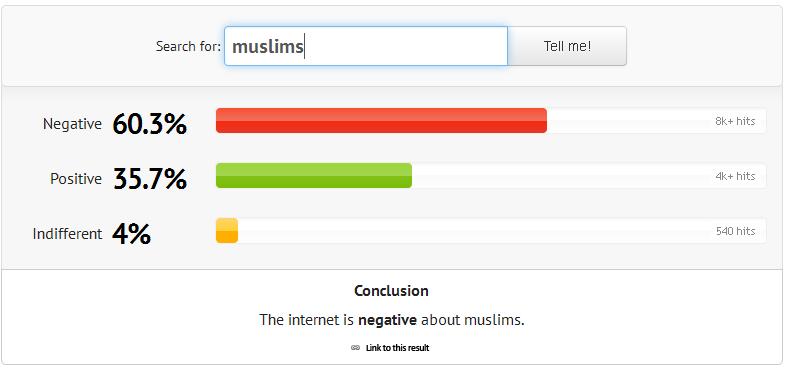
Thanks to the science fiction author John Scalzi, I stumbled upon an intriguing website called "What Does the Internet Think?" The site uses some methodology (who knows what) it comes up with a rating of the percentage of positive and negative postings on a topic across the internet. I couldn't pass up the chance to see what sort of fun data I could get out of this. For now, I'll post the information with very little commentary, but may follow up in the future.

Let's start by considering some broad subjects:

Where does the internet find truth and meaning?


It's probably not at all surprising that the internet skews toward the science-loving end of the spectrum, at least at the broadest level. I'm kind of surprised at the level of negativity about religion, to be honest. 

I would like to be heartened by the overflow of positive regard for skepticism, but it occurs to me that whatever methodology they're using probably cannot sort out the context of positive or negative statements ... so if a post is saying that it supports science, but then puts forward a concept like intelligent design as being scientific, it would likely count as a pro-science posting, even though it's really contradicting and undermining scientific inquiry and findings. Similarly, someone who supports being skeptical of evolution or skeptical of global warming would probably count toward being positive toward skepticism, even if their approach to the facts is fundamentally dogmatic, authoritarian, and revisionary instead of supporting principles of skeptical inquiry.

Which leads us to the next question ...

Does the internet prefer evolution or creationism?

The thing I find most interesting about this is that while there's a lot of indifference about creationism, there's virtually no indifference about evolution. This runs counter to my own experience. I know several people who are religious but are fairly indifferent about whether or not evolution is the physical mechanism of creation. In other words, they're religious but believe that God started evolution. But I know very few people on either side of the debate that are indifferent about creationism. 

However, given the extremely low hits on which "Creationism" is based, probably not much should be made of comparing these graphs. The "evolution" graph itself is, I think, telling enough on its own.

To put some of these values in context, though, we should look at a few baseline moral concepts, to see how they rate on the internet:

What does the internet think about morality?


I will let the above conclusion speak for itself ... for now. It's worthy of another post at another time.

On a morality-related note, though ...


What does the internet think of religion?


Christianity, Judaism, and Islam all rank positively ... but check out atheism & Buddhism! Amazingly polarized results on these religious viewpoints. Again, I'll let the results speak for themselves, although I'm sure I'll come back to this in another post sometime.

For comparison, though:


So atheists are viewed basically as negatively as their doctrine ... but both Christians and Muslims are (fairly or unfairly) viewed negatively by the internet, despite the fact that their religions themselves are viewed positively.

And, finally, a grain of salt:


Friday, October 01, 2010

Jews & Atheists Top Ratings in Religious Literacy Study

Which religious groups know the most about their own (and other) religious faiths? Some interesting results along these lines were announced this week from the U.S. Religious Knowledge Survey performed by the Pew Forum on Religion & Public Life. There's some really great information to be culled from these results about how religious information is distributed in America, so I'm going to delve into it a bit for my own gratification ... and you're welcome to come along for the journey.
World Religious Symbols
(Art provided by http://thegoldguys.blogspot.com/)

My Results
First, allow me to be self-indulgent for a moment and share my own results. The Pew Forum website has a 15-question quiz so you can find out how you rank up. I took the quiz and got 13 out of 15 (a score of 87%), which puts me above 93% of the U.S. population in religious knowledge. Only 3% of the population would have scored higher than me.

My two mistakes were that I didn't know the dominant religion in Pakistan and I mis-identified one of the key figures in the original Great Awakening. Only 11% got the Great Awakening question correct, but the Pakistan question has a fairly high rate at 68%. Honestly, on the Pakistan question I out-thought myself, because my gut instinct was correct but I figured that I was giving in to a stereotype and the real answer was probably something else. I should have gone with my gut. (There's a reason some stereotypes exist, I suppose.)

Interesting Results on the Quiz
Sorting through the data on the quiz yields some interesting results, which really just go to show that you have to really consider the data carefully. The overall population scores an average of 50% on the quiz. Here are some various breakdowns:
By Religion
  • Jewish - 65%
  • Atheist/Agnostic - 64%
  • Mormon - 61%
  • White evangelical Protestant - 54%
  • White Catholic - 51%   
  • White mainline Protestant - 48%
  • Nothing in particular - 48%
  • Black Protestant - 42%
  • Hispanic Catholic - 39%
By Worship Service Attendance
  • At least weekly - 52%
  • Monthly/yearly - 48%
  • Seldom/Never - 49%
By Gender
  • Men - 52%
  • Women - 48%
By Education
  • Post-graduate training - 68%
  • College graduate - 61%
  • Some college - 54%
  • High school or less - 40%
Now, remember, the above stats are the scores on the 15-question quiz, as compared with results from a nationally-representative sample of 3,412 adults. (The overall survey involved a total of 32 questions.)

Sorting through the data, there are some unsurprising results and some very surprising ones.

For one thing, we see the evidence that education in general also means you're more informed on religious matters. Growing up on the northern tip of the Bible belt, this merely confirms the evidence of a lifetime of frustrating conversations. If you're ignorant about everything else on Monday, chances are you were ignorant about church on Sunday. (It may also be of interest to consider this data from OKTrends which analyzes the writing proficiency levels of different religious groups on the OKCupid dating site. You'll have to scroll toward the end, past all the racial analysis, to get to the religious group data.)

Surprisingly, the people who never attend worship service do a little better than those who attend infrequently. The effect is only 1%, so doesn't mean much statistically, but it's not really surprising if you think about it. The atheists, who score high, presumably fall in the never/seldom category (along with many of the low-scoring "nothing in particular" group), while the people who go only monthly or yearly probably include many of the mid-range Catholics, mainline Protestants, and some of the "nothing in particular"group (who get dragged along to Easter service by their grandmothers). The result is that the group that has made a conscious decision to turn away from a religious life may be more well informed on religious issues than those who practice their religion in an indifferent fashion.

Item Breakdown
Now here are some extremely surprising results, from the item-by-item breakdown analysis by religious group. (There are answers given away in the data below, so if you want to know your rating take the quiz before reading further.)

  • There are 6% of self-identified Jews do not know when the Jewish Sabbath begins. (This is kind of a trick question - their Sabbath is Saturday, but it begins at dusk on Friday - though this shouldn't really trip up a Jew.)
  • There are 7% of self-identified Mormons who do not know the religion of Joseph Smith, the founder of Mormonism. In fairness, though, if they'd asked what religion Jesus practiced, most people would have probably gotten it wrong, too. (Hint: He was circumcised.)
  • 90% of Jews and 75% of atheists/agnostics correctly identified Ramadan as an Islamic holy month. No other religious group got higher than 55% on this question, and the only 52% of the overall population got it right. (Note that Muslims are not included in this data analysis. Presumably they'd have done well.)
  • Only 59% percent of White Catholics and 47% of Hispanic Catholics know that the communion is, in their church's view, a literal consumption of the body/blood of Jesus and not a symbolic one. This is a concept known as transubstantiation. Catholics who are not aware of it should ask their priest about it and watch him stammer all over himself as he tries to explain it in a way that makes sense.
  • For reasons I can't fathom, only 39% identified Job as the "Bible figure most closely associated with remaining obedient to God despite suffering." (By comparison, 38% knew that Vishna and Shiva were central to Hinduism.) Jews really tanked on this one, with only 47%. Oddly, Mormons know their Book of Job - they got 70% on this one, far outstripping the 58% from white evangelical Protestants.
  • One question which all groups were uniformly well-informed on (89% got it right) was that public school teachers could not lead children in prayer. However, only 23% knew that teachers could reference the Bible passages as an example of literature. (Again, the Jews and atheists/agnostics, being the big readers of the group, were the ones who got this the most correctly, although still only in the low 40 percentiles.) More on this later.
  • Ironically, white evangelical protestants (52%), white mainline Protestants (46%), and black Protestants (40%) could not identify the man behind the Protestant Reformation as well as Jews (70%), atheists/agnostics (68%), and Mormons (61%) could.

The Results in General

Though Jews and atheists/agnostics did best overall, on questions specifically related to Christianity and the Bible, the white evangelical Protestants and Mormons did slightly better.

The Mormons, especially, know their stuff. My guess is that this is, at least in part, due to the fact that they must continually defend the idea that their religion is in fact a form of Christianity, especially against the white evangelical Protestants, many of whom believe they are a bizarre heathen cult that corrupts Christianity. (Or, in the case of Mormon Glenn Beck, the best hope for "restoring honor" to our nation.)

I think a similar issue comes with the atheists/agnostics. Most people are not born into this belief system, they come to it through analysis of their options and thoughtful rejection of the status quo. Not only did it require thought and study to reach this position, but many have to justify it over and over again to family and friends. Like the Mormons, they are in a continual intellectual conflict with mainstream America over their choice of religious views.

Judaism probably scores high for a very different reason.  The Jewish faith is one that prizes scholarship and study. their entire religious identity is tied to the fact that during their many wanderings (some voluntary, some involuntary), they maintained a strict book of cultural stories and laws which helped them maintain their unity as a people. During the diaspora in Babylon, they became a people of the book. So it's not surprising that Jews are, on average, a bit more well informed than Christians. Christianity cherishes love, emotion, and faith over more thoughtful religious methods. (This is, of course, an over-generalization of both Judaism and Christianity, but we're talking about the average in this case, so I feel that generalities are justified.)

Religion in Schools
I'm still culling through all of this data, but one thing that I find endlessly fascinating are the clear misconceptions that this study demonstrates. For example, while the most correctly-answered question  was  about whether teachers could lead prayer in public school, there was amazing misunderstanding about other aspects of how religion can show up in the public education system.

The Supreme Court has clearly ruled that public schools can offer comparative religion courses and can study passages from the Bible as part of literary and historical studies, but the vast majority of respondents didn't know this to be true. In the words of the study's executive summary:
Together, this block of questions suggests that many Americans think the constitutional restrictions on religion in public schools are tighter than they really are.
Again, this comes to a matter of education. I find that the people who complain most about the lack of religion in schools aren't really that informed about what religion in school constituted. Think about it ... does any religious person really want a public school teacher to be responsible for the religious education of their child? Do they really feel it's justifiable that Jewish children be forced to study Christian teachings? Even among Christianity, what if the teacher holds different viewpoints? How does a teacher respond to a student's question about faith healing, speaking in tongues, or angels and demons? These are things that some Christian traditions teach are literal, true, and fundamental elements of the faith, and others view as largely symbolic. What if the teacher is a Mormon or Catholic and the parent is an evangelical Protestant?

In fact, the more religious you are at home, the greater the danger that your faith teachings to your child will be called into question by religious instruction in public school, because the school will have to provide a broad range of religious instruction to satisfy the broad population they serve.

Part of the opposition to religion in public schools was that Catholic children were being converted by the overtly-Protestant education in the school system. Surely a Protestant parent in Utah does not want Mormonism being taught to their child, nor does a Mormon parent anywhere else want their religious teachings to be called into question.

But, of course, many people don't think about the issues very carefully. They react not with their (dare I say God-given) reason and thought, but with emotion and faith, to recall a false nostalgia where times were simpler. It is almost always a myth ... like the myth, apparently, that going to church on a regular basis makes one significantly more well informed on religion than those who don't attend.

And, on that note:


Saturday, July 10, 2010

Rational Morality: What Is Evil? - Part 1

Sam Harris believes that morality can be reached without the intervention of religion. In fact, he seems to believe that religion, as often as not, complicates issues of morality more than it provides any clarity. He's an interesting guy, though I have not yet read his books (but that will change soon), so I was pleased to when I heard about his TED talk on the issue of morality derived from scientific principles.


The speech appears to be based on ideas and material from Harris' upcoming book, The Moral Landscape: How Science Can Determine Human Values. For those who, like me, can't wait for a meatier approach to the issue, consider this May article from the Huffington Post, "Toward a Science of Morality."

I'm very sorry to have missed these discussions when they first came out, because they parallel many of my own thoughts in recent years ... thoughts which have led me into a serious consideration of how to define morality in a purely rational framework.

Me, Joe Lieberman, and a Moral Quandry
Specifically, these thoughts can be traced back to the 2004 Senate primary campaign of Connecticut Independent (then-Democrat) Joseph Lieberman.

Lieberman lost the Democratic primary in 2004 because he supported the Iraqi War, and he did so because he thought that Saddam Hussein was an evil dictator who deserved to be stopped. This is the story as I understood it at the time and, frankly, I saw no reason then (and see no reason now) to question the sincerity of this stance.

While I didn't particularly agree with Lieberman's stance on the war itself, I was disturbed while witnessing some of the passionate disagreements with him. In part, they seemed to focus on a fundamental opposition to him taking a moral stance. In other words, it seemed like many educated liberals were attacking him specifically over his use of the word "evil" to describe a man who often tortured people, murdered his own citizens, and had "rape rooms." Lieberman was being attacked by Democrats, at least in part, because he was not adopting a moral relativistic stance, at least in regards to the Saddam Hussein's particular evil quotient.

I, too, thought that Saddam Hussein was evil. But why? I am also an intellectual, and I didn't have any particular religious-based convictions to give me guidance on evil. Was my only basis for calling Hussein "evil" a moral conceit, ingrained into me by the society in which I happened to be raised, or did I have a better grasp on the subject that I couldn't yet fully explain?

I didn't know, and that really bugged the bejesus out of me, so I began trying to figure out if there was a rational basis for my moral evaluation of Hussein as "evil" in some objective sense.

Framing the Question
My first step was to determine if this is the right question. Just a few moments' worth of consideration led me to believe that it had been framed wrong from the very beginning, because I actually had no idea if Hussein himself was evil as a person, but I did believe that the actions which he had been accused of (and to this day have no reason to doubt) were evil.

So my real question is what makes an action evil, not what makes a person evil. (The "evil person" question that had started this line of reasoning could be tackled later, I decided, if it was actually needed.)

Where, then, should be my starting point for defining evil? I believe that you can begin with a simple concept: suffering.

In fact, at this point I realized a beneficial aspect of this approach, and one which resonates strongly with the aforementioned Harris/Carroll discussion. It is my belief that when devising a rationale system of morality, it is best to start from the "evil" and work to the "good," rather than vice versa. I believe this for three reasons:

1. Morality in society is usually invoked harmfully through the "evil" label. If evangelical Christian pastors gave sermons about how wonderful and good the heterosexual lifestyle was, they would not inspire hate speech or crimes against homosexuals (but, I might add, would still get their basic message across). If Muslim terrorists spoke exclusively about the virtue of their Muslim religion, they would not feel the need to be terrorists. It is primarily through attaching the label of "evil" to others that religion and morality causes the most damage, so the "evil" label is the more important one to make rational.

2. "Suffering" is, I think, a more well-defined concept than "pleasure," "well-being," or any of the other concepts which might be used to define a "good" action. If I wanted to make someone suffer, there are a clear set of things that I could do that would guarantee their suffering. I could, for example, hit them in the knee with a hammer. Suffering accomplished.

3. If, however, I wanted to please them, it's less clear. Oh, I could offer them food, but what food would I have to offer them? What if they've got a nut allergy? Questions must be asked about causing pleasure which did not have to be asked in the attempt to cause suffering. (In that case, the only question that needed to be asked is, "Does he have a wooden leg?" Even then, I imagine banging on someone's wooden leg with a hammer would still qualify as making them suffer, though to a far lesser degree than intended.)

To use Sam Harris' metaphor from the TED talk, this is like pointing out that the best place to understand health is by really getting a firm handle on what it means to be dead. Once you've clearly nailed down the dead state, you can begin having a discussion about what would then constitute being alive.

Therefore, the first iteration of my rational definition of morality was as follows:

An evil act is one which causes suffering.

Though a nice start, we will see in the next installment of this discussion that this proves to be insufficient.

Sunday, January 10, 2010

Inalienable Rights: A Commentary

I'm currently in the process of listening to Dinesh D'Souza's intriguing book Life After Death: The Evidence on audiobook, primarily because I have seen some commentary that there's a discussion of string theory in it, and I wanted to see how it was being used in case I get questions about it during interviews.

I'll comment on the book itself when I get done with it, but right off the bat, I have an issue with the Foreward, written by The Purpose Driven Life author, Pastor Rick Warren ... who appears to have read neither the book nor the U.S. Constitution.

The first issue is that Warren says:

So where can we learn the truth about the afterlife? We have two choices -- speculation or revelation.

Aside from other potential problems with this statement, it has one serious contextual problem: the whole point of D'Souza's book is that there is a third option.

In this book, D'Souza does not appeal to revelation (though he himself is a Christian), but rather attempts to ground his arguments in the application of rational thought, proving that it is not irrational to believe in life after death. In other words, while he is not proving that life after death is true, he is certainly attempting to show that reason allows the possibility of life after death. It can't be ruled out, as the "new atheists" (or old atheists, for that matter) claim, purely as an irrational proposition. (So far, I find his case relatively compelling, despite some logical problems with some of his arguments here and there.)

The second issue from Warren's Foreward can be found in the following statement:

Even the American constitution points out that our "inalienable rights" are "endowed by our Creator," not by the government or any other human source.

For one thing, these quotes are from the Declaration of Independence, not the U.S. Constitution. (And, as an educational sidenote, the final version of the Declaration of Independence used the phrase "unalienable rights" - which means the same thing.) But the real problem comes when you look at the full sentence from the Declaration which Warren has extracted for his point:

We hold these truths to be self-evident, that all men are created equal, that they are endowed by their Creator with certain unalienable Rights, that among these are Life, Liberty and the pursuit of Happiness.

Warren is perfectly right to point out that this statement invokes the mention of a Creator, but he's misses a major point in this sentence, which goes directly against the message of his Foreward.

There is no appeal to revelation - in fact, the truths are "self-evident" - so by his own previous litmus test, this must be "speculation." In fact, neither the Declaration nor Constitution contain any statement of positive support of specific religion, nor any appeal to divine revelation.

The Constitution has two mentions of religion, and both are somewhat against religion - the well-known First Amendment, dictating that the federal government can not establish a religion, but also a clause specifically stating that the federal government cannot require religious oaths for holding office. (Some people swear on Bibles by choice, but the Constitution specifically states that this is not, and cannot, be a requirement of office.)

In fact, the rights outlined in the Declaration of Independence are based on a rational worldview, in contrast to a revelatory worldview. This didn't have to be so. The Declaration could have invoked specific divine authority (like pretty much every other political document in history until that point). As outlined in Jon Meacham's American Gospel, there was an impassioned debate among the population because many religious thinkers wanted the government to be Christian, and didn't like that it was specifically designed as a secular institution.

The real implication of this line of the Declaration (and, to an extent, of D'Souza's book) is that you can apply reason to obtain certain information about the nature of divine truths. The appeal to revelation may or may not be valid, but it is not the only way to obtain divine truths and, in forming a diverse community, it's not even the preferred way.

Why did the founding fathers make this choice? Because the political authority of the King of England was rooted in the idea of the divine right of kings. The King of England was, after all, also the leader of the Church of England. He was endowed by his Creator with the mantle of kingship.

By invoking individual rights that were "self-evident," the founders made it clear that there was no force - not even religious revelation - could unearth the foundation of individual liberty upon which the new nation's claim of independence rested.

In every respect (except marketing), Warren's Foreward to the book is a mistake, and an intellectually misleading mistake. If nothing else, D'Souza (who was a White House policy analyst during the Reagan administration and has since been a political writer) should have recognized that the quotes were from the Declaration and not the Constitution, but even more than that he should have recognized that the claims Warren were making were at direct odds to the central message of his own book: reason is a valid way to explore the nature of the divine.

More thoughts to come on the central message of the book (which I am so far finding much more favorable than the Foreward) as I complete it ...