Sunday, July 25, 2010

Film Review: Alice in Wonderland


I really had no desire to watch the Tim Burton version of Alice in Wonderland. His films are, of course, always visually stunning, but I am just not nearly as impressed with them as I'm supposed to be. While I love Johnny Depp's acting, Burton's need to put him in film after film is a bit grating, especially because it causes Depp to play on the same facets of his acting toolbox. The Mad Hatter certainly looked like a re-hash of his Willy Wonka persona to me.

Fortunately, this time, Mr. Burton pleasantly surprised me.

About the Books
I read both Alice in Wonderland and Through the Looking Glass last year, and was unimpressed with them, as well. I was aware, from various adaptations over the years, of all of the various characters and events, but reading them as they were originally laid out just did not resonate with me. They were nonsensical, and the books had no theme, moral, or even plotline as such. That's fine, of course, given the period in which the books were written ... but it just doesn't work for me.

And the fact that there are two books is also puzzling, because they're similar on so many levels but also have dramatic differences. Alice from one book doesn't seem to remember the events of the other, and the worlds are just different enough to be distracting. It was like Lewis Carroll thought of his premise - a young girl named Alice is magically transported to a fantasy world - but then came up with two different ways of writing the story. Instead of picking one, he instead just wrote both of them. It's a curious way of going about storytelling (although I can think of a few times in the Bible where a similar narrative strategy seems at work - like the multiple tales of Abraham & Isaac trying to pass their wives off as their sister).

Back to the Film
So we had a film by a director I was unimpressed with based upon source material that I was unimpressed with. The result: I really was not expecting to like the film. I put off renting it, but finally, when it was the only even remotely-desirable option at our nearby Redbox (and I had a promo code that would run out in a week if I didn't use it), I opted to rent Tim Burton's Alice in Wonderland.

And, overall, I am quite pleased that I did. Burton seems to have realized all of the same flaws that I had with the original material (which is surprising, since the nonsense of the original source material is somewhat similar to the nonsense that Burton spewed out in his "masterpiece" Big Fish) and sought to "remedy" it ... which is needed, because a film that was a faithful re-telling of Alice in Wonderland would have been a failure with any audience that was not using mood altering chemicals.

Of course, for people who loved the source material, changing it can be a serious point of contention. (See this Orson Scott Card review, for example, though he did ultimately enjoy the film.) For me, though, this worked wonders, because it made a bit of sense of things. He did take the story and make it more relevant (though Card is right that Burton added more than his fair share of failures to the venture, as well).

First of all, Alice has been to Wonderland before. It's not really explained how often, but this provides a means to explain the two books if the film is viewed as the third story in the series. First comes Alice in Wonderland (the book), then Through the Looking Glass, and then Tim Burton's film, which should honestly have been named Alice's Return to Wonderland or Alice's War for Wonderland or something like that.

This meant that Burton was free to use all of the characters, events, or themes from either of the books freely, but could also tell an actual story. Not only that, but he actually had a theme, and a good one, about belief in oneself.  In both of Lewis Carroll's books, the character of Alice is merely an observer who goes through no changes from beginning to end. It's a random series of entertaining encounters ... end of story.


Burton took the story from one of pure whimsy to one of growth, by introducing a character arc that was wholly absent from the original source material.

I won't discuss the specifics of the plotline, other than to say that it provides the characters that do show up much larger roles. Johnny Depp's Mad Hatter (one of the few characters other than Alice to appear in both of the Lewis Caroll books, but only for one scene per book) is given a major role, and he gets nearly as much screen time as Alice. (Card's review gives away more details of the storyline, for those who are interested.)

The fact is that this is still an Alice in Wonderland story, and the storyline doesn't (and shouldn't) completely eclipse the wonder of discovering this mystical realm. Still, there does need to be a storyline, because modern audiences are not yet so immune to storytelling that they will sit through a series of random events and feel satisfied.

So, in my take, Burton's film succeeds on almost all levels. Yes, there are some serious problems with his portrayal of Victorian society in the "real world" parts of the book, and there were also some problems with the interpretation (misquotes of poetry lines and such) which made it seem that Tim Burton himself may have been screaming "Off with their heads" to any English Literature consultants working on the film. But as someone who didn't particularly care for the books, or enjoyed them only as amusing little pieces of drivel, I thought it was great.


It was a fun film, visually stunning, and it actually had a good character arc. That's better than you get with a lot of films today.


Time in Wonderland
One personal disappointment was that I'd hoped for there to be some discussion of the curious behavior of time in the film. In Through the Looking Glass, the White Queen actually experiences time backward, which appears to have been completely ignored by Burton, though it could have provided some interesting material in the film.
Note: When a call went out for Alice in Wonderland and Philosophy, I proposed an article on the nature of time in Lewis Carroll's stories, but the editor passed on the idea. I still think it's an idea I might get back to sometime.


Modern Kid Lit: The Looking Glass War
The film made me think of a series of books that I'd stumbled upon a while back, but haven't yet read, called The Looking Glass War by Frank Beddor. It's a three-volume series which goes on the premise that Alice (called Alyss in the series) actually traveled to Wonderland, and that her stories were the basis of the classic books. The Mad Hatter plays prominently in the series, as some kind of agent who can travel between the worlds. Hatter has now come back to bring Alyss to Wonderland to stop a war that threatens both realities. (There also appears to be a Hatter M series of graphic novels, which looks as if it's something of a prequel to the novel trilogy.)

As I've said, I haven't actually read these books yet, so I cannot honestly recommend them. They did catch my eye, though, and I'm looking forward to having the time to get to them. If you've watched the film, or read the original books, and are interested in seeing more about how this subject matter is being adapted for modern audiences, these books may well be something you'd be interested in reading.

And if you have read them, please leave a comment letting me (and other readers) know whether they're worth our valuable time and money!
Looking Glass War trilogy

Hatter M graphic novels

Saturday, July 10, 2010

Rational Morality: What Is Evil? - Part 1

Sam Harris believes that morality can be reached without the intervention of religion. In fact, he seems to believe that religion, as often as not, complicates issues of morality more than it provides any clarity. He's an interesting guy, though I have not yet read his books (but that will change soon), so I was pleased to when I heard about his TED talk on the issue of morality derived from scientific principles.


The speech appears to be based on ideas and material from Harris' upcoming book, The Moral Landscape: How Science Can Determine Human Values. For those who, like me, can't wait for a meatier approach to the issue, consider this May article from the Huffington Post, "Toward a Science of Morality."

I'm very sorry to have missed these discussions when they first came out, because they parallel many of my own thoughts in recent years ... thoughts which have led me into a serious consideration of how to define morality in a purely rational framework.

Me, Joe Lieberman, and a Moral Quandry
Specifically, these thoughts can be traced back to the 2004 Senate primary campaign of Connecticut Independent (then-Democrat) Joseph Lieberman.

Lieberman lost the Democratic primary in 2004 because he supported the Iraqi War, and he did so because he thought that Saddam Hussein was an evil dictator who deserved to be stopped. This is the story as I understood it at the time and, frankly, I saw no reason then (and see no reason now) to question the sincerity of this stance.

While I didn't particularly agree with Lieberman's stance on the war itself, I was disturbed while witnessing some of the passionate disagreements with him. In part, they seemed to focus on a fundamental opposition to him taking a moral stance. In other words, it seemed like many educated liberals were attacking him specifically over his use of the word "evil" to describe a man who often tortured people, murdered his own citizens, and had "rape rooms." Lieberman was being attacked by Democrats, at least in part, because he was not adopting a moral relativistic stance, at least in regards to the Saddam Hussein's particular evil quotient.

I, too, thought that Saddam Hussein was evil. But why? I am also an intellectual, and I didn't have any particular religious-based convictions to give me guidance on evil. Was my only basis for calling Hussein "evil" a moral conceit, ingrained into me by the society in which I happened to be raised, or did I have a better grasp on the subject that I couldn't yet fully explain?

I didn't know, and that really bugged the bejesus out of me, so I began trying to figure out if there was a rational basis for my moral evaluation of Hussein as "evil" in some objective sense.

Framing the Question
My first step was to determine if this is the right question. Just a few moments' worth of consideration led me to believe that it had been framed wrong from the very beginning, because I actually had no idea if Hussein himself was evil as a person, but I did believe that the actions which he had been accused of (and to this day have no reason to doubt) were evil.

So my real question is what makes an action evil, not what makes a person evil. (The "evil person" question that had started this line of reasoning could be tackled later, I decided, if it was actually needed.)

Where, then, should be my starting point for defining evil? I believe that you can begin with a simple concept: suffering.

In fact, at this point I realized a beneficial aspect of this approach, and one which resonates strongly with the aforementioned Harris/Carroll discussion. It is my belief that when devising a rationale system of morality, it is best to start from the "evil" and work to the "good," rather than vice versa. I believe this for three reasons:

1. Morality in society is usually invoked harmfully through the "evil" label. If evangelical Christian pastors gave sermons about how wonderful and good the heterosexual lifestyle was, they would not inspire hate speech or crimes against homosexuals (but, I might add, would still get their basic message across). If Muslim terrorists spoke exclusively about the virtue of their Muslim religion, they would not feel the need to be terrorists. It is primarily through attaching the label of "evil" to others that religion and morality causes the most damage, so the "evil" label is the more important one to make rational.

2. "Suffering" is, I think, a more well-defined concept than "pleasure," "well-being," or any of the other concepts which might be used to define a "good" action. If I wanted to make someone suffer, there are a clear set of things that I could do that would guarantee their suffering. I could, for example, hit them in the knee with a hammer. Suffering accomplished.

3. If, however, I wanted to please them, it's less clear. Oh, I could offer them food, but what food would I have to offer them? What if they've got a nut allergy? Questions must be asked about causing pleasure which did not have to be asked in the attempt to cause suffering. (In that case, the only question that needed to be asked is, "Does he have a wooden leg?" Even then, I imagine banging on someone's wooden leg with a hammer would still qualify as making them suffer, though to a far lesser degree than intended.)

To use Sam Harris' metaphor from the TED talk, this is like pointing out that the best place to understand health is by really getting a firm handle on what it means to be dead. Once you've clearly nailed down the dead state, you can begin having a discussion about what would then constitute being alive.

Therefore, the first iteration of my rational definition of morality was as follows:

An evil act is one which causes suffering.

Though a nice start, we will see in the next installment of this discussion that this proves to be insufficient.

Monday, July 05, 2010

The Music Revolution - Pandora & Glee

I recently began listening to Pandora, a website that is able to take your musical tastes and create customized (and free) streaming radio channels with other music that you might be interested in. As it plays music, you indicate whether you like or dislike songs, and the future selections (as well as the ads, no doubt) continue to become more refined and personalized based on these interests. I won't go into detail on the website, as it's better explained by its creator, Tim Westergren, in this Colbert Report interview:


The Colbert ReportMon - Thurs 11:30pm / 10:30c
Tim Westergren
www.colbertnation.com
Colbert Report Full EpisodesPolitical HumorFox News


But, as many know, the internet lays all our secrets bare. It took virtually no time for Pandora to deduce my secret love of 80's rock ballads. Given my range of musical interests (some of which is visible on my Pandora profile), this is hardly surprising, but still, I would like to think that I'm a bit more complex than that. Sadly, it took the algorithm only a few hours of playing to bring up old middle school favorites like Firehouse, Trixter, and White Lion with their rockin' power cords.

In addition, I've always been a fan of showtunes. Sure enough, Pandora regularly brings up songs from the FOX television series Glee, of which I am a big fan. While I enjoy the music on the show, and it has propelled the popularity of the series, the fact is that I'm drawn even more to the great storytelling in the show, including one of the best television scenes ever.

Pandora is intriguing not only because it helps bring me music I enjoy, but because it has the potential to provide yet another means for the recording industry to make money in the digital age. I'm still waiting to see clear signs of better ways for the publishing industry to adapt to the digital age, and in fact science fiction author Robert J. Sawyer recently mused, in a keynote speech at the Canadian Book Summit, "Are the days of the full-time novelist numbered?" And this is certainly not because Sawyer is a Luddite! He is savvy in his use of technology for promotional purposes, having run his author website for 15 years (longer than Amazon.com!) which includes free give-aways of his short fiction as promotional material. But the question is whether publishing, as a whole, will find a way to flourish.

These issues of copyright, propriety, and popular culture are complex and difficult, and Glee really lies at their intersection, as adeptly described by technology commentator, free speech advocate, and also science fiction author Cory Doctorow. The fact is that the current copyright laws related to music mean that the sorts of mash-ups regularly shown on Glee are, in fact, illegal were they performed without permission of the original creators (or whoever owns the rights to the music).

For now, of course, you can choose to listen to Glee songs on Pandora, or you can buy the MP3 files, or still the old fashion CDs (still my personal preference, since I like to hold things in my hands). For my part, though, I can't wait for season one to come out on DVD, so I can see the storyline and characters develop from beginning to end.

Glee Music CDs:

Glee DVD (coming Sept. 14, 2010):

Thursday, June 10, 2010

Free(Market)Dom

In a recent blog post, science fiction author David Brin cites these two ideals as the core of libertarian thought:


Freedom and Fair Competition


Brin's science fiction is great, but in recent years I've grown quite impressed with his thinking on political issues. (Sometime I'll delve more deeply on his thoughts about the importance of transparency, but until there you can read about it on his site.)

Why does Brin feel the need to recap these core principles of libertarianism? Well, it may be because some of the most fervent libertarian conservatives seem to have gotten their priorities a bit confused. Regularly, I hear people claiming to be libertarians, and their solution to everything is for the government to remove essentially all regulations. They want markets to be absolutely free. That's all they talk about.

And free markets are certainly great things, as the history of the United States - married early on to the economic theories of Adam Smith by the first Secretary of the Treasury, Alexander Hamilton - has shown us. But they aren't magical. They don't fix everything all by themselves. They are, according to Smith, the ideal economic system, because they provide the most robust ways of dealing with the inherent flaws in human nature. We cannot be trusted to do the right thing, which is why we should trust the "invisible hand" of the free market. And a free market should certainly be, if anything, free, right?

With Great Power Comes Great Responsibility
However, as conservatives frequently remind us, freedom comes with responsibility. The individual has responsibilities to society, to behave in a moral manner, and there need to be forces in place to prevent individuals who break those responsibilities in a way that negatively impacts other individuals or corporations. That's why, if you kill someone or steal a car from a car dealership, you will go to jail.

Having a "free market" that contains no legal constraints of any kind makes as little sense as having social freedom with no legal constraints of any kind. It's a simple SAT analogy:

Regulations are to companies as laws are to individuals

(Of course, "regulations" are often enforced by "laws," but you get the idea.)

Few conservatives of any stripe would argue that if all laws were abolished, then society would function better. (Libertarian darling Rand Paul recently made such a claim, but only if everyone were Christian!) But these same people seem to believe that the economy would function better if essentially all regulations were removed, and companies were able to act based exclusively on economic self-interest.

But no one really believes that this freedom should be completely unfettered. When's the last time there was a conservative who suggested, for example, that the sex trade should be unregulated? Prostitution could be a major growth industry, if only the interference of the government were removed. (Look at Nevada!)

Conservatives and liberals both believe that laws are good things, to prohibit undesirable behavior in individuals ... they just disagree, here and there, about which actions should be classified as undesirable. They disagree about where the threshold between freedom and restriction should be set. It's a perfectly legitimate disagreement, and worthy of debate. (A lost art, according to political philosopher Michael Sandel.)

Privatized Gains and Socialized Losses
There's a major problem in the way the libertarian ideology is being marketed, especially by the tea party protesters who (in their rhetoric, at least, if not in actuality) want to abolish essentially all government interference. The problem is clear in this quote from Michael Lewitt (obtained from Brin's blog):

... the United States has strayed from a free market model to a system that privatizes gains and socializes losses.

The economic collapse in recent years was triggered by precisely this structure of things. The government put in place a system of insurance to protect the banks, so that they could expand their business operations. The intention behind this was supposedly to help more people buy houses, and it certainly had that effect. The construction industry grew, as did the banking industry grew. The banks, being insured, were able to find creative ways to earn even more money, by bundling mortgages together into derivatives and selling them off, and all sorts of economic things that I really don't bother to understand.

The long and short of it is that they were gambling with other peoples' money, because the government had promised that they wouldn't have to shoulder the full burden of the risk. (In fact, they wouldn't have to shoulder any burden, really, had everything worked out okay.)

When the crisis happened, of course, the banks came to Washington for help. Same with the auto industry (although they got into their problem entirely on their own, from what I know of the situation).

Now that things are getting better, these industries want to get out from under these loans as quickly as possible. They do not want the government to have any part of their gains, even though the government stepped in to help them in the time of trouble. Their goal is to earn a profit, after all.

They want the losses they suffered to be socialized, but they want the gains to be privatized. It just doesn't work, in my opinion, because the two ends of the transaction are inherently linked. If you're going to privatize the gains, then you need to keep the incentive of the losses in place to keep the gambling to a minimum. If you're going to socialize the losses, then there need to be some sort of socialization of the gains, to offset the risk the taxpayers are taking.

Now, what I've seen President Obama do since taking office is trying to reign in both ends of this problem. He's trying to socialize the gains a bit, but also trying to privatize the losses a bit, and both the conservatives and socialists (who I didn't even really know existed anymore!) are fairly cheesed off about this, because they don't agree with his decisions. The fact that he pisses off both extremes is something that I like, actually, so I figure he's doing a good job.

The exact formula of privatization/socialization that is optimal is a perfectly valid and important point of debate, but the libertarians seem to be coming solidly on the side of full privatization, in lockstep with the Republicans. As Brin points out:
The libertarian wing of conservatism ought to be the portion that non-leftist liberals and pragmatic moderates could negotiate with.  All three groups appear to be motivated by a shared set of general goals.  A dream of maximized individual opportunity and freedom.  An aversion to bossy accumulations of undue power. A belief that unleashed human creativity can solve a vast array of problems and that tomorrow could be better as a result.  These commonalities ought to make for lively, good-natured debate over the details, e.g. whether to use the state or laissez-faire or a tuned-markets to solve this or that problem. 

The Socialized Gulf Crisis

One last thought is triggered by this recent Huffington Post article, about how people who are normally very anti-government interference are okay with the idea of the government "bailing out" BP by paying a portion of the oil spill clean-up expenses. Again, they want to socialize the losses, even while they attempted to fully privatize the gains.

Now, I own stock in companies. I'm a believer in the free market and its power to generate wealth. However, if a company I own stock in is responsible for one of the worst man-made natural disasters of my lifetime, then I damn well don't want them to pay me a dividend. (This is why I diversify - to spread this risk out!) I want them to do the right thing and fix it. If that means they go bankrupt, then they go bankrupt, but every cent of the money in that company should go to fixing their mistake first.

Because that's the responsible thing to do, and being responsible is more important than being wealthy. I suppose I agree with Rand Paul's brand of libertarianism in this regard - in a world where everyone were truly a Christian, they'd hopefully do the right thing because they'd know Jesus was very clear on this:

Wealth is pretty darn close to the bottom on the scale of importance in this world. 
Treating people right is pretty high on the scale.

Thursday, May 27, 2010

Glee Provides One of Best Scenes Ever

If anyone was in any doubt that Glee is one of the best shows on television these days, it's because they haven't been paying attention. I got into the show right before their hiatus, and have been impressed (by and large) with the steps they've taken since coming back. It's hard to believe that the show is this huge in such a short period of time.

But what continues to impress me with Glee the most isn't the songs (though they're phenomenal, and averaging about 4 or 5 full-on musical numbers an episode is no easy feat), but the way they handle the characterization. And one of the best character dynamics in the show is between the flamboyantly gay singer Kurt and his ruggedly bewildered father, Burt.

This dynamic has had a lot of back-and-forth, with the father trying to support Kurt's choices of his lifestyle, and Kurt being profoundly hurt that it even takes an effort. Mike O'Malley, who plays Burt Hummel, definitely deserves a Best Supporting Actor Award from somewhere - Emmy's, Golden Globes, People's Choice Awards ... something! Every scene with Burt and Kurt (a rhyme that I only just now realized as I typed it into the computer) makes it clear that they love each other deeply, but just do not know how to really connect with each other.

To make it worse, Burt has been connecting just fine to football-loving Finn, whose mother he has recently begun dating. This has only deepened the tensions between father and son. Kurt, who has a mild crush on Finn, has been conflicted over the whole situation, and its implications for his own relationship with his father.

This week's episode started with the announcement that Finn and his mother were moving in with Burt and Kurt. Kurt offered to redecorate the room that the two of them would be sharing. It culminates in this, one of the best scenes I've ever witnessed on television:


What's so great about this?

On the DVD commentary for Dollhouse: Season One, series creator Joss Whedon (who also directed last week's episode of Glee, featuring Neil Patrick Harris, so this isn't a complete non sequitor) said that he loved having a scene where there are two people, both of whom you agree with, who disagree with each other. That's good television. (This is in episode 6 "Man on the Street," for those who are interested.)

And that's exactly what happened in this scene. There are three characters, and you are in utter sympathy with all three of them, even though the three of them are not in agreement about the outcome they want to see from the situation. It literally had Amber and me holding our breaths.

This is good storytelling at its finest, as opposed to my issue with most shows, such as Avatar, which fail to understand one of the fundamental tenets of storytelling:
Villains are not nearly as interesting as people who you kind of agree with
On Glee, even the vile Sue Silvester (who is a bit like Ann Coulter with a personality disorder) has redeemable qualities, and there are times when her opposition to the existence of the glee club actually seems to be founded on something resembling a valid moral principle. Even as a clear caricature of a wretch of a human being, she has far more depth than Avatar's Sergeant character.

This was one of the ways in which Lost really got things right, because no one - not even the Smoke Monster, really - was completely evil. The bad guys made the occasional moral choice, and the good guys made the occasional immoral one. In fact, there were no "good guys" and "bad guys," really, but just people with different goals, some of which required occasionally shooting a person or having them beaten. In the first season, characters who were portrayed as being "bad" - Sawyer and Jin, for example - were shown to be much more complex than was at first believed. Similarly, characters who seemed fairly moral on the island - Charlie, Kate, & Sayid - were shown to have been the sort of people who cavalierly ruined the lives of others in their pre-island life.

In fact, as I look at the shows that I like these days, I find that this tendency away from clear definitions of good and evil is one of the things that draws me most strongly. In our world there are no boxes of good and evil for people to step into, just individual choices that we have to make time and time again.

In this scene, Finn makes a bad (but understandable) choice out of frustration at a situation he does not want to be in. Burt's reaction is to stand up for his son, and to do so with brazen honesty that adds to the severity of the scene. Burt isn't condemning someone else's sins. He is condemning his own. He's condemning the very flaws that he is trying to work out of himself, which is why he can be so harsh on Finn without seeming unjust.

The episode is worth watching for a number of reasons, and the resolution of the storyline is great, with Finn making a similar moral stand on Kurt's behalf. In a world where there aren't boxes for good and evil, it's great to see a television series making the point - in such a bold fashion - that making moral stands when the time comes is all we can do.
"Injustice anywhere is a threat to justice everywhere." - Martin Luther King, Jr.

Friday, May 21, 2010

The "Lost" Series Finale and the Chain of Promises

Having watched 6 years of Lost, I've come to expect that their finales pose more questions than they answer ... but I'm hoping that isn't the case for the series finale. Sure, there will be some questions left open, but the big ones need answered. In this respect, Lost has always suffered from the best and worst in storytelling, because it continually offers promises/questions to the reader (as any good story should) but it has fallen far short of fulfilling them.

What's odd is that, throughout the series, the "big questions" have been moving targets. Most of the earliest questions have, at this point, been answered, but others still dangle before us to varying degrees. Some of the dangling questions matter and some do not. 

Consider the big questions established in the 2-hour series premiere, was the hook that got many people onto the show. The premiere had three big questions:

  1. What was the monster in the jungle?
  2. Why were there polar bears on the island?
  3. What's up with the French woman who's been transmitting a distress signal for 16 years?
Question 3 was basically answered within the first season (though more detailes of Rousseau's story have been fleshed out with time), and question 1 has finally been (mostly) answered, even if there's still some mystique behind the exact nature of the "Man in Black."

But question 2 still bugs me. Six years ago, I was promised an answer about why there were polar bears on a tropical island, and by God I want that answer come Sunday night or I will be upset.

To be honest, I don't expect one. They have a lot to do on Sunday, in just two-and-a-half hours, and I don't think they'll squeeze the polar bear explanation into it. To some degree it's already explained, because we know that the Dharma people kept the polar bears in cages for some sort of purpose, probably related to their zoological experimentation. But that's not good enough for me, because that doesn't really explain anything.

An interesting explanation proposed at lost.about.com is that they were being trained to turn the time-travel winch, so that the island could be moved without teleporting a person off the island. This would explain the related mystery of why there was a polar bear in the Tunisian desert. However, so far as I can tell, this explanation is not at all explicitly stated in the show. I want to know this answer for sure.

Telling a story is about a chain of promises, and when you present a mystery there's an implicit promise being made that the mystery will be solved by the end of the story. Lost has always been better at setting up the mysteries than at providing satisfactory resolutions, and this cost the show a lot of credibility throughout season 3 until they switched to the flashforward (not to be confused with FlashForward, a show that has sadly been cancelled by ABC, while they keep the mind-numbing V) format of the show. There were still mysteries, of course, and questions that never quite got resolved, but ... well, that's life.

It's a tough balancing act, because not everything in a story has to be explained. But enough has to be explained that the reader, or viewer, doesn't feel cheated. If the polar bears are not explained, I will feel cheated.

However, the show is good enough that other major mysteries do not need to be explained, and I'll be fine with it.

For example, I no longer need to know what's up with Walt. Season One established that there was a lot of mystery surrounding Walt. The Others kidnapped him, and at the end of Season Two it was established that it was, in part, because he had some ability to appear other places, like astral projection or something. What the heck was up with Walt?

I thought, at the end of Season Five, that Walt would return to the island with Jack and the others. I was really surprised that didn't happen, because it seemed like a natural course for the storyline, and would have allowed the show creators to resolve Walt's mysteries. But he didn't, and I have no expectation that Walt's role in things will be explained.

And, oddly enough, I'm fine with that. I'm fine with Walt being explained as just some random psychic who  happened to be among the candidates chosen by Jacob. That's a sufficient, if not entirely satisfying, explanation.

At this point, I think the finale will definitely focus (as it should) on resolving the more recent mysteries of this season - the strange situation with the alternate timeline/island timeline, and explain what's going on with Desmond, and how the cross-time memories are working in the alternate reality. There's a lot to do, and minor plot issues that haven't come up for three seasons are not likely to be high on the list.

Still, there continue to be a handful of other dangling mysteries that I would like to have explained:
  • Why did Benjamin have Michael kidnap Jack, Sawyer, Kate, and Hurley at the end of Season Two? How did he get that list of names? Is it a coincidence that these are the same four people who made it to stand against the Man in Black in the series finale?
  • What did Charles Widmore do to get banished from the island?
  • Why did Jacob & Richard make a deal with Ben, and kill off all of the Dharma people?
  • When Jack saw Christian & Kate saw Claire on the mainland, was that a hallucination or Jacob? (Presumably it wasn't the Man in Black, since he can't leave.)
  • Why was Libby in the mental institution with Hurley? What was she doing on the plane?
  • How did Ben get detailed files on everyone? They clearly go beyond what you can get in a normal background check, including the information that Locke's father was the con man who ruined Sawyer's life.
  • Was that really Locke's father who Sawyer killed? How did Ben get him there?
  • If the Smoke Monster cannot kill candidates, why has he been able to kill people on the island before, like Mr. Eko? Did Mr. Eko cease to be a candidate, and became fair game?
  • What's up with Bernard & Rose? They're still on the island, after all, living in Jacob's abandoned cabin.
There are, of course, many more questions ... but these are the main ones that come to mind. Any other ideas?

Saturday, May 01, 2010

Money From Virtually Nothin' at All

From college into my mid-twenties, I spent most of my spare time as a staffer on various text-based multi-user online games, most of them set in the World of Darkness roleplaying setting. My emphasis was on the Mage: the Ascension game, though I did have some overlap with Vampire: the Masquerade and Changeling: the Dreaming. My focus was then (as now) on telling a good story, and I was told by many that I was one of the best "storytellers" (as those who "run" these games are called) that they'd dealt with. The games that I was involved with were what were called MUSHes (multi-user shared hallucinations) or MUXes (not really sure what this ever stood for).

In 2003, though, I finally got drawn into the graphics-laden world of Massively Multiplayer Online Roleplaying Game (MMORPG), which include the better known games like Everquest, Ultima Online, Dark Ages of Camelot, World of Warcraft, and the like. The game that finally got its hooks in me was Star Wars: Galaxies, in which you were able to play a character in the Star Wars universe. Starting in the last few weeks of their beta test release, and continuing into the full version of the game, I played for nearly a year and a half as a Mon Calamari character, loyal to the Empire. (As a boy during the Clone Wars, my family's transport had been rescued from destruction by rebels thanks to a young Darth Vader, and Lord Vader forever after had my allegiance. Remember - it's all about telling a good story!)

My character - Evrab Akicky was his name, if I recall correctly - was an artisan (crafter) and merchant. In the course of the game, he obtained the profession titles of Master Artisan, Master Droid Engineer, Master Architect, Master Chef, Master Merchant, and possibly a few other master professions. (They have since, I'm told, revised the Profession system a bit.) Mostly my emphasis was on being a Chef and Merchant, the two Master-level rankings (along with Master Artisan) that I kept throughout my tenure in the game.

I built top-notch mining equipment, with which to extract the needed raw materials for my creations. I would go to a website that featured a list of all of the minerals available on all of the planets, along with their various statistics, then analyze the requirements for my recipes to figure out which places I needed to mine to get the most valuable resources. Then, in game, I would go to that location and try to find the highest concentration of the choicest resources. These resource deposits shifted regularly, so the process required careful attention or the mining machines would be sitting idle, costing me valuable credits and time.

As a Chef, I also needed materials like hide, bone, and meat from animals, which means I needed to commission Rangers to hunt for me (for resources, again, whose quality I obtained from the same website). Eventually, I created another character - a Master Ranger, Master Marksman, Master Rifleman - who could help me obtain these things without having to go through others exclusively. I was known throughout my guild as having some of the best resources around, and I honestly made more off of the trade of raw resources than off of selling my Chef concoctions (although in SWG at the time such food and drink provided powerful "buffs," playing the role that magical potions provide in fantasy-based games, so they were valuable in their own right and I made a pretty penny off of them).

As a Master Merchant, I was specifically designed to get the highest return, able to have many mechanized, customized vendors placed throughout the universe, on various planets. My trade only increased with the "Jump to Lightspeed" expansion, in which I gained the ability to craft customized spaceships.

This all sounds like I never actually played on the game, and that is certainly not true. I helped my guild found an in-game city, crafting many of the municipal buildings myself. In probably one of my proudest gaming moments at Star Wars: Galaxies, I officiated at the online wedding of our two guild leaders, wherein I told a touching homily about two ancient Sith Lords, whose love was torn apart by a deceitful Jedi who sowed distrust between. (Remember, I was an Imperial character.) The moral: be ever mindful of the importance of love, and mutual trust, in holding a relationship together.

My point in all of this is that for nearly a year, I spent about as much time "working" in Star Wars: Galaxies as I did in my day job. (I was single through most of this time, for reasons which should now be obvious.) And it was only toward the end of this time that I became aware that there were markets for selling in-game credits for real-world money. I never got involved in these sorts of transactions, but it did occur to me that it would be possible ... at around the same time I began dating again, and slowly got out of the gaming life, so never personally profited from it.

So when I saw the book Play Money: Or, How I Quit My Day Job and Made Millions Trading Virtual Loot by Julian Dibbell, I was instantly intrigued. At the same time I was playing Star Wars: Galaxies, Dibbell was diving head-long into the Ultima Online loot trade in an effort to make a living at it in real-world dollars. There but for the grace of God go I, and all that. I ended up getting Play Money on audiobook from my local library, and it was excellent!

For those who have familiarity with these worlds - who have once, as I have, been addicted to them - I would really recommend reading Play Money and seeing it through Dibbell's eyes. It's part nostalgia, part reality check, and part economic philosophy lesson. Here's a quote from my Amazon.com review of the book: 
The most intriguing aspect of the book is Dibbell's analysis of what it means to be "real" in an economic sense. Why do things have value? If people work for hours to establish a virtual economy, and that virtual economy has an exchange rate to the real-world economy, then is the virtual economy any less real than the real-world economies? In light of the recent financial crisis, caused in large part by the trading of insubstantial "derivatives" far removed from the tangible home assets that they purport to represent, in some obscure fashion (they actually represent the trust placed in a person to pay the mortgage on a home, not the value of the home itself, after all), Dibbell's questions become even more relevant.  Are the virtual economic decisions made by virtual game designers at a gaming company, in regards to how much money to introduce into the economy for example, substantially different from those made by the Federal Reserve? Isn't the only difference one of scale? There are more people affected by the U.S. economy than by the Ultima Online economy, and that's the only sense in which it is "real."

Wednesday, April 28, 2010

My Delusion of Grandeur - 4 Degrees from Ultimate Power!

So today an odd thought struck me ... which is, of course, not particularly unusual, but this one was odder than most. If I needed, for some reason, to get in touch with the President of the United States ... would I have any potential means to do so? (Aside from, of course, the WhiteHouse.gov contact page.) It just so turns out that I do!

Now, for my purposes, it has to be a path to the President in which each and every person actually knows who the other person is. My father, for example, is active in local and state Democratic politics and has met both of the Clintons, and may even have met Obama himself ... but if he tried to get in touch with any of them, I'm fairly certain that none of them would remember him. So each leg has to be a two-way street, not just fawning over a famous person who has no idea who you are.

It took only a few minutes of thought before I realized that I do have such a path. In fact, not only do I have the path, but I can document it photographically ... which I will now do.

First, a 2001 picture of me with science fiction author Robert J. Sawyer, when we met at Eeriecon III. (I interviewed Robert J. Sawyer, in fact.) In 2005, I took part in the week-long "Writing with Style" workshop at the Banff Centre for the Arts, taught by RJS, and I have been acknowledged in his Hugo-winning novel Hominids and in Rollback. He was the first person to review String Theory for Dummies on Amazon.com. So, he knows who I am, and therefore qualifies under my terms as a legitimate leg of this odd thought experiment. If I needed to get in touch with the President, Sawyer would take my call ... even if he refused to pass me further up the chain (which is, let's face it, probably the smart course of action on his part).
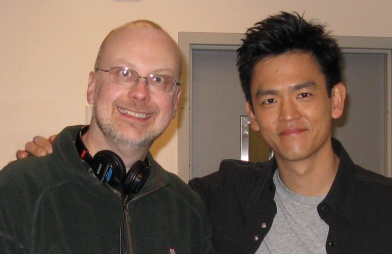
Next comes an August 2009 picture featuring a much-leaner Robert J. Sawyer alongside John Cho, one of the stars of the ABC television series FlashForward (loosely based upon the RJS novel of the same name). Based upon the exchange detailed on Rob's blog, it appears that John would probably remember Rob ... although it might be as the person who obliquely implied that he's a closet homosexual, so who knows if he'd be inclined to pass any message along. Still, it fits my criteria as a potential route to contact the President (although at this point, some of you dear readers may be confused as to how).
Also, Rob appeared in the pilot episode of FlashForward, in which Cho was a main character, which means that from this point forward we can proceed loosely under the rules of the "6 Degrees of Separation of Kevin Bacon" ... I'll just need to bring my camcorder next time I meet up with Rob at a convention! (Cho & Sawyer were not in a scene together, however, which means that my more strict rules for "6 Degrees of Separation," which necessitates that characters not just be in the same television show or film, but also be in the same scene, cannot be applied.)

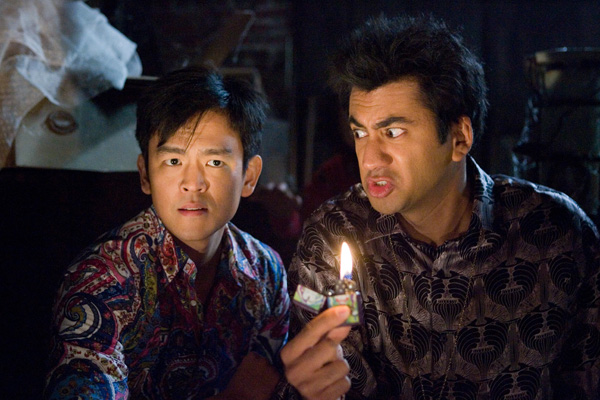
John Cho is known for things other than FlashForward, of course. He first came to prominence as the guy who, in the original American Pie film, defined the term "MILF" for an unfamiliar public. (Kids, if you don't know already, ask your mom. Please videotape her reaction for me.) His most popular role, though, is as Harold Lee in the buddy-stoner films Harold & Kumar Go to White Castle and Harold & Kumar Escape from Guantanamo Bay, alongside the Indian actor Kal Penn. (The image below is from the Guantanamo Bay installment of the saga.)
Kal Penn followed up Harold & Kumar by taking on the role of Lawrence Kutner on Fox's medical drama series House, M.D. ... which he left in early 2009 to join the staff of the Obama White House as associate director of the White House Office of Public Engagement, as an Indian-American community liason. Here is a picture of him with Barack Obama. (I assume that video of the two of them together at some sort of rally or press release exists, but I haven't been able to find it.)
Unfortunately, as I researched this blog post (yes, I actually research this stuff), I found out that just earlier this month Kal Penn announced that he's leaving his post at the White House to return to Hollywood, apparently for a Christmas-themed Harold & Kumar movie. (Another five after that and they'll surpass the Hope/Crosby "Road to" movies as the classic buddy/adventure/romance/comedy/satirical movies.)

April 2010 has been a particularly interesting month for Penn, since he's also been mugged at gunpoint.

Despite Penn's pending return to Hollywood, given the amount of campaigning he did for the President, Obama is certain to know who he is, so he fits my criteria.

Therefore, the path is: Me -- Robert J. Sawyer -- John Cho -- Kal Penn -- Barack Obama. 

4 degrees of separation! I officially rock!

What's really disturbing is that I'm even slightly more excited that this same chain gets me to Joss Whedon (creator of Buffy the Vampire Slayer, Angel, Firefly/Serenity, and Dollhouse) in just as many steps: 

Me -- Robert J. Sawyer -- John Cho -- Neil Patrick Harris (also in both Harold & Kumar films) -- Joss Whedon (Dr. Horrible's Sing Along Blog)

Ah, the (impotent) power that I now (think I) wield!

Friday, February 19, 2010

It's Official: I Talk Good!

Last month, I gave my first public talk and it went very well. The talk, presented at the Anderson Public Library, was entitled "String Theory for Everyone." Local high schools, as well as Anderson University, promoted the event, and many physics students in both places were offered extra credit for attending. Afterwards I was swarmed with fans wanting pictures with me ... mostly so they had proof for their teachers that they'd showed up.

Still, it was a good learning experience. Among other things, it showed me the places where I need to streamline my PowerPoint presentation before my next talk, on March 12 to the Central Indiana Mensa group.

As a follow-up, though, I asked for a testimonial letter from the library's information services librarian, who helped plan and coordinate the event. As I try to get more and more of these talks lined up, it of course helps to have these sorts of things. So, here's the fine (though somewhat bureaucratically sanitized) letter that I finally received:

The mission of the Anderson Public Library is to inform, connect, engage, and empower its customers. Since quality library programming meets many of the library's goals, APL strives to present its customers with the best possible programs. Your "String Theory for Everyone" presentation included all of the elements the library looks for in a quality program. You dealt with the complicated subject matter in an informative way while patiently allowing our customers to engage you with questions. Furthermore, your commitment to professionalism and excellent communication allowed the library to easily facilitate this program for our customers. On behalf of the Anderson Public Library, I would like to thank you for your efforts toward making this program a success!

This is a very nice addition to my speaking portfolio. I hope to get engagements in the future on a wide range of topics, some of which I already have planned. If any readers of this blog would like to solicit my speaking services for your organization, just contact me directly.

Note: I have many friends who are educators, so before I get frustrated e-mails from my elementary school grammar teacher, I'd like to state that I am aware that the title of this blog post is grammatically incorrect. It was done intentionally for entertainment effect. Grammarian, calm thyself.

Sunday, February 14, 2010

Avatar - First Thoughts

Amber and I finally went to see Avatar today (with thanks to Nana for helping out by watching the kids). Honestly, I've heard some mixed reviews about Avatar and wasn't feeling much need to go see it, but I got an opportunity to participate in an Avatar anthology ... assuming I can come up with a worthwhile essay subject. There's certainly a lot of great material here to build upon, so I'm hopeful. Now for my initial thoughts on the film:

First of all, Avatar is a visually stunning film. One of the most impressive that I've ever seen. Perhaps I'm jaded, but I honestly hadn't quite realized how impressive it would really be, even after seeing the promos. I thought, "I've seen cool special effects before. How much better could this be?" Well, I was wrong. It's frickin' awesome! I could just sit there and stare at the images for hours, especially the night scenes, set in a fluorescent forest. Very cool. It's so good that I would pay to go see this again ... but this time in 3-D at IMAX.

The characterization, on the other hand, had issues. Especially the major villain, the Colonel. He was a total caricature of the insane military commander who wants to decimate his enemy at any cost, even if that enemy isn't doing anything wrong. Most soldiers I know would balk at being ordered to decimate an innocent village for economic reasons, but I get what happened. Cameron was going for a mythic story, and in myths evil is clearly evil. Okay, I get it.

But the problem is that it would have been a far more compelling story if he'd gone another way with it. After all, the Earth is dying, and the material on Pandora could help. Instead of making the Colonel a bloodthirsty stooge for corporate interests, he could have been portrayed as a noble hero seeking to save his own dying race, but put in the unfortunate position of having to make tough decisions to reach that goal. The film could have made us, for just a moment, consider that maybe the Colonel's side is the one we should be on.

Joss Whedon made this sort of point in the DVD commentary on season one of Dollhouse, in reference to the episode "The Man on the Street." And I paraphrase: "When you have a situation where two people that you completely agree with disagree with each other, that's good television."

It would not have taken much work to make us believe that the Colonel's motivations were noble, even if those noble motivations led him to order an attack on the innocent Na'vi. Instead, though, he was eager to attack the Na'vi, considering them barely even human.

Are there people like the Colonel out there, in every military? Sure, there probably are ... but they don't make for an interesting story. Making the villain into a cardboard cut-out doesn't make the nine foot tall blue aliens look more realistic by comparison. Because of the extreme nature of science fiction, it's even more important that the characters behave in realistic and believable ways.

I'm sure I'll have more thoughts in the weeks to come, and hopefully they'll cohere into an interesting essay topic ... but for now, those are my thoughts on the matter, for what they're worth.

Friday, February 05, 2010

Silence of the Baby Chicks

As any parent can tell you, parenthood is an endless source of fascinating experiences which eclipse any experience that comes before children entered your life. Even the mundane act of watching a documentary can turn into a harrowing period of emotional turmoil, as I found out a couple of days ago while watching Food, Inc., about the industrial food system in the United States ... which ended with my son in my arms, in tears, and me turning the film off in the hopes that I'd have the time to finish it soon.

Food, Inc., is a candid look at the industrial food growing and processing institutions. The film begins with a general overview of the situation, and one of the scenes depicted is of hundreds, possibly thousands, of baby chicks being placed on conveyor belts. Some of them reach the end of a conveyor belt and fall off into boxes. The next clip shows workers in this factory (I don't know what else to call it) grabbing the chicks, with gloves covered in some sort of inky substance, and pushing them onto a device which looks, from what I can tell, like they're basically stapling the chicks' necks. I assume it's some sort of tagging or stamping system. It wasn't really clear, and the dialogue to which this backdrop took place wasn't specifically addressing the plight of these chicks.

My son was on the couch with my wife, while I was working on the computer. Finally, about five or ten minutes later, as they're showing the slaughtering of a cow, my wife decides we can't watch this while Elijah's still up. He's not actually watching this part, because he's laying on the couch with a blanket over his head, but it's still too graphic, in case he whips the blanket off of his head. I turn the television off, then come over to take him to bed ... only to remove the blanket and find that his face is red and covered in tears. (You know it's bad when he cries inaudibly, because it means he's not seeking attention.)

"What's the matter?" ask I, assuming he saw the butchering. "Did you see something scary?" He looked back up at me with big, wide, bleary eyes and said:

"I don't want them to hurt the baby chicks! Why do they have to be mean to them?"

He then reaches out to me, grasping for some sort of logic to a universe that has horribly betrayed him, but instead finding only my neck around which to wrap his arms.

I lift him up, but have no idea what to say. "You know those chicken nuggets you love so much? Well, sorry to tell you this, but ..." No, that wouldn't help things. As a parent, I have realized a truth which I never grasped in my younger days, and one which, as an intellectual, I still sometimes struggle with:

Sometimes knowledge isn't helpful. Sometimes ignorance is bliss.

Still, in short order, he stopped crying forgot about it ... but I didn't. I never will.

In many ways, Elijah is very sheltered. I expose him to a lot of ideas, a lot of books and subjects, but try to control the ways that he's exposed. For this reason, he's very innocent, even compared to some other kids his age. He lost a little bit of that innocence in that moment, just as when he saw a cat run into the street and get hit by a truck, or when he realized that he could hurt his mother and I by screaming "I don't love you" when we send him to his room.

It's necessary for children to lose their innocence, of course ... but it's a tragic necessity. I grieve each time it happens, as he travels the long and painful road from a boy into a man.  The son I held in my arms a few days ago will go away, and he will be replace by a son who does not cry for the baby chicks. He may well be appalled by seeing them handled this way, and wish for more humane (and healthier) treatment, as I do ... but he won't cry for them.

But now, every time I see a baby chick, I'll likely think of this experience, and I will weep inside. Not for the chick, but for him, for my son, and his lost innocence.

Recommended books on healthy eating,
hypereating, the food industry, and so on:

Saturday, January 30, 2010

Up: Pixar does it again, and not just for kids

The Pixar film Up is now out on DVD, and it's a thrill ride, with a lot of great story for young and old. In addition to the quality of the film (more on this below), the DVD includes a number of extra features - including Pixar shorts "Partly Cloudy" and "Dug's Special Mission" - which I haven't had time to fully watch yet, but I saw the movie in the theater back when it came out and have seen it once again since it came out on DVD. Really a great film! I wrote the following review of the feature film for Amazon (rate the review here):
From the beginning, Pixar has made films based on premises that I thought were going to be bad. A film about toys? A film about bugs? A film about fish? A film about talking cars? A film about a cooking rat? Yet, time and again, they've not only made the premise work, they've made it exceptional. (Actually, I didn't personally like the cooking rat film, but my point still stands.)

So by the time that I saw a preview for Up, I knew not to dismiss their weird premises. A film about a house flying because it's tied to a bunch of balloons? Eh, they've done weirder.
What I was not expecting, but should have, was that this flying house would provide the backdrop for a deeply poignant film about overcoming grief and embracing life. While all the films carry important thematic elements, I'd say that this is the first of the Pixar movies that adults can actually appreciate more for the adult themes than kids will appreciate for the fun parts. Don't get me wrong, there is plenty of fun stuff for kids ... but the story is something you have to be a little bit older to really grasp.

From the first few minutes, where we see a montage of Carl Fredrickson's (played by Ed Asner) life, adults especially connect to him in a very personal way, because it's clear that he's led a rich, full life ... but also that many unanticipated, tragic things have happened to him. He is now an old man, a widower, and about to lose everything. So, in reaction, he decides to go on a final adventure ... and take his house along with him.

The adventure, though, is really the old adventure he (and his wife) had always longed for but never achieved. It was not intended as an affirmation of his life, but a conclusion to it. It was not about boldly stepping into the future, but about connecting to his past. And, through the course of the film, Carl realizes that life isn't over until it's over.

It's a powerful message, woven into a film which kids will appreciate for the cute chubby Wilderness Explorer Russell, the talking dogs (some of whom fly airplanes), and the big crazy colorful bird. But someday, when they're much older, they'll realize that they had very different adventures from the ones they once dreamed of ... but that doesn't make them any less valuable.  If anything, it makes them more valuable. And maybe they'll think of Up, and realize there was a lot they missed in that film.

Wednesday, January 27, 2010

Boskone Panel Schedule

I've received a preliminary schedule for my events at Boskone, the Boston science fiction convention of NESFA.  Boskone runs from Febrary 12 through February 14. I'll be taking part in a number of science-related panels. There could still be some changes before the actual event, but here's what I'm scheduled for as of this moment:
  • Friday, Feb. 12 - 7:00 pm - Autographing
  • Friday, Feb. 12 - 9:00 pm - The Place of Prediction in SF and Reality
  • Sunday, Feb. 14 - 11:00 am - Bad Science on TV
  • Sunday, Feb. 14 - 1:00 pm - Time Travel in Science and Science Fiction
I've got some great co-panelists, including Karl Schroeder, Allen Steele, & Vernor Vinge, so I'm really looking forward to it.

Sunday, January 24, 2010

Exodus 6 - 40

Ever slowly, I'm progressing through the reading of the Bible, from Genesis through Revelations. Exodus has been some slow, depressing reading, but here are my thoughts on it:
  • Puppet Pharaoh: Repeatedly, Exodus explicitly says that God is responsible for the hardening of Pharaoh's heart (Exodus 7:3, 10:20, 10:27, 11:10). In Exodus 11:9, God says "Pharaoh will not listen to you, in order that my wonders may be multiplied in the land of Egypt."  God isn't just professing that Pharaoh is a jerk and will harden his own heart ... it's very clear that God is the cause of the hardening. This really paints God, not Pharaoh, as the bad guy in this tale. After every single plague, practically, it seems as if Pharaoh is about to relent ... and then his "heart hardens" or he "hardens his heart" ... but if God is really the reason why Pharaoh's heart hardens, then it's really God's fault that the Israelites aren't freed earlier, and it appears to be for the sake of showing off his "wonders." Furthermore, this brings up issues of free will ... rarely do you ever hear about God directly intervening in people's emotional states, but this seems to be a pretty clear cut case of this. Pharaoh is shown as little more than God's puppet in all of this. (This reminds me of the arguments that Judas' betrayal is necessary for the salvation in the New Testament, so Judas is, in an odd way, performing God's work.)
  • The mystery of the resurrected livestock: In Exodus 9, "all the livestock of the Egyptians died" (The Fifth Plague), but then in Exodus 11 (The Tenth Plague) the firstborn all die, including "all the firstborn of the livestock." But the livestock all died already, so how are the firstborn dying again? This brings up another point - one of timing. I can't tell from my read of this what sort of timeframe the plagues are taking place over. The impression is a fairly rapid-fire series of plagues, but I suppose it is feasible that these plagues are spread out over a period of years (although that's certainly less impressive than the more common depictions). Exodus 7:7 says that Moses is 80 and Aaron 83 when they first approach Pharaoh, but I'm not seeing a later age stated that would give us a timeframe. (If I'm just missing it, please let me know where it is.)
  • The firstborn belong to God: in Exodus 13:12, there is an intriguing command - "you shall set apart to the Lord all that first opens the womb. All the firstborn of your livestock that are males shall be the Lord's. But every firstborn donkey you shall redeem with a sheep; if you do not redeem it, you must break its neck. Every firstborn male among your children shall you redeem." In other words, you're supposed to sacrifice a sheep to redeem the firstborn male children. I wonder if anyone (Jewish or Christian) still follows this today.
  • The Red Sea or Sea of Reeds: the Bible account of the crossing of the Red Sea (or, as a footnote indicates, possibly the "Sea of Reeds") is always thrilling. I've heard the Sea of Reeds reference to try to tone down this passage, as if maybe God guided Moses through a marsh or something, but the account is pretty specific that this is dramatic. The water forms walls on the sides of the Israelites and collapses back upon the Egyptians, who are "tossed ... into the sea." There's not really any doubt that the passage is attempting to describe a spectacular miracle ... of course, it may be that this is an exaggeration of the actual events being described, and that the "Sea of Reeds" is the only remnant of the older version of the tale.
  • Jethro's managerial advice: I love Exodus 18, where Moses' father-in-law basically tells him that he's working too hard and needs to learn how to delegate before he burns himself out. Religious leaders should really devote a lot more time to making it clear that there's good, practical advice like this available in the Bible. 
  • The Real Ten Commandments: Well, the traditional Ten Commandments show up in Exodus 20, but they aren't actually called "The Ten Commandments." I did some investigation, and it looks like the name "the Ten Commandments" is actually mentioned in the Bible only later on (Exodus 34:10-28), where Moses makes new tablets after the Golden Calf incident, but that's a slightly different set of commandments. So every time some sanctimonious person wants to put the ten commandments on display in a public location, a smart-ass can try to make sure they're actually wanting to display the right ones. The actual ten commandments are the following, and are more worship-focused than the traditional Ten Commandment list, which are mostly moral laws:

    1. Have/worship no other gods.
    2. Don't make covenants with the people you encounter in the other lands (this is really a refinement of the "no other gods" one, because these other people will lead the Isrealites astray)
    3. Don't cast idols
    4. Keep the festival of unleavened bread (Passover)
    5. The first out of the womb belongs to God. Clean animals should be sacrificed, but unclean animals should be redeemed by the sacrifice of a clean animal. Human firstborn males should also be redeemed through the sacrifice of a clean animal.
    6. No one should appear before God empty-handed.
    7. Keep the sabbath, and observe three festivals per year: "the festival of weeks, the first fruits of wheat harvest, and the festival of ingathering at the turn of the year. Three times in the year all your males shall appear before the Lord God, the God of Israel."
    8. Do not offer the blood of sacrifices with leaven, and don't leave the Passover sacrifice out overnight.
    9. The best of the first fruits of your ground you shall bring to the house of the Lord
    10. You shall not boil a kid in its mother's milk
  • Laws and more laws: Yikes, this is a tedious section of the book, and I have the feeling it's going to keep going for several books. How to build an altar, a temple, the ark of the covenant. Can't wait until I'm through "the books of the law." 
  • Hatin' on witches: Exodus 22:18 says "You shall not permit a female sorcerer to live." ... but male sorcerers are okay? Odd.
  • Two tablets: In Exodus 31: 18, Moses is given two tablets which include "the covenant" ... but the details of this covenant took over 10 pages to describe in the Bible. God must have some crazy economical shorthand system to fit all of this on the tablets.
  • The Golden Calf: I knew that Moses' brother Aaron was part of the Golden Calf story, but I didn't realize that it was actually his idea! I'd always assumed that some putzes in the crowd got this going, and Aaron just kind of got dragged along with it, but it turns out that he was the ringleader in gathering the gold and casting the idol. In fact, when Moses comes down to straighten things out, Aaron himself places the blame on everyone else. What a wanker!
  • The Wrath of God: God gets mad over the Golden Calf incident, but Moses is able to talk Him down. This is a common event with the Old Testament God, and God seems to respect those who can talk sense into Him when He gets out of control. (This is actually part of what I most love about my own wife, so I can relate to this, although I rarely declare that "my wrath may burn hot against them and I may consume them" ... although sometimes I am close." - Exodus 32:10) "And the Lord changed his mind about the disaster that he planned to bring on his people." (Exodus 32:14) Still, despite Moses apparently convincing Him not to just "consume them" and then ordering the execution of 3,000 of the Israelites, God still feels the need that "Whoever has sinned against me I will blog out of my book" (Exodus 32:33) and he sends a plague (Exodus 32:35). Guess he changed his mind again.
  • The Wrath of Moses: In Exodus 32:20, after breaking the tablets, Moses "took the [golden] calf they had made, burned it with fire, ground it to powder, scattered it on the water, and made the Isrealites drink it." Then he begins berating Aaron and others, finally getting the Levites to kill 3,000 of the Isrealites, before he can get things under control. I'm assuming this isn't chronological, since I presume he'd want to get his people under control before he spends the day grinding the calf into powder and making people drink it (which, presumably, takes a fair amount of time).
  • Repetition again: We are re-introduced to Bezalel and Oholiab, who were introduced in Exodus 31 and then introduced again in Exodus 35. It's hard to see how anyone can read Exodus and believe that  it is not a collection of stories that got edited together. There's no way that a single person wrote this book, unless they had severe ADD and couldn't keep track of what they wrote the day before. Now, I suppose that in fairness, in Exodus 31 God is telling Moses about Bezalel and Oholiab, but in Exodus 35 Moses is telling the Israelites about them ... but it's basically the exact same passage, but told in first person and then in second person. (Bezalel & Oholiab are awesome designers/carpenters, who are placed in charge of building the Tabernacle that God earlier described. They got their crazy mad building skills from God himself, as we are told both times.) Then, after having the lengthy instructions for the Tabernacle from God, we're given the description of its actual building ... which, since they're following the exact steps outlined by God just a few chapters ago, is again repetition.
And that, my friends, is my reading of Exodus ... on to Leviticus.