Showing posts with label religion. Show all posts

Thursday, April 02, 2015

The Religious Beliefs of Corporate Persons


I still think the Catholics should go with this
more-inspiring sigil for the modern age.
Back in 2012, well before it occurred to me that a corporation could be said to have religious beliefs, I commented on the idea of "corporate personhood."  I focused on this idea at length in that post, but recent events have made it worth looking at again.


Indiana RFRA and Corporations

In the 2010 Citizens United decision, the Supreme Court decided that these corporate entities had the ability for unlimited, unregulated political speech, which can also be made behind a mask of secrecy about the funding sources. And in the 2014 Hobby Lobby decision, it was made clear that, at least for "closely-held corporations," they also had religious liberties.

This was recently codified into law in my home state of Indiana, as part of the controversial Indiana state-level version of the Religious Freedom Restoration Act, which resulted in widespread concerns about discrimination of LGBT members. I happen to agree that the original wording of the law would have given some additional support for this sort of discrimination (which is already legal in Indiana, actually, due to no anti-discrimination protections for LGBT groups).

In comparing the Indiana and federal RFRA statutes, one difference that stands out is Section 7.3. In this section it seems that the Indiana law specifically sets very broad definitions of what sorts of organizations/institutions may make claims of having religious freedoms burdened, broader than the "closely-held corporation" rule from the Hobby Lobby decision:
(3) A partnership, a limited liability company, a corporation, a company, a firm, a society, a joint-stock company, an unincorporated association, or another entity that:
(A) may sue and be sued; and 
(B) exercises practices that are compelled or limited by a system of religious belief held by: 
(i) an individual; or 
(ii) the individuals; 
who have control and substantial ownership of the entity, regardless of whether the entity is organized and operated for profit or nonprofit purposes.
The question this leaves open is whether courts interpret the above wording as applying only to closely-held corporations, as the Supreme Court ruled for the federal RFRA under the Hobby Lobby case. Nothing in the wording above indicates to me any such limitation as being an inherent part of the law, so I think corporations can at least argue that the limitation doesn't apply. If a publicly-traded entity is owned 51% by people who want to invoke a claim under RFRA, it would seem like it should be allowed under this wording. A non-closely-held corporation that wants to exercise these sorts of religious interests is free to, at least, make the argument that they should be able to under the Indiana RFRA, in a way that they couldn't under the federal RFRA.

This is followed up by the other major difference between this legislation and others, which is Section 9:
Sec. 9. A person whose exercise of religion has been substantially burdened, or is likely to be substantially burdened, by a violation of this chapter may assert the violation or impending violation as a claim or defense regardless of whether the state or any other governmental entity is a party to the proceeding. If the relevant governmental entity is not a party to the proceeding, the governmental entity has an unconditional right to intervene in order to respond to the person’s invocation of this chapter.
It seems that when applying the federal RFRA, there has been dissent within the courts about whether protected religious liberty can be claimed in a private dispute between individuals or not. The clear and unquestioned intended goal of RFRA was to provide defense of religious activity from government regulation, from what I can tell. Its use of the phrase "and obtain appropriate relief against a government" can be interpreted as restricting its claims to those of the government, or of including the government among those relief can be sought from. Different circuits have ruled different ways in this.

The wording of the Indiana law under Section 9 makes it explicitly clear that protections of religious liberty can be invoked in disputes between private individuals ... which, in conjunction with Section 7.3, would seem to mean that corporations can invoke religious liberty defenses in completely private disputes.

Against Corporate Personhood

This attribution is false, but I like the quote
and don't feel like changing the graphic.
Here's how I, as a small business owner of a sole proprietorship that operates without corporate protections and have looked into whether I need those protections, view the way a corporation functions:
A corporation is an entity that is used to perform an act on behalf of an individual or individuals, in a way that isolates the individual from harm. Should an individual attempt to use a corporation to perform an act, retribution strikes the corporation rather than the individual. The corporation may be terminated only by bankruptcy or willful dissolution, but is otherwise immortal. Even if terminated in this way, it may pass its essential essence along to another entity which, in most particulars, may function as essentially identical to the original entity in service of the owner. The person behind the corporation is unharmed, except by the inconvenience of having to create a new entity.
Gamers and fantasy readers will recognize this:
It is a construct of some kind, possibly a necromancer's undead minion, a golem, a wizard's homoculous, or some other kind of summoned/crafted proxy creature. In Shadowrun, it would be Rigger's robotic drone (or a corporation, since they have those in Shadowrun too).
So, essentially, we now have immortal non-human entities with the ability to amass wealth for unlimited political speech and able to invoke religious beliefs in disputes with other people and corporations.

I do not think this is a good outcome.

Because, simply put, corporations are not people.

The corporation does not, as a corporation, possess the ability to have a religious belief or conviction, it can only express the religious beliefs and convictions of the owners. Any claim to religious liberty, and the ability to exercise religious liberty, is only as a second-hand consequence of the rights held by the individual who runs the corporation. Those rights are protected for the individual, and may be protected as expressed through a corporation, but the corporate entity itself does not possess those rights.

There may be many perfectly valid reasons for supporting the broad freedom of corporations to serve as the means of expressing personal liberties held by their owners, but corporate personhood is not among them.

You'll hear all kind of people quoting nonsense about how corporations are people, but this diminishes the richness and complexity of what it means to be a person. It is offensive in every way, and as a rhetorical tool needs to end.

Thursday, September 11, 2014

Religion, ISIS, Atheist Hypocrisy, Confirmation Bias, and Tribalism

"Symbols of Religions".
Licensed under Creative Commons
Attribution-Share Alike 3.0 via Wikimedia Commons
Several recent atheist commentators have rightly condemned ISIS, citing it as an example of religion gone horribly wrong. But then they go further, using the example of ISIS to condemn religion as a whole. Is this a valid move? If not, then why not? And what clues, if any, does the activity of ISIS give us about religion as a whole?


Atheists Condemning Religion via ISIS

The theologian Randal Rauser has one of a handful of Christian blogs that I find quite fascinating and worth following, if only irregularly. I haven't been following it long and though he seems to focus a bit more attention on apologetic-style arguments than I tend to appreciate, he does so in a clever and fair manner, with pleas for nuance that are often missing from most others of that ilk.

Rauser recently posted a brief article called "If we all reasoned like the atheist ideologue" which made an excellent point, but I think did so in an incredibly unilluminating way. In it, Rauser attacks the notion that ISIS's mere existence is an example of problems caused by religion:
In the last few weeks the internet has seen a flurry of armchair analysis by atheistic ideologues offering their ruminations on ISIS. Desperately short in their understanding of the geopolitical, social, cultural and historical factors at play in the Middle East, they sashay into the hornet’s nest and opine that the problem is “religion”.
Rauser doesn't link directly to any such commentary, but here's one that I saw on Lawrence Krauss' Facebook feed that I think fits the bill.
"ISIS is a barbaric reminder: no such thing as a religion of peace, certainly not in Islam today nor Judaism and Christianity throughout history." (link)
Now, I am a fan of Lawrence Krauss - in both the Facebook and more general sense. I've read (and reviewed) his books for years. I interviewed Lawrence Krauss last spring, at a showing of his film The Unbelievers, and got my first edition of The Physics of Star Trek autographed. But, as Krauss himself often points out, there are no authorities in science, only experts ... and as such I am not in any sense obligated to agree with everything he says.

So I absolutely disagree with Krauss's point that there is "no such thing as a religion of peace." First of all, it's not true as a stand-alone statement, because many examples of peaceful religions can be found (and warlike non-religious teachings).

But even in the context of ISIS - a group of people that clearly hold to a barbaric, non-peaceful religious viewpoint - the line between evidence and conclusion is tenuous here. The barbarity of ISIS is so extreme that it actually serves to highlight how benign most Islamic interpretations are. Pointing at a clearly-aberrant example as if it were normative is not something you can do!

It is this second issue that Rauser focuses on (again, in general ... he doesn't specifically cite the Krauss comment):
What if we all adopted this degree of inane, ideologically driven analysis? What would the world look like?
For starters, if a woman cut you off in traffic, you wouldn’t blame her. Instead, you would conclude that women shouldn’t drive cars, period.
And if your neighbor’s boy damaged your flower garden while attempting to earn a skateboarding badge for Boy Scouts, you’d conclude that youth organizations should be abolished.
And if your son twisted his ankle doing track and field, you’d cast a pall on all youth sporting events.
And if you had a bad dinner at the local Chinese restaurant, you’d eschew all Chinese (or better yet, all “ethnic”) food.
This is the degree of absurdity we are dealing with when folks with little-to-no understanding of ISIS and the complex geopolitical, social, cultural and historical factors at play in Syria and Iraq offer their absurdly crass analysis that the problem is intimately related to “religion”.
I have two main points about Rauser's attack.

  1. His examples are incorrect.
  2. He doesn't explain the actual problem (which is far worse, I think, than mere crassness).

The examples all show a case where a single piece of evidence leads to an extreme general conclusion. This is known as the hasty generalization fallacy, and Rauser is right that it would be a real problem ... if that were the actual fallacy being committed in these cases.

But it's not. How do we know? Because Rauser has himself identified these people as "atheist ideologues," which suggests that these are established people who have already concluded that atheism is the proper way of viewing the world and religion is problematic. They may have committed the hasty generalization fallacy at some point in the past, but having read several books by these people, it's clear that it's not nearly as hasty as Rauser's examples suggest. They didn't look at one piece of evidence against religion and arrive at a generalization that religion was a problem. Rauser just wrote a 15-part review of a biography of a man who abandoned religion for atheism, so he presumably knows there's more than one piece of evidence at work here, which means this is easily classified as a straw man fallacy.

But there is a serious problem here, although it's not actually a logical fallacy per se, so much as a methodological fallacy. It is, in my opinion, one of the worst cognitive errors that we have to deal with in our search for a better understanding of the world: Confirmation Bias.


Confirmation Bias and Religion

Confirmation bias is the tendency to give more weight or significance to results or evidence that confirm an already-established opinion than we do to evidence that contradicts that opinion.

In this case, the error that the atheists are making in pointing to ISIS is that they are being very selective in the evidence they look at. Again, go back to the Krauss quote. He points to ISIS as a barbaric reminder that there is no religion of piece, but in doing so clearly ignores the many pieces of evidence that suggest religions are peaceful. You don't even have to leave Islam to find far more peaceful Muslims - and Muslims who say that their peaceful acts are motivated by their religious faith - than Muslims who are driven by hate toward violence.

And, as a scientist, Krauss certainly knows about confirmation bias. One of the major goals of the scientific enterprise is to minimize it. And he pretty much mocked poor confirmation bias on the religious side, quite deftly, here.

This is the real irony of Rauser's attack, for me, because confirmation bias is for me the largest problem with religion.
My issue with religion is not a fundamental rejection of mystical or supernatural influences, but rather that religion adopts a methodology in which confirmation bias is not only allowed, but encouraged.
My strongest evidence for this view comes in the central role of testimony in religious life. Outside of intellectual circles, religion is largely affirmed, in day-to-day worship, by anecdotal testimonies to the role of God in one's life. As someone who has spent most of his life on the outside of religion, I cannot tell you the number of times someone has tried to explain to me how God has actively transformed their life. They were an alcoholic or an abusive husband and then they got right with God, and they felt a transformation come over them, and this is proof of God's existence.

I attended an evangelical church for a time that was particularly intriguing in this regard, with relatively common testimonies from the congregation. For some context: the minister of this church had once been a construction worker, fell off the fifth story of a building, landed face-first on cement, and despite being so bad that doctors assumed he would die, he somehow walked out of the hospital about a week later. And, during his convalescence, he had a vision of Jesus. So it's absolutely understandable that this particular church put a lot of faith in testimony. (To date, I have no reason in particular to doubt the man's claims about the series of events. Nor, though I don't agree with his explanation, can I particularly fault him for attributing miraculous significance to them.)

Testimonies from others were far less impressive, but still moving and significant. They were stories about how turning to Christianity and handing their life over to God made real differences in their lives. At one point, a man talked about how God had cured him of diabetes and helped him stop smoking. At another point, around Christmas time, a woman talked about how money was tight and she was going to have to avoid paying important bills so she could get clothes and gifts for her children. At the register, however, the scanner had some sort of malfunction, and the clothes came up much lower than expected. I don't remember the particulars, but I think the clothes came up for a few cents apiece, and the woman ended up saving over a hundred dollars all told.

If you stripped away all testimony of this kind from all religions, it's not clear to me that much religion would be left. There might be some logical arguments that would have impressed Aristotle fans, but religions wouldn't be living, breathing entities that influence lives directly in this world.

But every single one of the testimony examples above is a glaring case of confirmation bias. If you were to sit down and think, "How could I discern the real truth of religious experiences?" then you could hardly construct a worse methodology of doing it than asking people of faith when something good happened in their life that they felt was attributed to God. (I encourage you to try, in the comments section.)

The difference, of course, is that religious people do not, by and large, know about confirmation bias. As such, they can absolutely be forgiven for not taking steps to avoid it. Atheists, on the other hand - particularly active secularists, skeptics, religious critics, and "atheist ideologues" - absolutely know about confirmation bias. Using ISIS as a bludgeon to confirm your views without proper respect for the counter-argument is, either consciously or not, absolute hypocrisy.


What Can Be Said About Religion and ISIS?

It is perfectly valid, however, to point at ISIS as an example of how religion can lead someone to do horrible things. In a recent interview, even the Muslim moderate Reza Aslan admits that this is a logically valid interpretation of Islam (though not one that he agrees with).

But if an atheist is going to attack religion, they need to be sure that they are placing ISIS within a much broader context of why religions produce these sorts of negative outcomes. This is hard to do in a tweet or a Facebook status update, of course, or even in a blog post. As Rauser points out: the various non-religious factors leading to ISIS' rise are very complex.

One person who I think has a firm grasp of this nuance, though isn't always necessarily the best at getting it across, is the atheist Sam Harris. His post today, "Sleepwalking Toward Armageddon," is characteristic of his balance of respect for Islamic people together with disdain for the dogmatic extremism that he feels comes from religion:
Which will come first, flying cars and vacations to Mars, or a simple acknowledgment that beliefs guide behavior and that certain religious ideas—jihad, martyrdom, blasphemy, apostasy—reliably lead to oppression and murder? It may be true that no faith teaches people to massacre innocents exactly—but innocence, as the President surely knows, is in the eye of the beholder. Are apostates “innocent”? Blasphemers? Polytheists? Islam has the answer, and the answer is “no.” 
[...] I would not want to create the impression that most Muslims support ISIS, nor would I want to give any shelter or inspiration to the hatred of Muslims as people. In drawing a connection between the doctrine of Islam and jihadist violence, I am talking about ideas and their consequences, not about 1.5 billion nominal Muslims, many of whom do not take their religion very seriously.
Then he launches into what I think is the absolutely proper point about religion that atheists should be making, if they are inclined to draw a larger point out of ISIS:
Religion produces a perverse solidarity that we must find some way to undercut. It causes in-group loyalty and out-group hostility, even when members of one’s own group are behaving like psychopaths.
Generally speaking, I think it's safe to say that religion is one of the most persistently tribal elements of our modern world. Although religious teachings that encourage conflict don't help, my view (and, to some degree, apparently Harris') is that it is really the particular group affiliation, and self-identification that so often comes with it, that create the strife we want to avoid.

Indeed, Rauser himself seems to recognize that this is the problem. When returning to deal with criticism that religion can exacerbate conflict, he points out that so can patriotism. But isn't that precisely because patriotism often, like many religious teachings, exacerbate the "in-group loyalty and out-group hostility" that Harris is specifically condemning?

Look at the standard array of non-religious atrocities from the 20th century, which theists are so fond of justly rolling out to prove that religion isn't the sole source of atrocities: Stalin, Pol Pot, Mao, forced eugenics, social darwinism. (They sometimes throw Hitler in there, but calling Hitler non-religious is a bit of a fudge.) Aren't all of these means of creating and enforcing tribalist structures? Throw in a healthy dose of authoritarianism, and you've got a recipe for disaster, even without adding supernatural religious beliefs and heavenly rewards to the mix.

My instinct is to side with Harris' statement a bit, though, that religion tends to exacerbate this situation. When your "in-group" includes God and the "out-group" rejects God, how could it do anything but exacerbate the situation? Certainly, I personally know of no individuals who want full-scale war in the Middle East more than a handful of fundamentalist evangelical Christian acquaintances who believe that it is both inevitable and will usher in the return of Jesus.

But then again, that might be confirmation bias, so I will hold off rather than make a hasty generalization fallacy.

Thursday, February 20, 2014

Why Plantinga Needs a Math Lesson on Materialism

In a recent The New York Times interview, philosopher of religion Alvin Plantinga goes through an involved discussion about how evolution doesn't guarantee that our beliefs are true. This is absolutely a valid concern ... and, in fact, I know of no atheist who doesn't recognize the fallibility of our inherent beliefs and thought processes. In fact, some of the strongest arguments in favor of a rejection of theism is based on the psychological account of why people embrace theism. This YouTube series on the Psychology of Belief lays it out quite well.


So, we'll grant that we are not granted inherently true knowledge by evolution. His argument is that if you believe in both materialism (that is the viewpoint that there exists nothing that doesn't have a physical basis) and evolution, then you have to admit that you have no good reason for believing that any belief you hold is true. There's an extremely extensive dissection of the various flaws over on the Rationally Speaking blog, from Massimo Pigliucci, who has a deeper background in biology and philosophy both than I and quickly dissects the key conceptual problem with the argument.

But I'd like to take a different tactic, to really try to give Plantinga's argument enough rope to hang itself, because I just don't think it holds up on any level on its own merits. The problem is not that Plantinga misunderstands evolution, but rather that he appears to misunderstand how human beings (and materialists in particular) actually think!

Plantinga's Death Knell to Materialism

Let's consider his argument on its own merit, at least to the best of my ability. In his own words:
Evolution will select for belief-producing processes that produce beliefs with adaptive neurophysiological properties, but not for belief-producing processes that produce true beliefs. Given materialism and evolution, any particular belief is as likely to be false as true.

...

Here’s why. If a belief is as likely to be false as to be true, we’d have to say the probability that any particular belief is true is about 50 percent. Now suppose we had a total of 100 independent beliefs (of course, we have many more). Remember that the probability that all of a group of beliefs are true is the multiplication of all their individual probabilities. Even if we set a fairly low bar for reliability — say, that at least two-thirds (67 percent) of our beliefs are true — our overall reliability, given materialism and evolution, is exceedingly low: something like .0004. So if you accept both materialism and evolution, you have good reason to believe that your belief-producing faculties are not reliable.

But to believe that is to fall into a total skepticism, which leaves you with no reason to accept any of your beliefs (including your beliefs in materialism and evolution!). The only sensible course is to give up the claim leading to this conclusion: that both materialism and evolution are true. Maybe you can hold one or the other, but not both.

So if you’re an atheist simply because you accept materialism, maintaining your atheism means you have to give up your belief that evolution is true. Another way to put it: The belief that both materialism and evolution are true is self-refuting. It shoots itself in the foot. Therefore it can’t rationally be held.
The starting point is the valid recognition that evolution results in useful, adaptive traits rather than factually true beliefs. No argument there.

His next step is interesting. He is quite generous in assuming that perhaps 67% of our beliefs are, in fact, true, based on processes that were not optimized for truth-seeking. Using this, he then says if we have 100 beliefs (and we have many more), then we arrive at a very low overall probability of 0.004. The calculation is actually much worse than Plantinga suggests:
0.67100 = 0.0000000000000000405%
That's 16 zeroes between the decimal point and the 4.

Now, what does this number actually mean?
It means that if a single individual has 100 beliefs, then the probability (based upon these parameters) is virtually certain that not all of these beliefs will be true.
(It should be noted that the probability that all of these beliefs are false is much worse ... you then end up with 47 zeroes instead of 16. Plantinga, of course, is not arguing that all beliefs are untrue, even assuming materialism and evolution, so let's get back to his argument.)

But for any individual belief, of course, the probability is much higher: 67% according to Plantinga's estimation.

Random Belief Analysis

So let's make an even less generous estimation. Let's assume that we have an exactly 50/50 split between a given belief being true or untrue.

First, let's note that, regardless of your worldview, it's kind of unlikely and troubling to evolution, human reason, or the very concept of truth to assume that there is an absolute lack of correlation between adaptive beliefs and truth. Even a religious fundamentalist would, I think, admit that believing a true thing is going to, on average, be more adaptive than believing a false thing. So this is by far an assumption that gives Plantinga's argument the widest berth that it possibly can to prove its validity.

Second, let's then consider how one can actually approach this problem of having false beliefs. Let's make some initial assumptions that we can start from:

Round One Assumptions:
  • 50% of beliefs are true
  • 50% of beliefs are false
  • Random designation (no systemic biases in favor of or against truth)
A good first-order approach in this case is to check with other people. So we ask someone else, "Do you have this belief?" If they share this belief, there's now a 50% chance that you both have a true belief and a 50% chance that you have a false belief. And, in fact, you'll find in this situation that no amount of checking with other people will ever move the needle from a 50% probability.

Out of curiosity, what happens with Plantinga's model if we begin checking our beliefs with other people. There's a 33% chance that any given person is wrong, so if you check with 5 people, the probability that all 5 would find the same random belief to be wrong would reach the following:
Using Plantinga's model, there is a 0.391% chance that 5 people would hold the same false belief.
So, on this basis, we do see that some sort of internal cognitive bias would quickly multiply in a community to a growing factual consensus, based purely on the sort of crude mathematical argument that Plantinga offers.

But consensus by itself is not really how we check our beliefs, even at the most basic level. We check them against reality. Let's assume though that, since we're so bad at thinking in this scenario, that we are horrible at these checks. There is only a 1% chance that testing any given belief will accurately show a false belief to be false. (Ignoring any possible positive results for now, to make the math easier and also because it's easier to disprove something than to prove it.)

Again, I should note that there is also every reason to believe that this level of instinct is biologically ingrained in us through the process of evolution ... and, honestly, that it's ingrained in most animals on some level. An animal that cannot trust any "beliefs" about the world world with more than random correlation with reality would find themselves falling prey to all manner of natural selection effects. So this most basic level of analysis doesn't take much in the way of assumption beyond what we've already assumed to think that it would be implemented as a way of finding truth and falsehood.

So we implement this method. What happens then?

What we discover is that, if you check a given belief against reality a mere 10 times, and this process shows it to be false every time, then even this admittedly horrible method of distinguishing truth from falsehood results in the following:
Probability a False Belief will Survive Round One: 0.5 * (0.99)10 = 45%
And, of course, if you begin checking with other people who are also checking these beliefs in the same way, you reach the following:
Probability a False Belief will Survive Round One in a Community of 5 Checking Against Reality: 0.455 = 1.8%
So in a community of 5 people, all of whom check a false belief against reality with a 1% accuracy, there is a 1.8% chance that the false belief would pass all of these checks and look equivalent to a true belief.

Congratulations. The neurologically challenged human race has developed some method of distinguishing true beliefs from false ones. On to round two...

Round Two Assumptions:
  • 95% of beliefs are randomly assigned 50/50 between true/false
  • 5% of beliefs are biased as follow:
    • 10% are true things that we don't believe (false negatives)
    • 30% are false things we do believe (false positives)
    • 60% are true beliefs
We now move on to considering what happens if we give some credit to evolution to create even marginally reliable belief-forming pathways. Our first round analysis gives us a starting point and, again, I'll give the benefit of the doubt that we're a bit more flawed in our neuropsychology than we really have any excuse for being.

Let's again go with just checking with other people and see what we get:
Probability of Given Belief Being True: 0.95 * 0.5 + 0.05 * 0.6 = 50.5% 
Probability of 5 People Randomly Believing the Same False Thing: 0.4955 = 3%
We see that even in this rudimentary situation, there is a strong reason to go with the community consensus from a truth-generating point of view. The randomness and biases tend to get weeded out, even at this level.

Now that we have some cognitive neurology that actually works, we can assume that we're able to develop a plan for testing against reality that does a bit better than 1% at disproving a false belief. Let's assume that it is 10% effective at showing a false belief to be false. What do we then get when we conduct another 10 tests using our improved methodology?
Probability a False Belief will Survive Round Two: 0.495 * (0.90)10 = 17%
Probability a False Belief will Survive Round Two in a Community of 5 Checking Against Reality: 0.175 = 0.014%
Ideally, we will respond rationally to the above evidence and stop believing these false beliefs. We are able to eliminate 83% of our initial false beliefs! We don't have to replace them with true beliefs, either, if we're okay with uncertainty. (Replacing them with true beliefs would favor the anti-Platinga argument, so this is again giving him the benefit of the doubt.) The result is the following:
Probability of a Given Belief Being True after Round Two (individual testing): 85.7% 
Probability of a Given Belief Being True after Round Two (group testing): 99.98%
I really don't need to go much further, I don't think, to show that the process of checking a belief against physical reality - the very belief that atheists actually demand as a methodological step for knowing anything! - does work at generating true beliefs, even granting it virtually every concession that we can realistically grant.

Conclusion

Plantinga's criticism of materialism/evolution just does not hold up. Recall that he gave an example of 100 beliefs and the probability it would take for them all to be true. Let's compare this to the results from Round Two's extremely crude falsification methods:
Probability 100 random beliefs True using Plantinga's assumptions (individual):
0.0000000000000000405% 
Probability 100 random beliefs True using Plantinga's assumptions (group):
99.8% 
Probability 100 random beliefs True using Round Two falsifiability rules (individual):
0.0000198647083%
Probability 100 random beliefs True using Round Two falsifiability rules (group):
98%
The "group" numbers represent what we get if we eliminate everything that 5 people agree are false, both in Plantinga's evidence-free assumptions and my own evidence-based ones from Round Two.
First of all, we see that testing against the evidence greatly increases the truth percentage of beliefs for an individual, way beyond what Plantinga would give credit for with his original assumptions.

Second, we see that both our overall level of truth greatly increases - in fact become nearly identical for both sets of assumptions - if we work in a group and just begin throwing out anything that we all agree are false beliefs. And this does, in general, match with empirical evidence, because even the most ardent atheist and most devout theist share far more beliefs than they disagree on (though neither might be willing to admit it). (I'll confess, the high value for the Plantinga's group number surprised me. I thought the reliance on evidence would play a more important role in the methodology. However, I did make every assumption overwhelmingly in Plantinga's favor, so I shouldn't be too surprised.)

Third, let me be clear: I think Plantinga is completely flawed in his approach and thinking about how beliefs are formed ... but my point is that even if he were absolutely correct, his argument would not hold up on its own merits. I am not presenting this trying to persuade anyone into materialism because nothing above actually supports materialism in and of itself, it merely supports our ability to gain true beliefs given false beliefs.

Therefore, there is every reason for a materialist evolutionist to, in fact, believe that they have a capacity to trust their beliefs, so long as they rely on evidence and are not trying to acquire knowledge and understanding entirely on their own.

There are extremely real negative neurophysical pathways built into the brain - for entirely adaptive reasons - which can kick in, of course, meaning that a group begins being pathological in its thinking, driving away from true beliefs and toward false ones. See the video posted above. This is precisely the reason to cultivate skepticism, as it helps to short-circuit these cognitive biases.

In conclusion, the materialist is well insulated from concern about Plantinga's criticisms of his rationality and his belief in the evidence for evolution can continue unabated ... at least until some kind of actual evidence to the contrary shows up.

Monday, January 20, 2014

Two Obnoxious People (and Me) on Marriage

© Alexey Bannykh | Dreamstime Stock Photos
A week or so ago, one of my friends on Facebook shared a fascinating blog post on the subject of marriage. It was on the Matt Walsh blog, an unapologetic conservative Christian blog, and involved an exchange on the nature of marriage with an equally unapologetic polygamist college professor.

What's interesting is that (not surprisingly) I disagreed with both of them, but not for the reasons that they seemed to think the other person should be disagreed with. So I'm going to try to sort out my thinking on the disagreements here, publicly, and see if perhaps there are any useful responses.

First, let's be clear: I am a monogamist. But my monogamy is a practical consideration, based on principles that are completely at odds with those Walsh put forth. My earlier discussions of marriage probably make it clear that I don't have particularly conventional views on the institution ... but also make it clear, I think, that I feel maintaining the integrity of that institution should be viewed as important to anyone entering into it. Monogamy helps maintain the commitment at the heart of marriage, so I advocate in favor of monogamy as a means of helping to repeatedly nudge marriage participants in favor of bonding with their partner in place of bonding with other people.

Ultimately, my disagreement is that both the professor and Walsh seem to be taking their personal preconceptions about marriage and, instead of arguing for some sort of general statistically-superior trend, they are both arguing in absolute terms that their preconceptions are always the right ones, which apply (and should apply) to all marriages. The obnoxious professor explicitly calls Walsh out on this perspective ... and then commits precisely the same fallacy.

In conclusion, though, I think it's Walsh's perspective that's the more dangerous. Though he applies it only to sex, there's no reason to stop there, and extending his reasoning makes a person think their partner can give them everything they need: emotionally, physically, sexually, socially, intellectually, etc. No relationship can achieve this ... and in setting up for that, he's doing far more damage to the idea of marriage than someone who thinks that the institution can withstand some open sex.  

Disagreeing with the Professor

Disagreement 1: Authority isn't evidence

First of all, reading the polygamist college professor's introduction, my natural aversion to authority kicked in, and I really wanted to see this guy knocked down a peg or two: 
I am a college professor, author, and researcher. It was obvious to me before you ever stated it that you are a man of little education and limited intelligence. Still, I commend your newfound fame and congratulate you on the enormous amounts of money you must be making. 
[Five more sentences of insults and pretentious self-aggrandizement] 
…You have become a hot topic in some of my classes and this very much worries me. It wasn’t until your name came up for a fifth time that I decided to investigate you. Your prose are rife with fallacies and Neanderthalic musings, so I could easily disembowel and discredit any part of it. But I’d like to concentrate on what seems to be your most common themes: heterocentricism and monogamism.
Now, it's possible that the "five more sentences" deleted are mis-represented here. Perhaps the professor laid out actual credentials that are relevant, such have been a lead researcher on extensive psychological studies in human sexuality, or something like that, and that Matt Walsh has deleted these relevant comments and lied about their content. However, given the tone of the quoted part of the letter, I'm going to assume that this casual dismissal is fairly accurate, especially since the remainder of the letter contains no valid evidence or citations for any of his claims.

In other words, I get every sense that he's written to Walsh merely to express that he - a college professor, author, and researcher - has a different view and that this alone, without sufficient supporting evidence, should be the basis for proving that Walsh is wrong.

Disagreement 2: Unnaturalness = Undesirable

The supporting evidence that is offered by the professor is the anecdotal evidence of his personal relationship with his wife. While this might be sufficient to counter Walsh's stance that other relationships can't work out, it does not actually support the professor's grander claims that monogamy is fundamentally unnatural, nor his implications that it is actually undesirable and somehow detrimental to one's well-being. 

There are problems with this stance on nearly every level. First, one has to ask what is meant by "natural" here. As someone who generally subscribes to both evolutionary theory and materialism, I would say that all human behavior is, in fact, natural behavior, because I believe that all human thought and motivation is the result of natural processes. In this sense saying that something that actually happens is "unnatural" is illogical, because if it happens then it clearly has to be allowed to happen by nature. 

Example: Flying to the moon without a spaceship is "unnatural," because the laws of nature don't allow it; flying to the moon with a spaceship is "natural," because the laws of nature do allow it.

Clearly, this isn't the sense of "natural" that either the professor or Walsh are using. (Walsh specifically uses a spaceship as an example of unnatural-ness.) I think more intuitively in this case, the word "natural" is probably meant as something that happens in nature without conscious intervention from a human being. The problem with this, though, is that unless you're having sex while sleepwalking, the choice of who to have sex with is a conscious choice of a human being, so neither monogamy nor polygamy is natural in this definition.

Still, I think you can move a step further and define natural in this context in this way: "Natural" is something which is done by creatures or processes in the animal kingdoms. Human beings may also do these things. This seems to be the sort of definition where we could actually say that monogamy is "unnatural," but the problem with this is that this form of "unnatural" is not at all related to being undesirable.

Example: Taking a bath with soap is not "natural," either, but I'm rather glad that I live in a society where people do it, and am willing to do so myself as part of the rules in that society.

In fact, I would argue that one major point of society in general (or governments in particular) is to institute social and legal contracts which constrict our "natural" tendencies. (Or, as another Facebook friend recently pointed out, accentuate the aspects of human nature we want to accentuate and inhibit the aspects we want to inhibit.) So attacks against something as being "against nature" isn't sufficient to prohibit a behavior ... which is basically the argument that Walsh lays out.

Monogamy is undesirable only if there is an argument that demonstrates its undesirability, which the professor hasn't in the least presented. (Honestly, he hasn't even really demonstrated its lack of naturalness.)

Disagreement 3: People in Archaic Houses Shouldn't Throw Stones

The professor also throws out a criticism of Walsh's support of "archaic relationship models."

But, the professor's whole point is that polygamous relationship models pre-dated the more recent monogamous relationship models. As such, it seems to me that it is the professor who is advocating for "archaic relationship models. (This was actually the first criticism that occurred to me, but is relatively minor in the grand scheme of things.)

Disagreement 4: Ad hominem attack ... or completely insane generalization?

This next line is just totally uncalled for and undermines the credibility of the rest of the letter (if it actually had any):
... but when you inevitably cheat on your wife ...
Unless the professor is omniscient and we live in a deterministic universe, there's no way he has any basis to make this claim, unless he is claiming that it is somehow physically impossible for Matt Walsh to avoid cheating on his wife. (Having not met Matt Walsh's wife, I don't know if this is a realistic claim.) 

He seems to be saving that monogamy itself does not exist. Not just that there's historical trends the argue against monogamy, or that monogamy isn't the most common form of relationship structure in human history, but rather that it is not possible for anyone to actually live a monogamous life.

Disagreeing with Matt Walsh

All of the above having been said, Walsh's disagreement - while quite rhetorically impressive, and displaying a much more deft intellect than the college professor - has some major flaws of its own ... flaws that are, in their own way, exactly the sort of points which prove some of the professor's points.

Disagreement 1: Static "definition" of marriage

The professor's key point is that, historically, human unions - including marriages - have come in diverse forms. Specifically, Walsh says in his reply:
Marriages, by definition, are supposed to be closed. Actually, I’m getting rather tired of people like you trying to hijack the institution, strip it of its beauty and purpose, and convert it into some shallow little thing that suits your vices.
Here, it seems to me that Walsh is doing exactly the same error that he's accusing the professor of, just shifting by several hundred years. The institution of marriage that Walsh describes is not the institution that is described in, say, the Old Testament. The Old Testament itself prescribes extremely harsh penalties (death, as I recall) for wives who commit adultery on their husbands, but far less significant penalties (if any) on husbands who cheat on their wives, which implies that some forms of "open" relationships were, if not officially sanctioned, then at least less punished in ancient times. Marriage today is not even really the same institution that it was just a few hundred years ago, when wives and children were largely viewed as the property of their husbands, by both most religious institutions and the secular law itself. 

Not having read Walsh in depth, I suppose it's possible that he still subscribes to these views on wives and children, but I'm going to give him the benefit of the doubt and assume that he doesn't believe that wives are the properties of their husbands.

If you accept that ancient polygamy was a legitimate form of marriage, and the husband-as-dominant structure was a legitimate form of marriage, and the husband-and-wife-as-equals structure is a legitimate form of marriage, then you have to concede that, at least in principle, the definition of marriage evolves over time.

Disagreement 2: Yes, Marriage Is Like Geometry

Walsh makes quite a good analogy at the end ... especially if you don't really know geometry:
Personally, I like circles but I hate squares. Can I subvert the laws of geometry and suddenly decide that all squares shall henceforth be circles? No, because geometry is geometry, despite my strange square-hating quirks. Similarly, marriage is marriage, no matter how many college professors insist otherwise.
It is interesting to note that there is another geometry analogy which actually serves the exact opposite point of the one that Walsh lays out. I describe it thusly:
From the time of Euclid to the mid-1800s, it was believed that "geometry is geometry," but then mathematician Frederick Gauss developed non-Euclidean geometry by questioning one of Euclid's basic assumptions. (There were actually several others throughout the centuries who periodically questioned these assumptions, but their voices were ultimately drowned out by those arguing for the status quo.) At the time it was developed, it was seen as purely a mathematical curiosity, an intellectual game, a bit of a quirky mathematical game, with no real-world relevance. When Einstein developed his theory of relativity, however, it turned out that the mathematics of non-Euclidean geometry was crucial to understanding the underlying physical structure of the universe itself.
So, you cannot turn squares into circles but non-Euclidean space allows you to construct perfectly valid squares that do not possess exactly the same properties as squares in Euclidean space. One set of squares isn't "correct" and the other isn't "wrong" ... they're just different squares, and their properties are defined not by pure rationalist considerations, but also by the environment in which those definitions take place. (Note that I didn't say "right" and "wrong," but that's because "right" in mathematics means "90-degree angles" and one set of squares is "right" in that geometric sense.)

Disagreement 3: Assumption that Sex is a Dealbreaker

When I first read this, as a fellow monogamist, the following two comments resonated with me:
I have found a woman who will be with me until I die, even while my hair falls out and my skin shrivels and wrinkles, even when I stumble, even when I fail, even through the doldrums of daily existence, through bills and dirty diapers, through all things — joyous or miserable, pleasing or painful — through every day until death comes. Why should it be hard for me to simply refrain from tossing such a gift into the garbage? 
... 
If you won 600 million dollars in the lottery, would you go out the next day and break into cars to steal the change from the cup holders? That’s what sleeping around is like when you’ve already found a woman who will pledge her life and her entire being to you for the remainder of her existence.
On reflection, though, I realized that there was an incredibly troubling assumption in these examples: they seem to assume that sex is, in and of itself, the most important aspect of marriage.

Look at the first paragraph quoted above, and all of the aspects of the relationship that are being praised. They are all worthy of praise, to be sure, because they are the very things that are valuable about being married. In fact, I would argue that marriage is precisely about being willing to make that sort of commitment to another person.

Why is it that a consensual open sexual relationship would negate all of those things?

I am inclined to agree with Walsh's underlying assumption that retaining this commitment is easier in the context of a monogamous relationship. This is the entire basis of my support for monogamy: if you are going to maintain commitment to someone else, you should limit the bonding behavior performed with other people. I find it extremely likely that sex with other people weakens the bonds of commitment to one's spouse.

Oddly, it occurs to me that it's precisely my naturalism that leads me to believe that monogamy is preferable if we are to maintain the "unnatural" state of marital commitment. We are constructed by nature to bond, at a neurochemical level, with our sexual partners. If we have sexual partners other than our spouse, then we are going to bond with those other people when we could be bonding with our spouse ... and that just has to have a negative impact on the bond, or to create similar bonds with other people.

But that doesn't mean that it's impossible for anyone to have an open relationship and retain this level of commitment into old age, as Walsh seems to suggest. 

The second analogy also breaks down along these lines ... Walsh is assuming that sex outside of marriage is equivalent to betraying the marriage. A better example would be you win 600 million dollars in the lottery, but you really enjoy collecting coins. Previously, you had done this by scrounging for any old coin you can get your hand on, but you now have 600 million dollars, so you can take your time, and only select the coins you really want. You aren't stealing anything, because you have 600 million dollars with which to buy coins. (It's completely okay with the 600 million dollars, and in fact it occasionally buys coins of its own ... okay, I think the analogy has broken down a bit here.)

In essence, Walsh is committing the same error that the professor committed earlier, when he said that Walsh would "inevitably" cheat on his wife. He is taking his preconception of an outcome and assuming that it is a general rule that applies in all cases, but without any hint of evidence that this outcome is, in fact, inevitable.

Disagreement 4: Sex Isn't the Most Important Thing in Marriage

Related to the above disagreement is that this argument seems to only apply to sex, but sex isn't the only thing that married people do, and arguably isn't the most important. As I mentioned above, I think that all of Walsh's other points about the things we do in marriage are far more significant in marriage:
I have found a woman who will be with me until I die, even while my hair falls out and my skin shrivels and wrinkles, even when I stumble, even when I fail, even through the doldrums of daily existence, through bills and dirty diapers, through all things — joyous or miserable, pleasing or painful — through every day until death comes.
If you have all of those but only skimp on the monogamy part (consensually), I'm personally willing to put that relationship into the "marriage" bucket without qualms.

Despite the wonderful commitments listed above, think about how "open" we make even those key commitments. If I grow old and stumble, there's absolutely no expectation that my wife is the only person I'm allowed to have help me. If I end up incontinent, having dirty diapers that need changing, then not only would it be permissible for my wife to seek help, she wouldn't even be expected to stay within the family. In fact, rather than asking my sons to help maintain my deteriorating body, it would be perfectly socially acceptable for her to hire a complete stranger to do so, in the form of a home health care nurse, if we had the means to do so!

Or even back off from something that severe. By marrying my wife, I am committing to her as one of my closest friends and confidants throughout the rest of my life. However, by doing this, I am most certainly not placing the expectation or responsibility that she can meet every single need I have in friendship throughout my life. If she were my only friend, most psychologically healthy people would recognize this as a big problem, and suggest that I needed other friends to fill other social roles. It's just unrealistic for anyone to think that their spouse can and will be everything to them as a friend.

If you're having financial trouble within the marriage, it's acceptable to get financial help or go to an accountant, and not to necessarily expect that you and your spouse are qualified to make these plans without input. (And lest this be dismissed as a trivial analogy, keep in mind that financial decisions are extremely personal ones, both Biblically and pragmatically.)

If you dance, then presumably you'll most frequently dance with your spouse, but it's considered socially acceptable to occasionally dance with other people. In fact, if one of you don't enjoy dancing, then the other person might spend most of their dancing time with other people.

Again, all of the above things are ideally something that will be primarily, if not exclusively, handled between spouses ... but if a pair of spouses don't like the same music, and dance with other partners, or if a spouse hires a nurse to help during a time of health problems, then I know of no one who would argue that they're "tossing such a gift in the garbage." 

In fact, I am genuinely curious: Is there any component of marriage (other than sex) where it's considered absolutely inappropriate to involve people outside of the marriage to help with lack of full satisfaction within the marriage?

I cannot think of any.

Disagreement 5: Walsh's View of Marriage is Mythical ... and Dangerous

The culmination, then, is with a point that Walsh even partially concedes. His perspective on marriage is supernatural. It is unrealistic. It is, to use the professor's words, mythical.
And it is dangerous.

It's dangerous because the single biggest danger for marriage is the over-idealization of the institution. People today enter into marriage with the bizarre notion that they will be completely fulfilled by the other person. 

It seems to me that this has not been the case historically. The rise of "romantic love" as a common motivation for marriage is a fairly recent invention within Western society, and love used to be far more pragmatic in its concerns. There was nothing particularly "beautiful" about young women being sold off to old men for political alliances, which has a far older pedigree than romantic love. And, honestly, the rise of "romantic love" probably had much to do with the works of playwrites such as Shakespeare than it did any legal or religious institutions. The concept of "soulmates" was largely created by Plato, but it didn't take hold in the belief system of the ancient world for quite a long time. Historically, people knew that marriage was hard work. They didn't expect everything to work out once they found the "right person."

I don't know that Walsh himself has this over-idealized view of marriage, but his argument in favor of marriage seems to lean heavily upon this worldview. Find the right person, commit to them, and everything will work out ... without needing to look outside of that relationship for anything.

Walsh applies this argument only to sex, but if you accept it, then there's no reason why it shouldn't apply to all of the other intensely personal needs we have in our life and expect our spouse to primarily fulfill. There's no reason why you shouldn't assume that your partner can fulfill every need you have, or else that if they can't (or won't) fulfill them, then you're supposed to just go without that need being fulfilled.

That is a view of marriage that's fundamentally flawed and dangerous. Marriage is a commitment ... and it's up to the two people within the marriage to decide what they need to do to make that commitment work. They can learn from their tradition (faith and/or historical traditions) or from psychological principles or whatever, but if they believe that they will somehow miraculously have things work out without facing hard decisions, they're wrong.

And if Matt Walsh thinks his solution is the only one that could ever work ... then he's just as obnoxious as that college professor.

Friday, August 30, 2013

A Child's Ontological(ish) Argument for God's Existence

It's the metal detectors.
He contains all things,
so they just go crazy when he enters the building.
This is where my mind drifts when I'm driving home from dropping my son off at school:

Peanut butter is the best thing ever.
God is the best thing ever.
Therefore, God is peanut butter.
Peanut butter exists.
Therefore, God exists.

This proof, of course, can be adapted for your favorite food of choice.

Side note: If your favorite food is spaghetti, this also serves to prove the necessary existence of the Flying Spaghetti Monster.

Wednesday, April 03, 2013

The Philosophical Christian: Understanding Easter as Survival of Love

Buddy Christ icon from Kevin Smith's film Dogma
Despite having been raised Christian and celebrating Easter throughout my youth, I'll confess that this holiday never made any sense whatsoever to me. Christmas makes sense. You don't have to believe in the Virgin Birth as a literal event to understand the wonder inherent in the story of the nativity for those who believe it.

My Easter Confusion

Easter is an entirely different animal. Sure, the Resurrection is clearly a miraculous thing worthy of celebration ... but just two days before that is Good Friday, which celebrates the Crucifixion, and you really can't decouple the two. In the traditional Christian view of these events, it's actually the Crucifixion - the blood sacrifice of the son of God - which is the big deal, with the Resurrection being "merely" the event that happens to highlight how important the Crucifixion was.

The result is an Easter weekend (and a religious view) that has always vexed me. See, I don't personally hold with human sacrifice (or animal sacrifice, for that matter). It just seems to me a very poor way for a benevolent deity to structure the universe. "In order to appease me, you've got to kill" is not exactly a starting point that resonates with me. I've never understood how anyone would be comfortable with the central role of this brutal murder in a spirituality of salvation.

This view only makes sense to me in one of two cases:

  1. God was powerless to forgive sins without a blood sacrifice of his son.
  2. God could have forgiven sin without the blood sacrifice, but demanded it anyway.

Neither of these creates a view of God that I find particularly appealing (although I much prefer 1 to 2), and certainly neither meshes well with the traditional Christian view of God.

A Revised Metaphysics of Easter

But this Easter, I instead heard a new interpretation which actually resonated with me. Attending my Christian Church, which emphasizes a "metaphysical" reading of the Bible over a literal one, the Crucifixion is viewed instead as a the attempt to kill Christ, who represents a perfectly loving being. Christ's Resurrection, therefore, is the bold declaration that, despite all appearances, love cannot die.

This, to me, has profound implications. This creates a view of the Easter weekend events which allow for me to look at them as something other than an indictment of God as a malevolent force. Instead of the Crucifixion being a blood sacrifice demanded as atonement for sin (the traditional Christian view), the Crucifixion can be interpreted as an event that Jesus chose to do to get the attention of those around him, to shake them out of their pre-conceived notions about what was important.

Nor, for that matter, is my minister the only guy teaching this view of Easter. Over on Patheos, there's a post discussing the Easter season (who knew it was a whole season? 50 days of Easter?), and the words he use are in line with the metaphysical interpretation that I heard on Sunday:
Easter invites us to imagine a world without fear. It invites us to imagine what our world would look like if violence and retribution were indeed signs of weakness rather than strength and might makes right. It invites us to imagine that violence and death and the Powers that Be do not have the last word. It invites us to imagine the transformative, mountain-moving power of nonviolence and grace, of faith, hope and love. 
In fact, Easter proclaims that this is true. Easter proclaims this is the reality of the world God has created, and that this had indeed always been the reality in which we live. God has always been calling to us, through prophets and sages of the past, to live as if love, not hate and violence, were the forces that matter most in the world. Easter isn’t true because Jesus was resurrected. Easter is true because it has always been true that God loves us, because it has always been true that God hasn’t been interested in controlling the world with war, violence and oppression like the Powers that Be, but in transforming it with love and the giving away of power. 
... 
Easter invites us to start living, and living fully, and living fully for others rather than living for ourselves, for security, for our small portion of domination of others in the midst of our own oppression. 
Easter is costly.
Easter asks us not to perform penance, but to practice hope. 
This is a view of the Easter events that I can respect. The focus on the literal historical nature of the Crucifixion and Resurrection creates all sorts of metaphysical, logical, and moral problems for me, but ignoring the literal events and focusing exclusively on the message of hope, that works for me.

Friday, February 15, 2013

What does the internet think ... and does it matter?

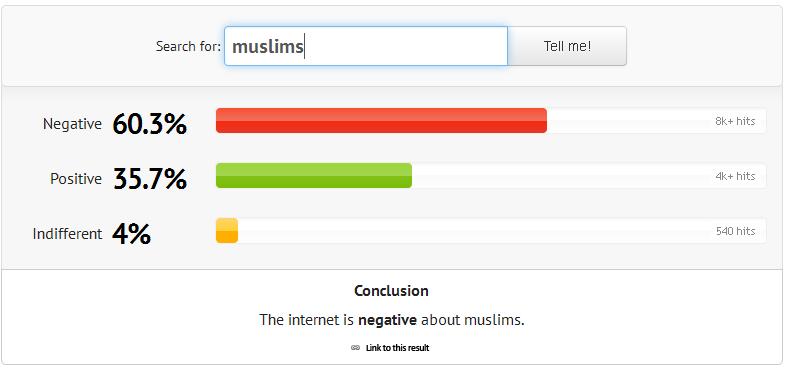
Thanks to the science fiction author John Scalzi, I stumbled upon an intriguing website called "What Does the Internet Think?" The site uses some methodology (who knows what) it comes up with a rating of the percentage of positive and negative postings on a topic across the internet. I couldn't pass up the chance to see what sort of fun data I could get out of this. For now, I'll post the information with very little commentary, but may follow up in the future.

Let's start by considering some broad subjects:

Where does the internet find truth and meaning?


It's probably not at all surprising that the internet skews toward the science-loving end of the spectrum, at least at the broadest level. I'm kind of surprised at the level of negativity about religion, to be honest. 

I would like to be heartened by the overflow of positive regard for skepticism, but it occurs to me that whatever methodology they're using probably cannot sort out the context of positive or negative statements ... so if a post is saying that it supports science, but then puts forward a concept like intelligent design as being scientific, it would likely count as a pro-science posting, even though it's really contradicting and undermining scientific inquiry and findings. Similarly, someone who supports being skeptical of evolution or skeptical of global warming would probably count toward being positive toward skepticism, even if their approach to the facts is fundamentally dogmatic, authoritarian, and revisionary instead of supporting principles of skeptical inquiry.

Which leads us to the next question ...

Does the internet prefer evolution or creationism?

The thing I find most interesting about this is that while there's a lot of indifference about creationism, there's virtually no indifference about evolution. This runs counter to my own experience. I know several people who are religious but are fairly indifferent about whether or not evolution is the physical mechanism of creation. In other words, they're religious but believe that God started evolution. But I know very few people on either side of the debate that are indifferent about creationism. 

However, given the extremely low hits on which "Creationism" is based, probably not much should be made of comparing these graphs. The "evolution" graph itself is, I think, telling enough on its own.

To put some of these values in context, though, we should look at a few baseline moral concepts, to see how they rate on the internet:

What does the internet think about morality?


I will let the above conclusion speak for itself ... for now. It's worthy of another post at another time.

On a morality-related note, though ...


What does the internet think of religion?


Christianity, Judaism, and Islam all rank positively ... but check out atheism & Buddhism! Amazingly polarized results on these religious viewpoints. Again, I'll let the results speak for themselves, although I'm sure I'll come back to this in another post sometime.

For comparison, though:


So atheists are viewed basically as negatively as their doctrine ... but both Christians and Muslims are (fairly or unfairly) viewed negatively by the internet, despite the fact that their religions themselves are viewed positively.

And, finally, a grain of salt:


Monday, December 17, 2012

The Philosophical Christian: 5 Reasons Not to "Fear God"

Today I finally got back on Facebook for the first time since the shooting at Sandy Hook Elementary School. I've been intentionally avoiding it. It's made my wife cry multiple times already and, since we don't have television, I was able to have a nice weekend without being confronted with the tragedy continuously.

When I finally did log on to Facebook, I was prepared for the assorted pro- and con-gun control/Second Amendment posts ... but I was not prepared for the bizarre religious trend to many posts. I was not prepared for the proclamation, from seemingly sane friends of mine, that this sort of thing happens because God is absent from schools.

And perhaps most bizarrely, I was not expecting the post which said the problem is that children are not taught to "Fear God." (The above picture isn't the one from Facebook, but you get the idea.)

The entire notion of "God-fearing" has never resonated with me, but to invoke it in the wake of this tragedy is absolutely perplexing to me on a number of levels. Specifically, I can think of 5 huge problems with it:

1. You Can't Love What You Fear - You cannot have a healthy, loving relationship with an entity that you fear. You can certainly have strong emotions, but if you love someone and fear them, then your relationship is dysfunctional. Most people who believe in God have a dysfunctional relationship with the notion of God because they hate and fear it at the same time. Unless you drop the notion of God entirely, the best approach I've seen is to let go of the fear part.

2. The Best Christians Don't Fear God - If you look at the Christians who are worthy of the name - including the big J.C. himself - you'll find very little "fearing" in relation to God going on. They exalt God, because they believe in a God who's worth exalting.

3. It's Blasphemy - The phrasing "Fear God" should be absolutely offensive to any God that's worth worshiping, and equally offensive to his followers. If you're going to use "fear" and "God" together, it should be as a negation, such as "Because I believe in God, I fear no evil" or something like that. If you believe in a God who relishes that those who believe in him fear him, I humbly submit that you worship a psychopathic bully.

4. God Didn't Do This - Specifically in the wake of these shootings, this comment to fear God is especially bizarre, because the implication is therefore that God was somehow behind the shootings. Or, at the very least, he removed his hand of protection from innocent children because of offenses committed by others. Most Christians would, I believe, find this highly offensive as well.

5. In conclusion, children (and the rest of us) certainly have enough to fear in this world. There's no need to add God to the list.